Stoney Goose Ridge new release – Hipster’s Reward®

Hector Lannible, CEO of Stoney Goose Ridge presents the latest wine from this progressive company.

Use it or lose it. 2016 Hipster’s Reward® is another new wine in our world-beating portfolio.  This is an entirely natural, “orange” wine. Except that orange doesn’t do the wine justice, It’s very dark, slightly cloudy and fascinatingly petillant.  Another slam-dunk hole-in-one from Stoney Goose Ridge!

This wine was no accident. One of our winemakers was relieved of his duties for completely understandable but persistent over-indulgence of our company’s numerous fine products. The consequence was that necessary preparations were incomplete, and the orange wine is the result of benign neglect. No additions – machine harvested Palomino, Trebbiano and Gordo on a fruit day, bottled on a flower day. Many companies would dispatch the wine for distillation, but Stoney Goose Ridge is much more alert to commercial potential.  We push the envelope outside the square. For this knockout wine, we stepped up to the plate and kicked a winning goal.

Depending on domestic take-up frenzy, we anticipate significant export potential into the ongoing future time-frame period.

Our orange wine is proudly green- the bottle is recyclable, the label is made from Australian hemp, the seal is natural cork, topped with beeswax..

We’ve snookered the competition, and hit them for six. Although we already know that with our trusted branding, customers will leap at the chance to purchase this collectable, we have an extensive campaign targeted at this key demographic, utilising our social branding network including Twitter, Facebook, Whatsapp, Instagram and numerous other media and apps.

We don’t care about critics except when they blow our trombone, but Hipster’s Reward® has already been blogged about locally by Jane Holliday, Jenson Olivier, Helen Hook, Maxine Ellen, Nic Stork, Cam Madison, Tom White, Gary Welch and Philip Ritchie, and internationally by Janice Robertson, Robin Parkin, and Tom Akton.  Plus lots of chirps and chatter. It’s been described as the ants’ knees and bees’ pants. Need I say more? Stoney Goose Ridge smashes another touchdown, redoubled in spades.

Stoney Goose Ridge continues to support our distribution chain in the usual pioneering way with rebates, merchandising incentives, promotional and volume discounts, POS, BOGOF and so on.

When we hit the bullseye, the dominoes fall like a pack of cards. Game, set and match– checkmate!

2016 Hipster’s Reward® is available now with an RRP of $16.95, and the definitive classic crafted SGR back label is appended below.

  • Not drygrown, no additions, indigenous yeast, au naturel.
  • Unfined, unfiltered, feng shui bottled.
  • Recyclable bottle, natural cork, biodegradable hemp label, beeswax.
  • MSG free, gluten free, GM free, no milk or nut traces.
  • Suitable for vegans. Carbon offset.
  • Drink in modulation.


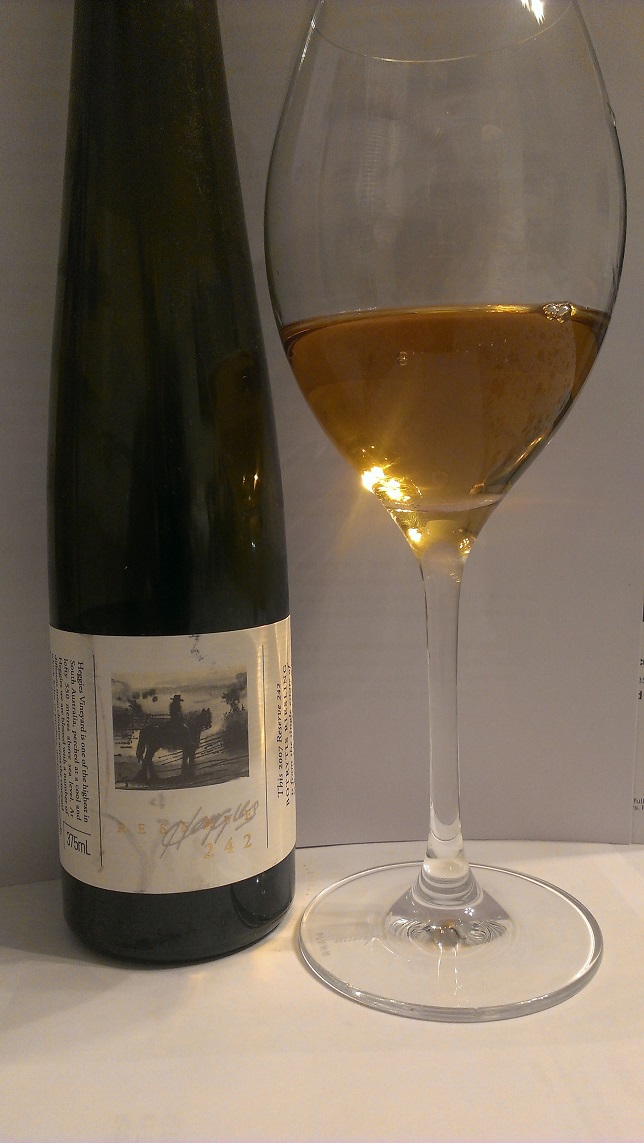
2007 Heggies “242” botrytis Riesling 8.1% (screwcap)

From the Eden Valley in South Australia, this remarkable wine achieved 242 g/l of residual sugar, hence the “242” on the label.

I have not been a fan of the dry Heggies Riesling, usually finding it a bit clumsy, although bottle age usually helps.

This wine is however, something special.

2007 heggies

It has a deep bright gold colour, and powerful aromatics of apricot, passionfruit and lime. The palate is super-lush, and mouth-filling with some lemon-peel candiness, backed by the ripe apricot marmalade flavours, ripe red apple and dried pear. There is some almond-meal semi-nutty character as well (highly unlikely to be from oak).

This wine is intense, lingering, cleansing and delicious, with the monster botrytis not diminishing varietal character. Complex, and damn fine. Botrytis is generally a nuisance in Australia, and this wine is a lovely expression of care in the vineyard, and the winery successfully transiting into bottle. Age has charmed, not harmed.

Drink to 2025, 94 well-deserved points

Snippets from the cutting room floor

Here are several wines enjoyed in the last few months that haven’t shown up in this blog – not terribly thematic but  too good  to ignore – no scores, but assume a minimum 94.

NV Krug Rosé Champagne

Confession time again- due to problems with oxidation, and poor VFM, I ceased purchasing rosé champagnes many years ago. A tasting class late last year rekindled my interest in this complex style.

Krug is fully priced, and this wine is available if you have a lazy $500. But it’s fantastic. Apparently 2006 base vintage plus reserves back to 2000. 59% PN, 33% Chardonnay, 8% P Meunier, partial mlf on 2/3 parcels, 7 g/l residual). PN Fermented on skins, uses small oak casks.
Red fruits- strawberry, raspberry, candied glace fruits, and some lemon too; not merely the overt bread/dough/pastry of most Champagne There is some complexing light vanilla (oak) and the palate is a very fine layered, textured style. It is delicate but there is tension and power to spare, and even some tannin. Beautifully constructed, I cannot really imagine a better example of this rosé style, and no rush to drink this.

2002 Salon Cuvee ‘S’ Les Mesnil Champagne  Blanc de blancs

no malo– disgorged early 2014
Brisk, energy, drive! Acidity will propel this for many more years.
As it warmed, the initial reticence uncoiled, showing ripe apple, some slightly browned sugar, cinnamon stick, crystallized lemon, and light yellow honey. The palate had the immaculate pure citric drive plus minerals, and was just astonishingly fine. Length was amazing.  Revisit in at least 5 years for an even better result. But it costs around $750.

2002 Ayala Blanc de blancs
Honey, citrus, some earthy oyster mushroom age characters; high and clean acidity, lots of minerals, energetic.
From an excellent year, but not a producer I’m familiar with; this was all class, and one to watch for.

2000 Mt Mary Triolet 13%
Vineyard plantings are 75% Sav blanc; 20% Semillon, 5% muscadelle
Mainly old oak, for around 11 months, lees stirring etc. $42.50 on release
Bright clear yellow colour; toast, honey; abundant fresh lemon, and some “juicy fruit” tones.
Grapefruit on palate, fresh, long, delicious – A super Yarra Valley wine that improved over a few hours before fading

2005 Mt Mary Triolet, diam cork
Sauvignon blanc, Semillon and a dash of muscadelle, this Yarra wine has proven cellaring ability.
Lemon colour, and amazingly fresh; passionfruit, gooseberry, tropicals; plus grapefruit and some spiciness from oak. Hard to describe, but has fruit freshness, oak and some honeyed aged complexity. At a lovely stage which should hold for at least another five years. Outstanding. Fruit drive, zippiness and complexity.

2007 Nigl “privat” Riesling 13.5%, screwcap!
From Kremstal in Austria.

Still pale in colour- with a mystery floral bouquet of green apple, nettle, lime. It’s ferociously acidic, yet balanced on the youthful layered palate; there is some grip, and waves of dense zesty refreshment, and nervousness. Complex grass, green and red berry flavours. Unmasked, its identity makes sense, but impossible -blind- to identify this with certainty as Riesling – it’s a high acid yet high alcohol white, quite unlike Australia, Germany or Alsace.  Very highly recommended; prospects are excellent for another 20 years.

2004 Crawford River Riesling , screwcap (Henty, Victoria)

Outstanding. A pull of lime but the undertow of acid pulls us back to Victoria.  Great length, minerals and a compulsion for “more!”. Another 20 years of superb drinking in prospect. Battles with Seppelt Drumborg as Australia’s most consistent outstanding Riesling producer. There are flashes from Tasmania sometimes, from Great Southern sometimes, Canberra sometimes, and the Peter Lehmann Wigan.

2009 Hardy (Eileen Hardy) chardonnay 13%, screwcap
Outstanding. Fruit from Tasmania.
Still a pale lemon colour, it exudes ripe nectarine, lemon peel and a touch of smoke. The palate is rich, alive with stony flinty characters, with a background of classy lightly nutty oak. The fruit flavours are stonefruit – white peach plus some grapefruit. With its abundant natural Tassie acidity, this wine has years of drinking enjoyment ahead.

2004 Seppelt St Peters Shiraz (screwcap)
Outstanding wine. Its a dense dark ruby colour, so fragrant and layered; pepper, dark cherry, blackberry, raspberry.
There is fine-grained tannin on the fleshy, voluptuous palate, and more dark fruits while the finish lingers, and continues. Concentrated without being ridiculous. This Grampians wine is drinking brilliantly, and should maintain this form for another ten years – conservatively. Easy gold medal. Irresistible, and a lesson in balance,


Plus some chardonnays tasted blind in a line-up of 20. Instant gold medal scores to

  • 2013 Oakridge 864 F&D (Yarra Valley)
  • 2014 Vasse Felix Heytesbury (Margaret River)
  • 2014 Penfolds 14a (Adelaide Hills)

They sell for about $60 per bottle, but vividly demonstrate the beauty of modern Australian Chardonnay across 3 different States, and provide wonderful complex drinking now and over at least the next five years.

Seppelt Port siblings

Seppelt Commemoration Port (Oscar Benno Seppelt) 20%

Blended from selected reserves of – Barossa – Para liqueur 1933 to 1980.

Commemorating the 100th anniversary of OBS’s birth in 1873, this is one of the series (there was a large family) and I gather this bottle was released around 1990, as a “premium” release. Internet searches have not been illuminating!

It was unusually sealed with a normal cork (not a stopper) and has thrown a very heavy crust. It’s a recent auction purchase. After bottling, this tawny style will change very little, but certainly needs aeration after its extended time in bottle, and a very careful decant.

In the Seppelt Para house vein, the colour is a brilliant glowing amber with a khaki rim. Myriad flavours; coffee bean, vanilla bean, nuts (more almond than walnut, but both are present).

nv seppelt ob

It seems relatively dry, a marvel of blending old material with fresher wines “selected by the directors”; savoury and delectable on a gloomy winter night. The inherent acidity makes another taste inevitable.

Drink now (but will not collapse); 90 points as a drink, more if history is valued.


Seppelt Commemoration Port (Leo Renato Seppelt) 21.5%

Blended from Para liqueur port vintages 1933 to 1972.

Not unexpectedly, there is little difference in colour, aromatics and flavours. This wine tastes slightly “brighter” with its fruit profile displaying some citrus peel nuances as well as those mentioned above, and perhaps the weightier mouthfeel of the marginally higher alcohol -but we are well into the realm of variation between individual bottles

This wine nudges up to a score of 92 points, with the key word “yum”.


Now we are six (months into 2016)

Six months into 2016 and it’s time to update the cork taint hall of shame – 8.4% so far  this year, and the offending wines are listed.

As usual, these are wines I have opened, from my own cellar, and do not include wines I’ve assessed as too old, so the appalling headline number is understated. The following wines provided zero drinking pleasure.

  • 2000 Grongnet Special club champagne- corked – credited by the importer
  • 2002 Guy Castagnier clos st denis -corked- replaced by importer with 2011 Pierre Amiot Gevrey Chambertin les combottes 1er
  • 1987 Moss Wood special reserve cab sav – corked – replaced by winery with 2013 Moss Wood Cab Sav
  • 2007 Dirler Riesling Kessler heisse wanne – oxidised
  • 1997 Louis Sipp GWT Osterberg -oxidised
  • 1998 Zind-humbrecht Pinot Gris clos Windsbuhl – corked
  • 2007 Dirler Riesling Kessler sgn- corked
  • 2003 Huet Le Mont demi-sec – oxidized

Alsace continues with its dreadful record of corks interfering with enjoyment of wines.

And worryingly, the few replacements I’ve obtained disappointingly do not provide fair compensation for carefully cellared wines from well-regarded vintages. Certainly a replacement is better than nothing, but the replacements were not of similar calibre to the discarded wines.