Two countries, two styles

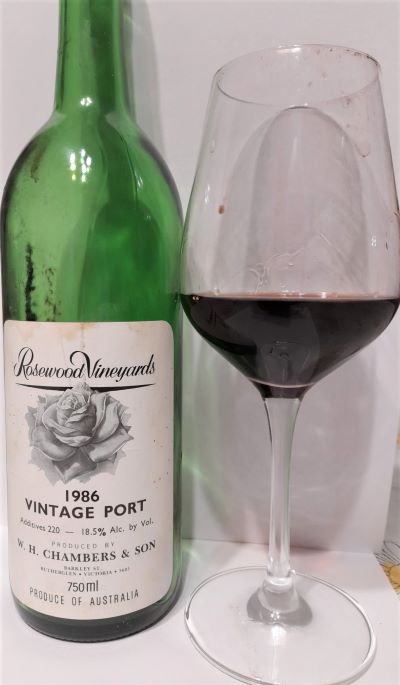
1986 chambers VP

1986 Chambers Vintage Port 18.5%
Rutherglen, Victoria.

This wine had substantial sediment, so decant very, very carefully. The colour is aged and bricky, but solid. Red liquorice, cherry, mocha, malt and beautiful spirit. The palate is very sweet, but such is life. The rest of the package is the spirit integration, the freshness and tannin elegance. Made by the legendary Bill Chambers, likely Shiraz – but who knows? – a terrific tribute to a winery renowned for its ancient muscats and topaques, but akos with a monster range of reliably underpriced table wines.

Drink to 2033, and 93 points

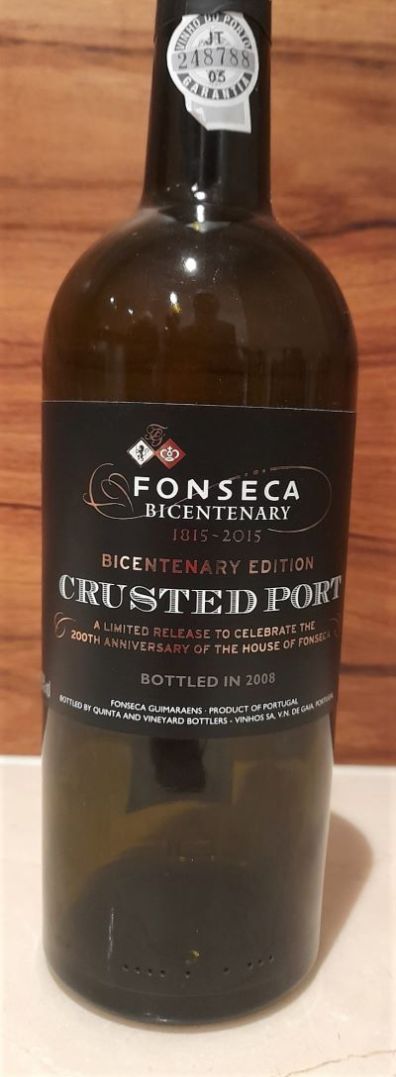
2008 fonseca crusted

2008 Fonseca Crusted Port 20%
Portugal.

Similar in style to a late-bottled vintage Port, this fortified wine spent four years in large oak, and was bottled unfiltered, thus having a (heavy) crust and demanding decanting.

Deep in colour – and served masked- I instantly leapt to Portugal as its origin, the florals including roses, blueberry and violets. The palate was savoury, laden with cherry, plum plus fruitcake spices and super-supple, an elegant, youthful fresh and lively style with delicious spirit integration. My only question was whether the wine was a VP (did it have enough “stuffing”) or an LBVP, or a single quinta? I wrongly settled on a young VP, perhaps 2007. Regardless, a lovely drink with many years ahead.

Drink to 2033, 94 points

Two styles, two hemispheres

1990 Marc Bredif Grande Annee 12%
Vouvray, Chenin Blanc

The Grand Annee is the selection destined for aging. With their high natural acidity, Loire Chenin Blanc can age a long time. Domaine Huet, and Marc Bredif are particularly well known for their range of Vouvray wines. Australia has been less successful with Chenin Blanc – although I had a soft spot for some of the age-worthy Houghton “white burgundies” of the 1980s, and a thrilling botrytised 1981 St Leonards! I have tasted some startling South African Chenins across several styles too.

Presented blind, this wine was pale gold, but had some distracting cheesy/waxy notes. Fortunately,  this dissipated and the wine motored along improving with each taste showing honey, plenty of acidity and some residual sugar (50 g/l?) melded with spices made this wine a terrific, showstopping adventure. Just a marvel. When revealed, the freshness for its age was dramatic.

Drink to 2035, and 95 points

1994 Stanton and Killeen Vintage Port 19%
Rutherglen, est 95% Shiraz, 5% Touriga

“Will mature in the bottle for up to 20 years” claims the back label, but truly there is no need to rush, despite this being rated an “average” vintage with only a few silver medals listed.

Syrupy, almost jammy, dark-fruited, huge sweetness, dark cherry, plum, liquorice, chewy and still bright-tasting. A powerful flavour-bomb that doesn’t quite scale the heights of some other vintages. It’s in an enjoyable holding pattern. But that’s the vagaries and mysteries of the season, and this wine was heartily appreciated.

Drink to 2030, and 91 points.

Old and unusual

1996 Boll and Cie Champagne de Ratafia 18%
From Reims, Champagne. Pinot Noir, fortified.

Served masked, and I was baffled. Amber colour. Scents of camphor, nettle, marmalade, furniture polish and oranges. Very likely French, but not sauternes, not Loire, not vin de paille. Not Banyuls/Maury/Rivesaltes. I correctly estimated the residual sugar at around 120 g/l. It seemed to have relatively high alcohol (but not guessed as high as the label), and obvious age. Eventually I stabbed at a botrytised Alsace (historically in, and out of France), excluding Riesling or Gewurztraminer because of the lack of florals, so a Pinot Gris VT or SGN. Wrong!

I thought I had never tasted a Ratafia, but turns out I had tried one before. It was no consolation when someone pointed out the wine was stylistically like a pineau de Cognac (never tasted that wine either). This wine style is made by adding brandy or high strength spirit to unfermented, or barely fermented grapes, ending up with a wine both strong and sweet.

Drink now, but this is a curio rather than a wine of real merit, so 87 points just out of interest.

1973 Kaiser Stuhl Vintage Port
Barossa, Shiraz

Mocha, almond/marzipan, headsy spirit. Less tannic than expected and more sweetness than expected. Australian, and with time ahead. Very pleasant, albeit straightforward, After the unmasking, it’s always special to have a 50-year old wine that is drinking well. The company was swallowed and eventually shuttered by corporate manoeuvres but that wine certainly triggered memories.

Drink to 2030, 87 points

Hector’s Stoney Goose Ridge annual report

Stoney Goose Ridge EOY round-up 2022-23
Another year is over, with another well-deserved bonus for me. In fact, several employees also received small remuneration supplements after my distribution dwindled the incentive pool. I welcome several recent hires who bring outstanding investment management pedigrees, client orientation and result perspectives. This will supplement the vision of my own hardcore lens across the mercantile business entities.

Apart from the contributions of remaining staff, I particularly thank my supporting team – personal trainer, stylist, PA’s, chauffeur and biographer. Stoney Goose Ridge could not have completed its most successful year ever without their capacity to broadcast my inspirations and motivations down and across the organisation.

Our liquidity covenant headroom holds us in good stead. This enabled us to gather distressed assets (and alternative assets) of our suppliers and competitors. When opportunity knocks – however faintly – I swoop to conquer.

Meanwhile recent wine vintages have been difficult.  But the tide has gone out and we can see the finish line downstream. As ever, our competitors are awash in financial morasses, ethical scandals and gropethink. But their ongoing incompetence is astonishing. Whenever a new executive embarks on a myopic “listening tour”, I am amazed at this cavalier waste of time and money (WOTAM), bleeding their budgets while merely pumping the spurious hubristic tyres of their egos, while they seek glittering baubles of adoration. Caught in a web of their vacuous hyperbole, sponsoring their fancied hobby-horses so they can “network” in corporate boxes and mingle with A-Z grade rent-a-celebrities. Conflict of interest is an unknown concept, as they swim in related-party interest-free loans and outrageous share incentives. Stoney Goose Ridge is comprehensively vigorously vigilant in highlighting these numerous disgraceful shortcomings to media, courts, and Governments – any inaction concerning their overt transgressions is clearly due to nepotism and corruption.

While it’s difficult to make predictions – especially about the future – the inane blathering and forecasts about industry trends by the so-called leadership teams of my so-called peers truly makes astrology seem respectable. Their SNAFU strategies seem to consist of convoluted 360-degree U-turns, supported by inane puff-pieces propagated by “journalists” swilling in the trough of junkets on the gravy train.

Meanwhile at Stoney Goose Ridge, cashflow, customers and margins remain king! My team is wheeling and dealing 24/7, augmented by my magisterial managerial and marketing mentorship.

Our innovative legal section continues to thrash its way gathering punitive exemplary damages and colossal compensation, with selective use of no win-no fee, its caseload bulging with success. Add their sterling work on exploiting tax minimisation loopholes and extracting grants, subsidies etc and they fully deserve their incentivised remuneration packages.

Our rolling recruitment program (Project Android) continues to progress filling inevitable vacancies due to wastage, attrition and footprint expansion in our high-talent pool. We are ready to head-hunt in all glamour areas – taxation minimisation, legals, accounting and financial analysis, data mining, sales motivation, social media freneticism – even mundane beverage fabrication and nurturement. Project Medusa has had significant impacts in successfully tarnishing the image of “celebrity brands”, exposing their shameful peccadilloes, legal battles and infamous photos, videos, tweets and cover-ups. Project Klingon continues to bear fruit, seeding new markets in preparation for Stoney Goose Ridge by establishing beachheads in hostile markets. We take no prisoners, and fully enjoy routing the opposing forces and smashing the fragile force-fields shielding their mediocre, subsidized, overpriced alcoholic confections.

I refuse to allow regulatory straightjackets or ludicrous “sin” taxes to stifle our trajectory momentum. I am busy with full-frontal head-high evidence-based persuasive tackles on impediments, forensically renowned for woking up bureaucrats and legislators for the benefit of their stakeholders – which incidentally includes Stoney Goose Ridge.

New releases
We continue to extend our fully trademarked DRC (Decisive Real Champions) range. This is – yet another – of my passion projects, my inspirations assisted by a team of researchers (interns, work experience, trainees, juniors, etc), using atypical standard beverage industry data-mining tools of property and tax records, electoral rolls, local landmarks, genealogy and so on. In short, years of collaborative toil following the discovery process, all purposed to vindicate the evident connection to the wines’ inherent nomenclature.

These are very serious wines not akin to the well-known Randall Grahm’s Bonny Doon whimsies (Cardinal Zin, Big House Red, Old Telegram, Le Cigare Volant, Il Fiasco, Clos de Gilroy etc etc) and absolutely not droll copycats like Fairview’s Goats do Roam and Goat Rotie.

We have stringent lease/buyback/profit-sharing arrangements for new plantings and winemaking allied with my profound involvement in the assessment and triage. The following wines will be progressively released over the coming twelve months when I deem marketing conditions are apposite.

  • Clos de la Rocks
  • Clos de Lampreys
  • Clos de Tar
  • Clos du Marky
  • Chateau Cannon
  • Chateau Fig-axed
  • Chateau Hugh Bryan
  • Chateau la lagoon
  • Chateau Left feet
  • Chateau Leo’s Villa las Casa
  • Chateau Mountain rockslide
  • Chateau Oz-owned
  • Domaine D Jack
  • Maison Lee Royal
  • Paul Rodger (only col fondo at this stage)
  • Quinta do Novel
  • Coast gorse
  • Seeming Legal
  • Vega sans Silica
  • Blass Phillip
  • Hill of grass
  • Mount Marty

What a sublime collection! Labels have been embossed with respectful and entirely legal homage to what might have accidentally inspired them, by the celebrated artiste Binksy. Sublime quality is certain. Mega award-winning presentation, individually numbered, with a personally hand-signed certificate of authenticity. In some examples there are only three barrels; at best only ten barrels, with the wines truly expressing their natural micro and macro sub-terroir characters, under fully sustainable biogeneric principles.

These DRC wines are all made in minuscule quantities and destined for our extreme high-rolling net worth whale collectors – financiers, oligarchs and so forth; members of our exclusive 88 club.

Branding and diversity update
Adventure afar (AA), celebrates our retargeted strategic global premiumisation thematic, with omnichannel touchpoints including packaging, POS, OOH, digital, experiential, social and events across key live markets. Media partners and our global customer audience adore this refreshed conceptual vitality framework plus its adjacency synergies defined across the metaverse.

Stoney Goose Ridge is exclusively disruptive and inclusive, expanding our respected x-culture generational power brand, transcending beverage categories, catering for the rising value category of the Luxuriant culture pioneer. The halo of our premium luxury icons brandlines transcendently cascades through other fully balanced price-point ecosystem categories.

Our social media impact is gargantuan, almost as stunningly impressive as our carbon-neutral green offset aspirational framework principles.

I am proud of our diversity; it’s not a matter of numbers and categories- we have a startling range across full-time, part-time and casual employees, and (where permitted) commission-only – with wide-spread age-ranges.  We have direct employees, contractors, agents and consultants. We have a range of academic qualifications, varying from rudimentary to those bursting with multiple tertiary degrees (such as myself). Salaries, wages, entitlements and bonuses are extremely disparate. Personnel are based in a (growing) number of countries, with varied ethnic, demographic, linguistic and supplementary characteristics. We respect that staff have private, personal lives that we support to the extent that they never interfere with their agreed committed contractual KPI obligations.

We only lack diversity in talent. We recruit with mutually understood expectations that all levels entirely execute their deliverables. This requires attitude and unrelenting application. Staff are fully supported through our appropriately infamous up-skilling in-house development programs. Further, all personnel know they have access to my Holmesian problem-solving skills, experiential omnipotence, communication excellence and unfailing intuition.

Conclusion
My favourite question? How quickly can you increase my allocation of Stoney Goose Ridge?

Your revered hyper-aggressive leader, Hector Lannible

New releases from Stoney Goose Ridge

Stoney Goose Ridge is thrilled to announce new releases, which were quietly gestating on the backburner. Now, even more marquee products will light up the runway, and satisfy our want-it-now, get-it-now (WINGIN) customers.

First, an extension to our existing range of luminous premixed cocktails -this one is based on a blend of vodka and tequila with a tinge of red from cherry, tomato and raspberry;  a revolutionary radical creation, with a fiery kick – the Molotov. In a handy re-usable container.

Also one new wine with a fascinating story – it’s one that an employee tried to keep secret during its genesis, until inevitably I discovered it. My spreadsheet prowess found some almost imperceptible anomalies, and a snap on-site audit led to the immediate dismissal of the culprit. Civil action for fraud will follow with inevitable financial detriment for the former staff member with punitive earnings garnishees sought. All inadvertently associated with this enterprise in any fashion have been counselled and disciplined in extremis.

I had to stage an heroic nuanced intervention to significantly improve the wines inherent magical character. Because of its dubious origins, Stoney Goose Ridge sacrifices this wine to avoid a backdoor fire sale. Now be thankful.

2021 Stoney Goose Ridge Bin 666 Vintage fortified Touriga/tempranillo/durif
It’s a devil-may-wine. Dark and monstrous, with a deep black massive soul, with burning fiery (heads) spirit. Best left in a dark place, or consumed while reading Aleister Crowley or HP Lovecraft, while listening to Santana’s supernatural, Credence’s Pagan Baby, Grateful dead, Black Sabbath, or any other faustian heavy grindcore gothic death metal. Or watching the Exorcist, Angel Heart, or the Seventh Seal. Very Limited release in selected areas. I put a spell on you. Ageless, irresistible, tempting, Classic, with a label worthy of its heritage. RRP (AUS) $88.88

CEO,  Hector Lannible

Revisiting two fortifieds (blind tasting)

Ideally, I make my tasting notes over several days, noticing nuances and changes. But in a blind tasting there is much more emphasis on speed. Its challenging to see how accurately (or not)  I have described the wine, its age and origins after it’s unmasked. Here were two wines that I have previously reviewed on this site – my descriptions and conclusions were (gratifyingly) consistent – with one important exception.

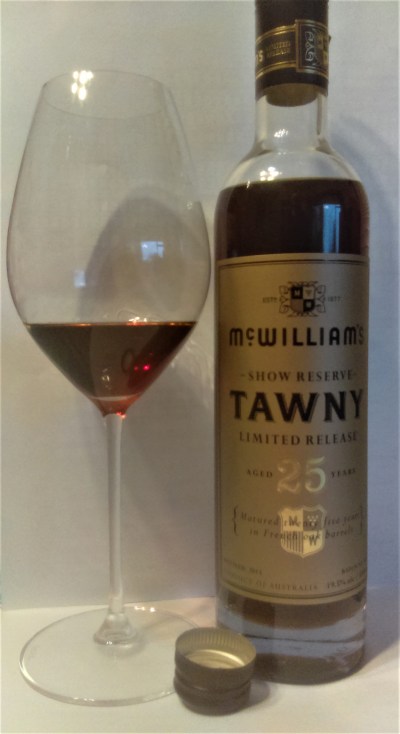
nv mcwilliams 25 tawny

McWilliams Show reserve Tawny limited release 25 years old 19.5%
Riverina, NSW. 500ml, bottled in 2015. Also reviewed in June 2020.

Khaki/olive colour with an orange rim. There is a lot of vanilla here, with sweet fruit and a savoury finish. Luscious, and convincing with dried citrus fruits, brazil nuts, jersey caramel. Australian for sure, and a tawny style.  South Australia or Rutherglen, and 20 years old (or more). Well I cannot be faulted for not getting the region correct. Made from Grenache, Touriga and Shiraz. Enjoy the decadence!

Drink now, 93 points.

h&h 20 terrantez

Henriques and Henriques 20 y/o terrantez 20%
Madeira. Also reviewed in January 2019

Pale orange/khaki, with a clear rim. Sea-spray, green olives, citrus peel. Tawny port style. Palate is savoury, crisp and prolonged. Acidity is pronounced, massive. Beautiful wine. Madeira? Verdelho? Palate sings with freshness, citrus, nuts, fruitcake- the works. Terrantez is rare, and fits between Verdelho and Bual in sweetness. This wine was 74 g/l residual sugar, but swamped by the acidity, that propels further tasting investigation.

Last time, due to some staleness I found, I gave 88 points. This time no problems, and rather than a life of weeks after opening, a life of months is possible- except in my household.

Drink to 2050, 94 points

Three countries, two curios

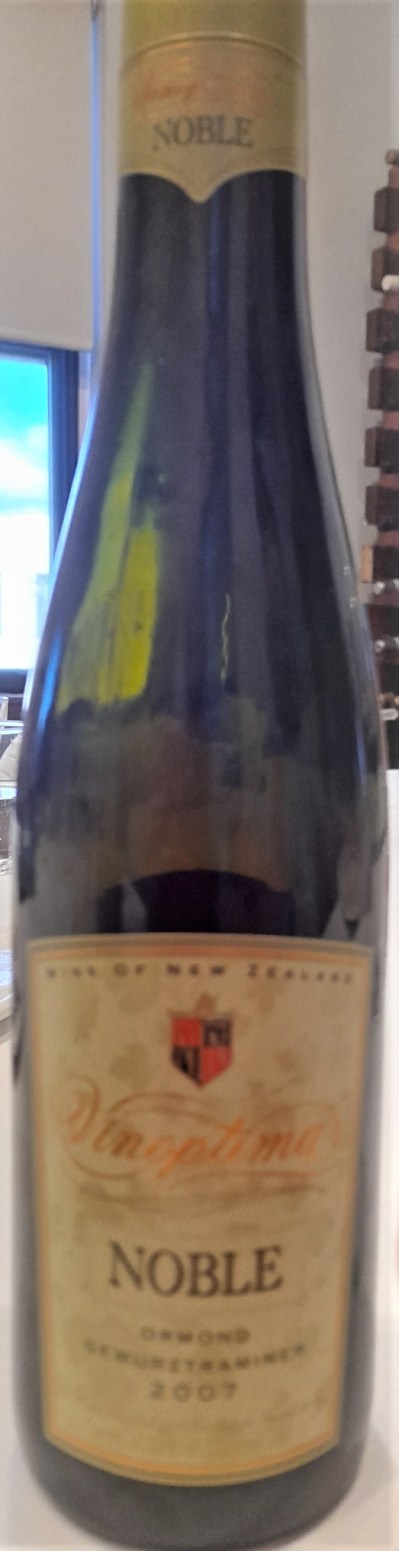
2007 vinoptima gwt noble

2007 Vinoptima Noble 11%
Gewurztraminer, Gisborne, New Zealand

From a half-bottle served blind. Orange/copper colour, very floral grapey muscat characters and sweet spices; extremely sweet palate with botrytis plus apricot marmalade, herbs and mixed spice. Not Sauternes, and not fortified. Not Riesling, but the botrytis confuses the variety. Not oaked. Gewurztraminer, Muscat, Pinot Gris – or something less common from Austria or Hungary? Alsace? Ten years old? But the reveal was New Zealand and Gewurztraminer– abetted by around 180 g/l residual sugar. A surprise!

Drink now, 90 points and one to baffle punters obsessed with options.

1987 buller vp

1987 Buller Limited Release Vintage Port 18.3%
Rutherglen, Victoria 70% Durif, 30% touriga

Deep colour with some bricking; mocha, swiss chocolate, sweet for style with spices, soft balanced spirit and almond. One astute taster commented “Australian, with a significant Touriga impact, possibly a third variety”. In any case, a terrific wine with superfine tannins drinking remarkably well for its age (and most had never seen this label).

Drink to 2030, and 93 points

2000 warre's vp

2000 Warre’s vintage port 20%
Portugal.
From two half-bottles (a third half- bottle was corked, alas)

Short corks but in good condition, and a lot of sediment. My main takeaway was that despite the smaller packages, this wine has a long time ahead! Good colour for age; complex mix of blue, red and dark fruits – figs, and a touch of almond. Succulent, fresh, sweet and mouthfilling – but deserves much more time to uncoil. Super integration of fruit and spirit, but it’s just a baby. Warre’s seems to like this wine.

Leave this alone or give it a long decant. Drink to 2040, 95 points.

Very mixed masked sweets

sweeties april 2023vitsoc april 2023

1976 Deinhard Winkeler Hasensprung Riesling Auslese
Rheingau.

At first sight, there didn’t seem much hope of drinking pleasure (it looked like an old fortified). But it smelled like a Gewurztraminer, laden with spices, honey, apples and a touch of cork (not taint, just age). The palate was very sweet, enough to move its origin to Germany, but age a puzzle. It tasted grapey and reminiscent of muscat of Alexandria. Thus the clues mounted. German Riesling, perhaps Auslese back in 80’s? 70s? When unmasked, surprises all around. Past its best for sure, but a drinkable survivor.

Drink now 87 points (and higher if history guides you – up to 90 points)

2005 Tertre de lys d’Or Cuvee d’exception
Sauternes. Diam!

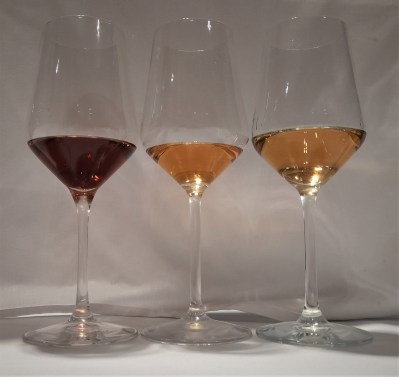
Darker colour compared to the next masked wine. Lemon meringue, vanilla pod, charry oak. Palate showed lemon and marmalade, but much lighter and straightforward than anticipated. Sauternes or Barsac for sure.

Drink now, 85 points

2014 Chateau Suduiraut 13.8%
Sauternes. 95% semillon, 5% sav blanc 150 g/l residual sugar
18/12 months oak, (50% new, 50% one y/o)

Lighter colour than its paired wine; has thrilling nettly/green pineapple and much greater impact overall. Palate is a much more viscous and sweeter with more overt oak impact. This is all class, and one to revel in. Ripe year – 2009? 2014? Botrytis and bursting with stonefruit and spices. Super freshness, length and hedonism already in an immaculate package, but will reward the patient.

Drink to 2035, 95 points now, and more to come.

Momentous archaeological discovery will rewrite history

Emeritus Professor Albert Pedant (PhD) hosted a packed press conference in Jerusalem on April 1, 2023 with media attendance from around the globe. Here is the transcript.

“Welcome everyone, this is a historic occasion that you will long remember. I’m sorry that this was the largest venue with media facilities available at short notice; the recent leaks and ill-informed speculation forced a response about a significant archaeological discovery.

Firstly, obviously the materials were found some months ago, but arranging and conducting the necessary scientific analyses took some time; as did security and administrative essentials. But at last, I can officially make this announcement.

You will doubtless know that I have had oversight of archaeological investigation at various sites throughout the Middle East. This includes Khirbet Qana (Cana), in Israel. This broader site is now managed by Israel and has been sporadically unofficially excavated since the 1870s. Recently, ground-penetrating radar revealed several small underground pockets, which led to increased focus on one particular portion of the current site.

Given that the cavern was only a few cubic metres in volume, extremely meticulous care was taken by the experienced team of Dr Henry Jones in parsing the mixed sand, gravel and rocks.  There were remnants of a room, with surviving sections of mudbrick and timber walls. The “hero” find however was one ceramic pot. Amazingly, the contents had not evaporated. It contained just over three gallons (eleven litres) of liquid. Analysis showed this fluid had an alcohol, sugar, and acidity content consistent with wine, and had been preserved with some covering of straw, cork, and olive oil, protected by the constant temperature and humidity of its special underground location.

Alas, only one intact amphora was located in the storeroom, with many shards of other pots in close proximity. There was uncertainty about its age, but thermoluminescence and moisture recombination dating methods provided evidence that the pot was around two thousand years old. The glaze, patterns, and colours were consistent with established specimens from AD 10 – AD 50.

Hebrew characters carved on the side of the jar were likely the name of the potter, (or the owner’s).  The storeroom also contained seeds, papyrus, charcoal, and fabric fragments which provided unambiguous contemporaneous support for the pot’s authenticity and provenance. Two low-value Roman coins were found, and although badly damaged, x-ray and other tests of their underlying images and metallic composition confirmed their concurrent age.

Further, radiocarbon dating methods on the parchment fragments, the timber frames, and bricks yielded similar results. Sadly, fingerprints and DNA were unable to be detected.

Finally, several experts were then assembled to taste the vessel’s contents with no information supplied, other than extreme age of “several centuries”. The professionals’ comments included “remarkable, ethereal, haunting”. When informed that the liquid was at least one thousand years old, agreement was unanimous that the (understandably) pale fluid was in sublime condition given its antiquity. “It’s the oldest wine I have ever had the privilege of drinking” stated Hector Lannible (CEO of beverage behemoth Stoney Goose Ridge) “and it’s not just a curio – it has memorable qualities”.

What makes the Cana find unique?
Pictures of wine drinking go back to the Standard of Ur (c 3000 BC), and early writings include medical papyri from Kahun (c 1900 BC), the Homeric texts (c 850 BC) and numerous “newer” references. But the wine in the amphora is the oldest drinkable sample of wine ever found. Microscopic traces of wine were found in a vessel from Mytros (Crete) dated to 2000 BC. And this Cana wine is also very different to the ‘Speyer Wine Bottle’ discovered in 1867 which held 1,700-year-old liquid that used to be wine (the alcohol had evaporated); its contents dubious and without vinous merit.

According to the New Testament (John 2:1-11 and various apocryphal records), Jesus, his disciples, and his mother were present at a wedding. After the wine ran out, at his mother’s prompting, Jesus turned the contents of six water pots into wine. The steward congratulated the bridegroom for holding the “good wine back”. The Cana contents are potentially from the water that was turned into wine by Jesus, in his first miracle.

There have been all sorts of scams, fraud and fakes involved with alleged biblical material. The shroud of Turin is a well-documented medieval fake. Relics incredibly include numerous bones, foreskins, multiple crowns of thorns, nails, pieces of the Cross, lances, and the grail. Indeed, I have been consulted concerning the authenticity of all sorts of unlikely artefacts allegedly owned or used by the child or adult Jesus (toys, including wooden marbles, and carved animals, sandals, dice, furniture, even impossibilities such as a hula hoop)!

But here we have another matter entirely. The storeroom’s provenance is established; it has been undisturbed for nearly 2000 years; its age has been verified by a variety of methods; finally, the wine’s existence is unparalleled. Other vessels of antiquity have been found – but any liquids are extremely meagre, and unsavoury. To, summarize, it is not definitely proven the wine was created by Jesus; but it is beyond reasonable doubt that finding this wine intact at Cana is extraordinary.

With all these confirmations, security at the dig site was ramped up, to deter theft, vandalism, overcrowding, attacks by religious extremists, drones, and so on.

Israeli Government reaction
There has already been enormous ill-informed commentary about what this discovery means. For some, it verifies the literal existence of Jesus and confirms his divine ability to perform miracles; for others, it’s merely the uncovering of some old wine in a long-abandoned township.

I properly, and promptly alerted the Israeli Government, and personally informed Prime Minister Benjamin Netanyahu of potential ramifications. I know there were intense and passionate discussion among the parties represented in the coalition Government, and I was vigorously questioned. There were views that the discovery should be suppressed, as inciting division within Israel, as it could inflame religious tensions within the Middle East – and elsewhere.

Thankfully, the combined wisdom of science, political courage, history and academic freedom prevailed.

Understandably, this is a national, and international treasure.

As an Australian, this astonishing find is the pinnacle of my career as an historian, archaeologist, and researcher. I was in the right place at the right time – what a privilege!

And what now?
The Antiquities Bureau of Cana (ABC) has been established to

  • Ensure the safety and preserve the integrity of the artefacts – further scientific analysis is currently deemed unnecessary.
  • Prioritise submissions from the many institutes, scientists and scholars wishing to study the materials.
  • Continue excavations in the vicinity -although the immediate environs seem desolate of evidence of historic habitation.
  • Determine the conditions (if any) under which pilgrims will be able to view the artefacts (or replicas)

There is enough material extant to guarantee rigorous excavations over several decades and the forthcoming academic publications and musings will spur a total rewrite of history.

I am unable to take questions at this time; they can be submitted in writing to the ABC –which is the definitive, and only channel that can respond officially. They will soon distribute time-lapse images of the uncovering of the storeroom, and the survey of its interior.

Finally, I, Albert Pedant, am thrilled to have been an active participant in this extraordinary “miracle at Cana” and honoured to make this significant announcement”.
better mixed sweets

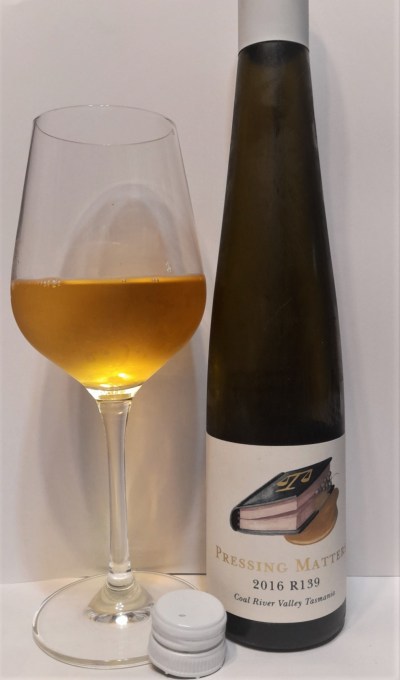
2016 pressong matters r139

2016 Pressing Matters Riesling R139 9.2%
Coal river valley, Tasmania

Pale colour, lime, pear, apple, ginger biscuit. The winery specialises in the unusual combination of Pinot Noir plus assortment of Rieslings at varying sweetness levels (R0, R9, R69 and r139) with many wine show successes and a wine club that offers regular museum releases. This wine is a cracker. With the crisp Tasmanian acidity, it has the magic combination of varietal definition, botrytis and purity. White peach and lime, thrilling acidity and it just lingers gracefully. Special!

Drink to 2030, 94 points

2015 ca' d'gal vv

2015 Ca d’Gal vite Vecchia Moscato d’asti 5%
Piedmont, lightly sparking (frizzante) packed with icing sugar, musk, and grapiness, spices and texture. The muscat character shines.  Around 90g/l residual sugar, and >$100.

Not as stellar as the 2008 tasted about twelve months ago, but its vitality will utterly revive jaded palates, and confound many with its delicious, bracing freshness.

Drink to 2027, 92 points

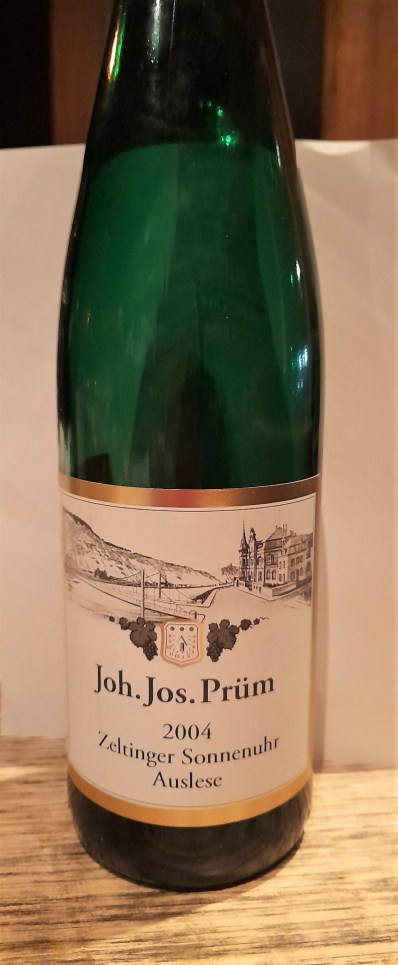
2004 jj prum zs auslese

2004 Joh Jos Prum Zeltinger Sonnenuhr Auslese Riesling 7.5%
Mosel, and a startlingly pale colour for its age. Showing white flowers, herb, apple and pine/nettle. The palate is full of minerals and phenolic grip. More modern vintages are riper and sweeter, but even though this wine was served straight after the Ca’ d’Gal, it didn’t seem to have the level of Auslese sweetness (my guess was Kabinett) A rare, relative disappointment from this producer.

Drink to 2026, 90 points