An Oz model VP

Stanton and Killeen Vintage Port 19%
Rutherglen

Served blind. Medium ruby colour with clean spirit; blueberry, red liquorice, roses, sweet cherry liqueur, camphor and spices. Very concentrated, fresh VP style with integrated tannins – but with different tannins than Portugal, and a little sweeter. Setting origin aside, a marvellous wine, with some light chocolate vanilla crème, and plum adding to the intrigue. Australian – probably Stanton and Killeen – 2005? was my conclusion.

Unveiled, it proved older than anticipated, and clearly on a monster plateau. I last wrote about this wine in 2018, and I was delighted to taste it again. (60% Shiraz, 25% Touriga, 5% each of tinta cao, tinta barocca and Durif). The back-label had a litany of its well-deserved wine show successes. A piece of history, and a great success in provoking memories plus providing enormous drinking satisfaction.

Drink to 2035 or longer- 96 points

Surprises recently

1972 Gayfers Durif Port
Rutherglen (Chiltern)

I wrote about this wine in June 2017, but this time – served blind- it presented very differently. Such is life, when dealing with a 50-year-old wine from a winery that made way for a highway. This time around, I was puzzled by the tawny, aged colour with an amber rim; sweet fruited (pulled me to Australia as its origin) with dried fruit peel and a lot of vanilla (pulled me away from a VP style), but missing the rancio/acidy to point at a tawny. Regardless, it provided genuine drinking pleasure and bafflement after the reveal.

Drink now (or sooner, based on this bottle) – 88 points

2007 Ch de fargues 13.9%
Sauternes
This was a hasty replacement for a 2005 Ch Doisy Daene that was a bit limp; faint TCA was suggested, but it looked quietly oxidised to me which robbed its vibrancy– cork frailty in both instances. But the de Fargues was a brilliant backup. Not easy to find in Australia, but the few bottles I have tasted have been memorable.

This was a deep burnished gold colour, with an unmistakable Sauternes origin- apricot, yellow peach, vanilla icing, orange blossom; lively with spices and bitter orange notes on the syrupy palate. Power with balance. A sublime and lengthy finish. While ravishing now, I would drink up if you are fortunate to have any bottles handy.

Drink to 2023, 95 points

a 2007 pair from Willi

I hav long enjoyed the wines of Willi Schaefer, and have visited for an exceptional tasting once. The difference in the two wines below is the AP number, in small print on the label. In this instance the wines are from slightly different plots within the same vineyard. The Schaefer Graacher Domprobst wines tend to be more earthy/minerally than those from their Graacher Himmelreich plots.

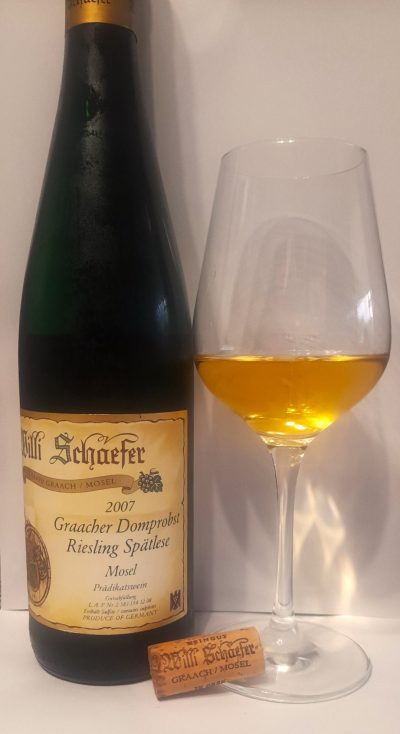
2007 Willi Schaefer Graacher Domprobst Riesling Spatlese AP#12 8%
Mosel

Gold colour, red apple, spices, honey, citrus, whispers of tropical fruits. Deliciously swete, and fresh, and textured, The palate is creamy textured, with some stonefruit character and just so damn refreshing. Fresh fruit beckons.

Drink to 2032, 92 points

2007 Willi Schaefer Graacher Domprobst Riesling Spatlese AP#5 8%
Mosel

A mirror of the above, with slightly more of everything; weight, texture, fruit depth, spices and some attractive green herbs. Gorgeous,

Drink to 2035, 93 points

Impressive Europeans from one dinner (all served blind)

2010 Zilliken Saarburger Rausch Riesling Spatlese AP#8 7.5%
Mosel, Germany
Gold colour, still a touch of reduction, apple, cinnamon, and the palate is lush, delicate and balanced. This is an absolute delight, with poised sweetness (sweet for spätlese too) and acidity. A very high-acid year in Germany, and Zilliken achieved marvellous high sweetness levels.

Drink to 2035 (but irresistible now) and 95 points

2014 Ch Rayne Vigneau Sauternes 13.5%
Medium gold colour, then all sorts of tropical fruits – pineapple rind, dried paw-paw, crème brulee, almond; palate is stylish, with marzipan, citrus, pear, freshness and balance. Some other tasters thought this was fully mature and ready, but I see no need for haste. Serious wine!

Drink to 2033, 93 points

2015 ch Bastor-Lamontagne Sauternes 13.5%
Lighter gold colour; light apricots, and mealiness. Straightforward, easy (and ready) to drink,

Drink to 2028, 90 points

2017 Taylor’s Vintage Port 20%
Portugal

Vivid, astonishingly youthful black/purple colour – ultra fragrant – camphor, blueberry, cocoa, mulberry. Palate is supple, with drive, enormous concentration, strong defined tannins that the fruit power defies. Portuguese varieties for sure, and the savouriness is definitively Portugal. Then the liqueur cherry flavours meld with the blueberry and mulberry; the spirit is supportive. Drive and persistence. What a wine! And yet with a long, long way to go, this is insanely good.

Drink to 2045 (or more), 97 points – and will deserve more in time.

Hector – novels and movie (underway)

It’s not just my stellar business (and academic) career that I’m admired for – a recent facet has been my successful foray into publishing and the film industry. Stoney Goose Ridge only forms a very, very  minor part of this story.

When invited to the 20th reunion of my executive MBA at Harvard, I tasked one of my PAs to search my archives for sketches and impressions of my classmates. These were located along with “I also found material from your creative writing class”. With my usual enthusiasm, diligence and creativity I had written a long submission when asked for a short story. Unsurprisingly, I had won yet another prize but had forgotten the details. The examiner’s comments were “Outstanding. The best student work I have ever seen. With a short polish, this is easily publishable as a novel, with potential for a movie. A stylish thriller with vivid locales, memorable and witty characters driven by a cracking plot. Beautifully crafted”.

I had been busy with my MBA, my work as a partner at a consulting firm, plus had recently just become engaged to Domenika. And I neglected my book. Nearly twenty years on, I spent a few days making thousands of edits; tightening, and resequencing chapters, removing refences to superseded technology, and outdated idioms, fixing acronyms of organisations that had undergone name changes, and adding some small characters. My original novel had anticipated the “outback noir” gritty hard-boiled crime thriller revival so I had the choice of retaining the local colour or internationalizing the key plot trajectory. True to form, I had it both ways, ending with two books dissimilar in tone, characters, locale, plot basics, twists, and style. No AI, as spreadsheets and databases are wonderful!

My Harvard lecturer had become a formidable popular writer. When I got in touch, she remembered both myself and my work, and recommended an Australian literary agent. The same agent was suggested by my Speakers’ Bureau. A short conversation, a few tweaks to the standard contract, and I was represented.

Two days later, my agent was gushing with enthusiasm at my novels’ potential. The agent had forwarded my synopsis and first chapter to the usual suspects and queried if I had a sequel planned. (thanks to my writing framework, this was well in hand). Publishers rapidly returned with bids, undeterred by my insistence on a nom de plume, or my warning that their standard contracts would not be accepted. Australian, UK, USA publishers, Europe (France, Spain and Sweden seemed particularly keen), narrators of the audio book, film rights translators, page to screen agents, digital rights, graphic adaptations, and many more formed parts of my positioning. All I had to do was create a pseudonym.

Some words of my novels were altered to be more familiar to their national audience (sample American extract below).

“I took my sidearm from the crawlspace at my crib, then went to the parking garage. I got the bankroll from the trunk of my automobile and gunned the Chevvy downtown. The jai alai arena was kitty-corner to City Hall. Whittaker was waiting in the bar, with snacks surrounding his cocktail.

“There ain’t enough mayo and ketchup to match the brewskis, but it goes OK with soda-pop. I’ll get the busboy to run to the drugstore for some candy and cookies.”

“Where’s our informant?” I asked.

“He’s in the can, in back of you,” said Whittaker. “I’m copacetic.”

The barkeep had been sampling his merchandise and looked as sharp as a potato. Outside, the mean streets were as dark as the inside of my Stetson.”

The publishing world is full of piranhas. Standard contracts fillet the author through a thousand cuts – but my negotiating prowess embedded some interesting clauses: painless – at first glance – to prospective publishers, but with clever side-effects.  The size, timing, and currency of my six-figure advances were cunningly specified.

And Hollywood (Universal, Disney, Paramount and more) was interested. It’s a curious business where only unicorn films ever make a profit, thanks to imaginative accounting. It’s model of how to distribute money with little to show for the result. Publishing is predatory, but Hollywood is the apex predator, apart from crypto!

But studios became more interested when my novels quickly became runaway best-sellers in various countries. The novels even attracted favourable reviews from high-brow literary snobs, who habitually ignore or deride “airport” books. My literary pseudonym was never linked to Hector Lannible, and I was not required to resort to plausible deniability. My interest in the screen adaptation was reported as a dilettante’s obsessive over-reach.

Thus, I took my virgin sabbatical from Stoney Goose Ridge to battle Hollywood. First came layers of minders, personal assistants and secretaries (usually family members or ephemeral romantic attachments) whose task was to prevent anyone reaching the rare creatures with decision-making powers. But my deep personal links to A-list stars, producers, directors, etc through the Stoney Goose Ridge range of DRC wines made all the difference. Access achieved! This gave the green light to explore details.

The next level of minions presented different issues, apart from their minuscule attention spans. There was a whole new set of industry jargon to navigate, spoken either rapid-fire or at a glacial pace by people currently affected by recreational pharmaceuticals or in search of their next high. Their dialogue also rambled through non-sequiturs, detours into bizarre personal paranoia, self-aggrandizement, and denigration of their underlings. Plus, endless gossip and obsessive commentary about the recent “wildfires.”   Nevertheless, I corralled enough of these folk to draw conclusions.

With film production, conflicts of interest are assured but never mentioned. All props, equipment, office space, locations, lighting, cameras, sound recording and so on are leased (at inflated rates, through related organisations), when cheaper to buy outright, with assured proceeds from their later sale. Then came an armada of varmints attempting to take a percentage (points) for arbitrage, facilitation payments, introductory consultancy fees, success fees, ambassadorial allowances, contingency fees, finders fees, wrap bonuses, underwriting fees, territorial subsidies, relocation assistance support, facility hire, brokerage, commissions, refreshers and so on. Packages included assorted production companies obsessed about the size and placement of their logos. Special effects, dialog coaches, and music rights entities seemed to be on speed-dial, even when superfluous. One historic example of extravagant waste was how a dog was hired at $1000 per day, plus owner, plus trainer, plus vet, plus groomer, for four months  – for three seconds of screen time in the distant background. Similar infamous instances are legion.

The studio ”brains trust” alleged the film had a preliminary budget estimate of $60 million and wished to engage some local hack to draft a shooting script, followed by firmer budget estimates. They were gobsmacked when I distributed storyboards and detailed estimates for a $30m film, all from credible people within the industry. I made a hefty profit for on-selling these well- prepared artefacts.

And Hollywood has sufficient artistic talent to draw imitations of stick figures (not to scale). The director initially proposed was noted for his work on music videos and a few undistinguished TV sitcom episodes. Intrusive product placement was expected. Packaged with other scripts, under development etc, residuals, nets.

This “creative industry” was not familiar with Hector Lannible. Let’s just say that matters went entirely in my favour as break fees would have derailed careers and sent companies into restructuring.

The studio offered finance at 19% interest. I stated that my sources presented 7%, and if needed I could underwrite the entire movie. That’s my way to make progress, and I how became an executive producer (EP in the trade vernacular). My near-veto rights over shooting script, actors and final cut- a result of the clauses that I had insinuated into the assorted contracts- made my input essential.

I held a lockup meeting that went through every budget line item, (no mobile phones permitted). No-one was allowed to leave until we were finished. It took 14 hours, with no debate after decisions, thanks to scrupulous records. Curiously, I was also offered a lucrative long-term trouble-shooting role by the studio, but I was not interested in the tedium, tantrums and terminal sycophancy of the fillum industry.

I had allowed one month for my pilgrimage to Trumptopia or Trumphades, but my whirlwind energy and negotiating prowess mean all was over in merely two weeks. My stay in the alternative reality of Hollywood is thankfully concluded, and I can return to the sensible beverage world of Stoney Goose Ridge. I can’t help but laugh at how perfect I am! C’est la vie.

Release of the movie is absolutely on target for late 2026, and the sequel novels will hit outlets around late 2025.
A freak fortified

Morris Old Premium Rare Liqueur Topaque 17.3%
Rutherglen, Victoria

This wine is the comrade of the muscat, but made made from muscadelle, picked when very ripe, fortified and barrel aged. It was made by David Morris, no doubt using some material from the stewardship of the legendary Mick Morris. And “rare” is the classification used by most Rutherglen producers to indicate the top quality level.

The wine is a deep, dark amber colour, with khaki showing on the rim; it looks old and concentrated. Away we go with malt, jersey caramels, dried fruits, a touch of butterscotch and some nuts. The palate displays mastery of the style; it’s very sweet, but there is ample acidity to keep the balance; the spirit performs its task of letting the fruit power shine. The material is old and barrel-aged but remains fresh thanks to immaculate blending with more youthful material. The flavours are ridiculously persistent and compel luxuriating in the wine’s complexities.

The wine is bottled in batches – this is altogether a marvel – a world-class wine at a paltry RRP a smidge over $100 for 500ml. Once opened, the wine can be kept for weeks – but not at my house.

No need to cellar- and this wine deserves 97 points.

Another Rutherglen ripper

1978 Morris Vintage Port
Rutherglen, 62% Shiraz, 17% Cab Sav, 17% Bastardo (touriga), 4% Durif

A recent auction purchase, the level was down slightly (but good for age), the cork was slightly raised, and proved soggy. But the wine was just fine.

Great colour for age- liquorice, plum, blackberry, camphor, mixed spices; palate powerfully packed with mixed dark fruit as above; mocha, and spirit seamlessly melded in. Clearly Australian, and a wine of depth and charm. Tasters were totally surprised by the final options question on its age “1978, 1982 or 1986”, as the colour in no way indicated a >40 y/o wine. Indestructible, given the less-than-perfect storage evidenced by the slight ullage and condition of the cork. My assumption is that the Cabernet and Durif components were to bolster the tannins, and the Touriga to add floral and spice notes; and a great result from the blend overall.

Drink to 2035, 93 points

Botrytis semillon bargains from De Bortoli

De Bortoli makes so many wines it’s hard to keep up. And a lightning day trip during vintage last year convinced me of their very serious intents. But as well as their Yarra base, plantings at Heathcote, Rutherglen, plus the incredible amount of Prosecco processed, they have a substantial outpost in the irrigated Riverina, (NSW), where a speciality is botrytised Semillon wines.

The 1982 Noble One was a memorable wine, and the line continues to be made with only a few unco-operative vintages. Having picked botrytis Riesling, I can appreciate the stresses involved in weather-watching, picker availability, dodging “less-than-noble rots” plus the challenges in pressing, fermenting, and manoeuvring wines safely into bottle, without excess VA to detract.

Noble One shows its capacity to absorb an amazing quantity of oak; but the wines that piqued my interest recently are the Deen de Bortoli Vat 5 Botrytis Semillon. Sure, it’s a “junior” label that won’t get the best fruit, will see little oak, and get less fanatical winemaking care, but the quality difference is much less dramatic than the price differential. The RRP of $17 half bottle leaves me bewildered at how this is possible, when the wines provide so much character, hedonism and engagement – and have bottle age as well. This pair of wines were made under the stewardship of recently-retired Julie Mortlock (and no doubt Steve Webber continues his strong interest in the line).

I preferred the 2018, and came to no harm drinking a half-glass every few days over a week. My generic match is fresh fruit, but an array of cheeses, or a tea cake will work wonders too.

2017 Deen de Bortoli Vat 5 Botrytis semillon 11.5%
Bright gold colour with some copper. Quince, bitter melon, apricot, cumquat, dark honey, vanilla, nougat. Ready! 158 g/l residual sugar.

Drink to 2027, 90 points

2018 Deen de Bortoli Vat 5 Botrytis semillon 9.5%
Bright deep gold. Apricot, cumquat, vanilla, dried pear, fruit peel, ginger. Absolutely seductive, lingering, generously drenched mouthfeel. My guess on residual sugar was >180g/l. It turned out to be 231 g/l! But wrapped in acidity, there was no cloying. This measure is well into the German BA territory, and will be an excellent sensory assessment exercise for wine students, the curious, and furthermore won’t break the bank.

Drink to 2030, 93 points

Portuguese, available and terrific

2017 Quinta do Noval (unfiltered) LBVP 19.5%
The LBVP is halfway cross between a VP, and a tawny, this one aged five years in Portuguese oak and chestnut casks. Touriga Nacional, Touriga Francesa, Tinta Roriz, Tinto Cão and Sousão, made from a decent year, with excellent fruit selection, and care. The style can easily improve with some bottle age – and represent great value! This wine was purchased at retail recently for $65.

A vibrant dense crimson colour, lashings of cherry liqueur and blueberries. Juicy, fleshy, bursting with vitality, and a touch of liquorice. Proper tannins, integrated spirit. Mixed fruit peel, dark spices, old leather, very, very comforting.

93 points and drink with real pleasure to 2033.

Stoney Goose Ridge – FOMO

I have had a recent flare-up of a chronic medical condition, including six nights in hospital. I was unwell before that stay, but I’m on the mend, and looking forward to resuming wine tasting. In the meantime, a teaser from Stoney Goose Ridge.

When I (Hector Lannible) took over as CEO, revitalising the company, and setting an outstanding system of transnational excellence, I didn’t fully forsee the depth of customer demand for NOB (natural, organic, bio) wines.

But I am adept at finding and leading trends, and we have an arsenal in the pipeline. Lo-fi, no-fi, au naturel. Skinsy, textured, tactile. I follow the money, and rake it in, accelerating our margins while shaming rivals with our QPR.

We began with Hipster’s Reward®, then came our Petty Nat (sparkling), and then Cloudy Hay! Our latest entrant into this niche is FOMO (Far Out Mystical Outcome). It’s sure to place an exceptional smile on the delighted faces of our happy clientele, deliver outstanding memories and certainty that our advocates will enlighten their friends and acquaintances to the engaging and irresistible pleasures of the comprehensive suite of Stoney Goose Ridge beverages. Wines, beers, spirits, mixers, cocktails, all rewarding with renowned resonances and unbeatable quality and value.

FOMO of course comes with our brand’s typically innovative packaging’s presentational stylistic verve and elan, with artistic interpretation from Binksy, under my detailed guidance.

FOMO – the wait was well worthwhile.