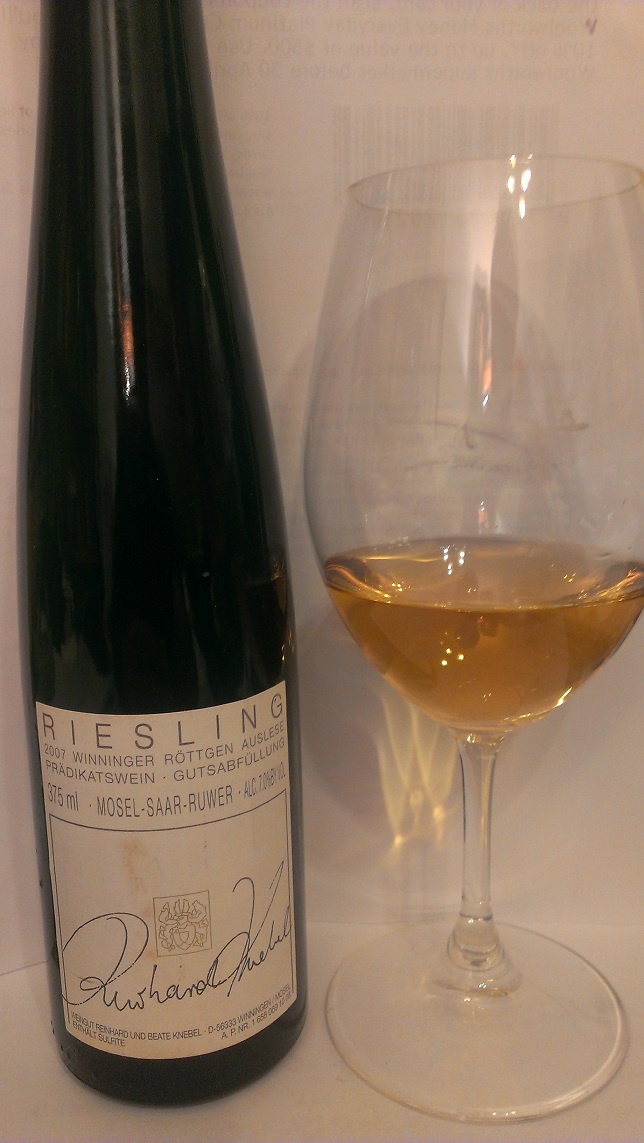
A night of Alsace whites

A group of enthusiasts aimed to explore mostly wines from 2007, except for the bracket of sweet wines at the end.

Alsace is in France near the German border, so its flipped a number of times. A cool Continental climate, and shelter from the Vosges mountains means it’s very dry. The wines can get very ripe, and often some sugar is retained to keep the wines balanced. Frustratingly, this means it’s difficult to tell in advance how dry/sweet any wine will be, and what food matches work.  Many wines are more textural and phenolic than Australians are comfortable with.

There are 51 grand crus sites – too many, and too large. The sweeter wines Vendage Tardive (VT) and Selection de grands Nobles (SGN) carry a significant premium price.

2007 Boxler Sommerberg Pinot Gris 13%

2010 Jean-luc Mader Schlossberg Pinot Gris (sweet) 11.5%

Off to a good start, with both wines gold in colour, the Boxler (approx. 30 g/l rs) viscous, displaying pear juice, limes, ginger and nutmeg spices, marzipan and citrus peel on the palate – drink to 2020, score 93).  The sweeter Mader was not as forthcoming on the bouquet, with dark honey to the fore, but had a finer, longer creamy mouthfilling palate, and was the groups preferred wine (drink to 2022, score 94 points).

alsace 2016 pg and gwt

2005 Zind-Humbrecht Hengst Gewurztraminer 14.5%

2007 Sorg Eichberg Gewurztraminer 13.3%

2007 Dirler Cade Kitterle Gewurztraminer 14%

The three wines all showed their varietal character. ZH rows their own boat, with high alcohols on most wines, this one showing rose, honeysuckle and musk, its length partly contributed by its alcohol, and the palate beginning to dry out (37 g/l rs).  Drink up, 85 points. The Sorg looked more “feminine”, gently textured, but some bitterness detracted (drink to 2018, 88 points). The Dirler (41 g/l rs) was the group’s preference, some apple and tropical fruits on its bouquet, toffee, honey, and an attractive touch of apricot on the palate; altogether lovely (drink to 2020, 91 points)
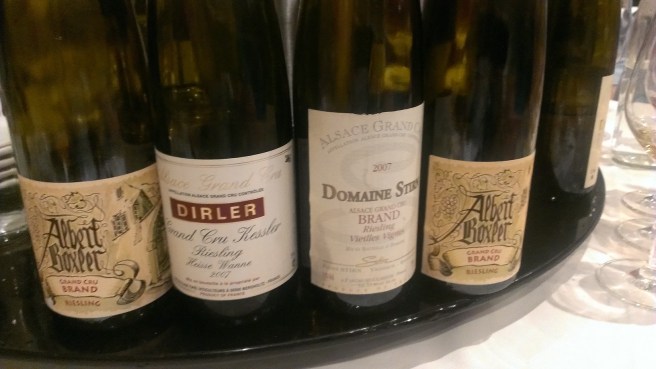
alsace 2016 rieslings

2007 Stirn Brand Riesling 13%

2007 Dirler Cade Kessler “heisse wanne” Riesling 13.5%

2007 Boxler Brand Riesling 13%

2007 Boxler Brand “K” (kirchberg) Riesling 13.7%

The Stirn seemed a bit awkward initially, austerity and some petroleum over-riding its flintiness. But it limbered up, with limes, white flowers and minerals emerging (drink to 2020, score 91 points).  The Dirler was our first casualty – blue cheese, butterscotch and oxidation too noticeable for me. The group favourite Boxler (18 g/l rs) was a delight; dried red apple, cinnamon and other spices, terrific length and lip-smacking texture (drink to 2025, 94 points). The Boxler “twin” was the 4 g/l rs “K”; with a similar slinky supple palate, but the higher alcohol made its presence felt Drink to 2020, 91 points).

Then it was a true gamble with a bracket of deliberately sweet wines, and individual desserts.

alsace 2016 sweeties. jpg

2009 Stirn Muscat VT 12.5%

2007 Dirler Saering Gewurztraminer VT 14%

1998 Zind-humbrecht Clos Windsbuhl Pinot Gris 13.5%

1997 Hugel Sporen Gewurztraminer SGN 13%

1997 Louis Sipp Osterberg Gewurztraminer VT 13%

The Stirn was a restrained style but full of interest; grapey, fruitcake spices, poached pear, and Lemon peel (drink to 2020, 90 points)

Zind-humbrecht (71 g/l rs) was affected by hessiany TCA – a shame as there was plenty going on underneath. The Louis Sipp was badly oxidised.

The Dirler (54 g/l rs) looked slightly bruised-apple-oxidised, and a little hard and burnt; but still provided some drinking enjoyment with stewed apricots, orange blossom and some savouriness on the palate. There will be better bottles.

The Hugel (103 g/l rs) was a classy wine; even though the colour was amber, it had the luminous glow that often brings up the expectation of excitement.  And it delivered – citrus peel, marmalade, dark honey, on an unctuous balanced palate. And will keep for many more years (to 2023, 96 points)

Overall, the wines were ready to drink, (although the Boxlers look age-worthy) with cellaring a bit of a gamble. A very enjoyable evening, despite cork problems making 3 of the 14 bottles undrinkable, and one more slightly affected– a disgrace.
A tasting at Selbach-Oster (Zeltingen, Mosel)

Selbach-Oster is a well-known estate in Germany, but distribution in Australia (via Nelson’s, Sydney-based) is recent, so I hadn’t tried many of their wines. The estate is 22 hectares, and typically produces 35 different wines each year, covering 7 sites, different classifications. Picking can proceed on the same site several times as well as picking different classifications at the same time – all site –dependent. Wine is quickly pressed, settled and gravity fed into old oak, and some into stainless steel tanks.  Ambient yeasts are used, (cultured yeasts used only if necessary). Fermentation is slow, and cool.

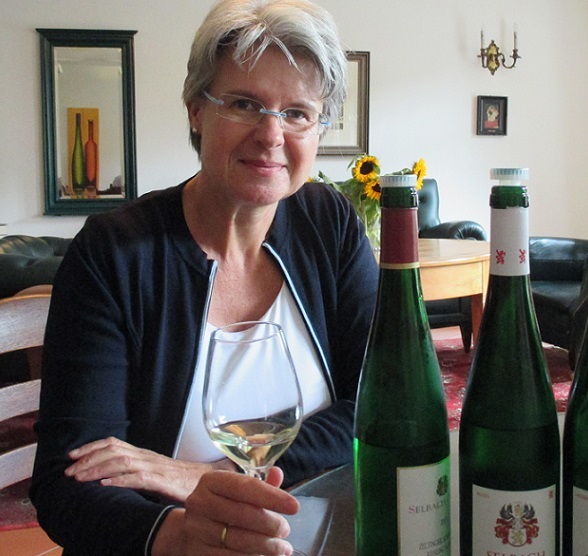
We set out to gain some familiarity with the styles made, with the English-speaking Barbara Selbach.

barbara selbach

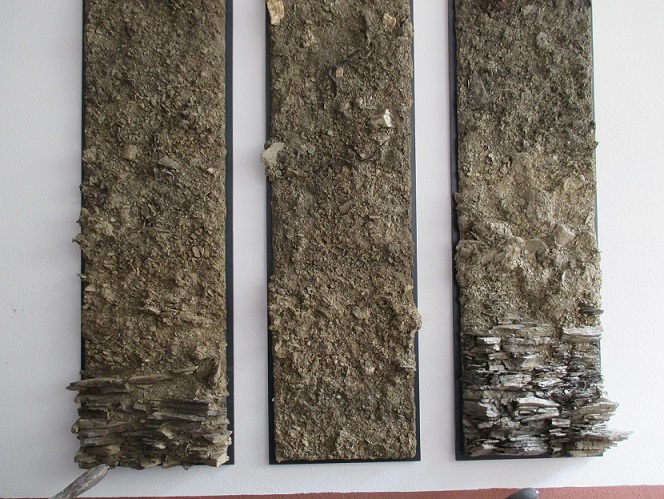
First we were shown profiles of the soil, showing the slates and degree of decomposition. L-R is Zeltinger Himmelreich (kingdom of heaven), Zeltinger Schlossberg (hill of the castle), Zeltinger Sonnenuhr (sundial).

so rocks

2014 S-O Weissburgunder (Pinot Blanc) 13%

Little is made in Australia, and I’m not terribly familiar with the variety, although I have been surprised at the depth of flavour in some wines from Alsace. S-O makes very little, matured in new 1000l litre oak. Round, mouth-filling flavours of white peach and smokiness (oak-derived?). Brisk to close. Great education on one of the Mosel’s “non-Rieslings”.

Drink now- 2020, score 89

Then we moved to a bracket of Rieslings. All were very pale.

so wines

2012 S-O Riesling Kabinett trocken 11.5%

Scents of cape gooseberry, green apple, stones, minerals, textured

Drink now – 2018, score 90

2012 S-O Riesling Schlossberg Spatlese trocken 13%

More aromatic, spices, melons, viscosity. Lovely drinking style

Drink now – 2019, score 92

2014 S-O Zeltinger Himmelreich Kabinett

Approx 17 gl/ residual sugar. Highly floral, red berries, green plum, gun-smoke, granny smith apple, plus some honey and lemon. Lots happening here!

Drink now- 2020, score 90

2014 S–O Riesling Kabinett 8.5%

Icing sugar. Musk, Ultra-light,  feathery. Where else can you get this delicious drinking style than in the Mosel? A lovely drink all-day wine

Drink now – 2018, score 90

2013 S-O Riesling Zeltinger Sonnenuhr spatlese feinherb “Ur Alte reben” 12.5%

From vines >100 years old! Grapes described by Barbara Selbach as loose bunches of lentil size, and as ‘a treasure”. Immediately seems ripe, with passionfruit, honey, citrus, and serious acidity. A “masculine” wine, and very serious.

Drink now – 2025, score 92

2009 S-O Riesling Wehlener Sonnenuhr Spatlese 8.5%

Ripe, and extremely playful, there are almost tropical arrays of pineapple here and other exotics. This wine just seems so balanced, natural and unforced, with warming, extensive finish. Completely delicious.

Drink now- 2025, score 94

2013 S-O Riesling Zeltinger Sonnenuhr Auslese 8.5%

Light white honey plus ripe nectarines. More depth and concentration than the previous wine, Creamy, rich, fine, balanced, refined. Very extensive finish

Drink 2020-2030, score 93

Conclusions

We had the great good speculative fortune to taste uniformly excellent quality across the board. The wines are balanced and unforced, with the benchmark Mosel acidity and excellent VFM. There is a fanatical degree of care taken to preserve the various parcels but in a low-intervention manner. Barbara Selbach emphasised several times that winery work could not fix any problems that left the vineyard. Keep your eyes peeled especially for their parcels such as Anrecht, Schmitt and Rotlay!

Most of the Rieslings made even in the Mosel are “off-dry”, but Selbach-Oster takes a great deal of pride in their dry wines too, regarding them as more difficult to achieve finesse.

Finally, many of the wines – thankfully – are in screwcap, so no cork issues such as TCA or oxidation.

Grampians masterclass

Grampians (Western Victoria), centred around Stawell and Ararat is less known for its Rieslings than its Shiraz, – probably overshadowed by the Rieslings from Henty (Seppelt Drumborg and Crawford River). However the Grampians can produce long-living, floral and mineral styles. Judicious use of low levels of residual sugar seems to help. The wines below are firmly in the “fruity” camp, not sweet.

Seppelt Great Western Riesling 2014

Varietal bath-salts, talc, mineral tang, zippy, delicious (14 g r/s) balanced, versatile

Drink now-2020, Score 92

Mt Langi Ghiran Langi Riesling 2010

Geisenheim clone of Riesling. Some bottle age-characters, honey and limes, but is on the austere side

Drink now- 2020, Score 88

Halls Gap Estate Riesling 2015

Obviously very youthful, residual sugar (8 g/l) is subdued by the beautifully judged.acidity, Fruit tingles. A producer new to me, although winemaker Duncan Buchanon is well known

Drink now- 2025, score 94

Best’s Great Western ‘Foudre ferment’ Riesling, 2014

Alsace-inspired, but thankfully at 11% not overblown as Alsace can be. Moderately soft, with some musk, citrus peel and florals, but the reward is the palate- slippery, slinky, textured, rounded.

Drink now- 2022, score 91

Jamsheed Garden Gully Riesling 2013

Skin contact, some barrel ferment. unfined, unfiltered, Looked a bit cloudy, and had some sour/bitter characters. Full on, very determined winemaking, very individual, but definitely didn’t appeal to me.

Not recommended

The Story Westgate Vineyard Marsanne Roussanne Viognier 2014

OK its not a Riesling, but was included in the bracket. There’s only a few rows of these varieties around in the district, and it’s a field blend. Bright, clear, tell-tale citrus and honeysuckle with a rounded palate. Comfortable rich wine, but I think some extra acidity would be my preference.

Drink now-2017, Score 86


Grampians shiraz is the “hero” wine; like many of the red wines grown in alluvial areas, it’s robust in flavours while being only medium bodied – likely benefitting from old vines, and restrained yields. The array of exotic spices and pepper integrated with natural acidity means the wines are long-lived, savoury and food-friendly. A move to whole bunches in the ferment means care has to be taken in techniques and judgement to avoid green characters and the technical composition including pH of finished wines.

2013 was a warm vintage with the added issue of varieties ripening together, complicating the typical vintage task of matching capacities of the right kind of vessel and picking best blocks at right times while crossing fingers and toes for the rest. All colours of wines tasted below were very youthful, with oak and tannins just beginning to really integrate. Alcohol levels were generally around 14%. Patience will be rewarded, as they are a pretty bracing now, with their best well ahead, as demonstrated with the bracket of wines following.

I feel that maybe it was not the best season to be brash on whole bunch inclusions.

Seppelt St. Peter’s Grampians Shiraz 2013

A riot of mixed spices matched with fine mocha-oak. Mix of black and red berries. Balanced but possibly lacking the usual concentration of this marque. Whole bunch used as “blend-in” material. Curiously disappointing after recalling the quality of the VFM Seppelt 2013 Chalambar Shiraz.

Drink 2018 – 2030, score 91

Bests Bin 0 Great Western Shiraz 2013

No “Thompson” made in 2013, so this wine has benefited from the “trickle-down”. A very health rude purple colour, there is upfront oak, but built in over savoury, clove-y, cocoa notes. I find the Bests Bin 0 often not especially varietal except via elimination, but this is a splendid wine regardless.

Drink 2016-2030, score 94

Jamsheed Garden Gully Vineyard Syrah 2013

80% whole bunch – high pH, high TA (a curious combination). I found the tannins here hard and green, Time may help, and I may be entirely wrong.

Drink 2015-2019, score 82

Halls Gap Estate Shiraz 2013

Seems, rawer and sweeter-fruited than other wines in the bracket. Tannins make their presence felt, but ultimately seems a bit straightforward – although keenly priced.

Drink 2016-2020, score 86

The Story Westgate Vineyard Grampians Shiraz 2013

Crisp, savoury, smooth, slinky, classy wine. There is some hardness in the tannins here too. I’m a fence-sitter on this one

Drink now-2020, score 89

Mt Langi Ghiran Langi Shiraz 2013

Slightly medicinal bouquet (forgiveable) which dissipated over time, oak is prominent, acid is poking through and this wine looks entirely backward; hard to describe which means it is “right”, with all in place; best course is to revisit in a few months

Drink 2017 – 2027, score 91

Now we get to look at the time capsule; older wines as a pointer to how the 2013’s could develop. Most of these wines are lower alcohol.

Seppelt Great Western Hermitage 1971

A wine I have agonised over on previous occasions; is it a bit of TCA, or is it a combination of some hay/straw and some garlicky sulphides and varietal mushroom? It resuscitates on the palate as a fully mature, generously flavoured old wine with tremendous now-vinous fruit concentration. Remember its 44 years old, and deserves respect.

Drink now, Score 87

Bests Bin 0 Shiraz 1984

Chewy, some Ribena-like characters, and dark cherries. No rush!

Drink now-2020, score 86

Bests Bin 0 Shiraz 1998

Vibrant, beautiful medium bodied wine of length, charm and finesse. Astounding.

Drink now- 2025, Score 95

Mt Langi Ghiran Langi Shiraz 1998

Also very alive, with some sweet toasty oak, a decent wine but wouldn’t place it as Victorian

Drink now – 2018, score 87

Mt Langi Ghiran Langi Shiraz 2004

Colour seems to show its been in a deep freezer; ultra youthful. But it seems a bit “stretched”, and I cannot see improvement with further maturation.

Drink up 84

Jamsheed Shiraz 2006 (magnum)

Colour is a bright bomb; there is some slight reduction on the bouquet, but the wine is dense, and flavour packed. Very happy here, and future is extensive.

Drink now- 2022, Score 93

Seppelt Show Sparkling Shiraz 1986

Disgorged in last week or so, there are some unattractive decayed elements on the bouquet, and the degree of bubbliness is subdued; BUT the fruit power remaining on the palate is extra-ordinary; full ripe plums, and blackberries, a wine at peace with itself.

Drink now, score 90