Two styles, two hemispheres

1990 Marc Bredif Grande Annee 12%
Vouvray, Chenin Blanc

The Grand Annee is the selection destined for aging. With their high natural acidity, Loire Chenin Blanc can age a long time. Domaine Huet, and Marc Bredif are particularly well known for their range of Vouvray wines. Australia has been less successful with Chenin Blanc – although I had a soft spot for some of the age-worthy Houghton “white burgundies” of the 1980s, and a thrilling botrytised 1981 St Leonards! I have tasted some startling South African Chenins across several styles too.

Presented blind, this wine was pale gold, but had some distracting cheesy/waxy notes. Fortunately,  this dissipated and the wine motored along improving with each taste showing honey, plenty of acidity and some residual sugar (50 g/l?) melded with spices made this wine a terrific, showstopping adventure. Just a marvel. When revealed, the freshness for its age was dramatic.

Drink to 2035, and 95 points

1994 Stanton and Killeen Vintage Port 19%
Rutherglen, est 95% Shiraz, 5% Touriga

“Will mature in the bottle for up to 20 years” claims the back label, but truly there is no need to rush, despite this being rated an “average” vintage with only a few silver medals listed.

Syrupy, almost jammy, dark-fruited, huge sweetness, dark cherry, plum, liquorice, chewy and still bright-tasting. A powerful flavour-bomb that doesn’t quite scale the heights of some other vintages. It’s in an enjoyable holding pattern. But that’s the vagaries and mysteries of the season, and this wine was heartily appreciated.

Drink to 2030, and 91 points.
One sweet, one strong

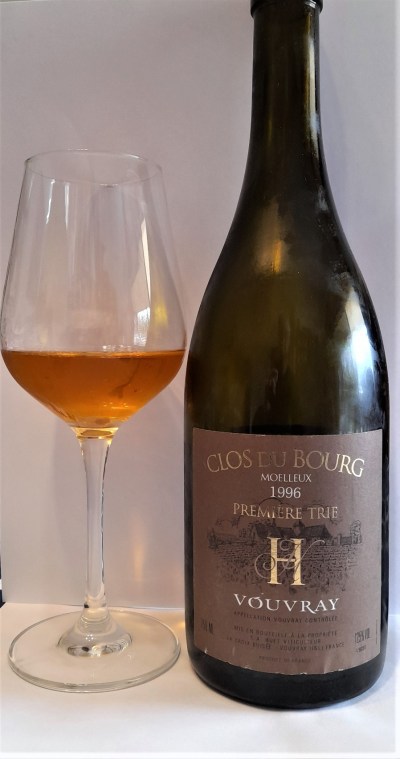
1996 SA Huet Clos du Bourg Moelleux 1er trie 12.5%
Chenin Blanc, Vouvray, Loire Valley (biodynamic since 1990).

Huet is a famous maker, with a range including sparkling, sec, demi-sec and sweet. Clos du Bourg is regarded as its “top” site. Chenin Blanc is a high acid white wine variety, entirely undistinguished in Australia (although it played an important role in old Houghton White Burgundies, and there are a few brave producers persevering, such as Coriole).

1996 huet

The cork was unremarkable but had performed its task, and the colour was bright gold. Despite its sweetness level (70 g/l?)  this wine was deliberately served with a meal as a savoury white wine. The acidity was completely integrated and concealed the inherent sweetness. Apricot, cumquat, baked apple, honey, marzipan and shortcrust; resoundingly fresh and savoury in intent (regardless of its  analytical sweetness).  Super-complex, it was just a delight to drink and a reminder of the potency of the best wines of the Loire (much harder to find in Australia than they deserve).

Drink to 2030, and 94 points (for surprise value, a higher score is warranted)

1971 Metala Vintage Port
Langhorne Creek, South Australia, likely Shiraz.

Langhorne Creek is not a “renowned” area for VP styles in Australia, but it’s full of surprises. Its longstanding contributions to the red wines of Wolf Blass cannot be ignored. Bleasdale makes an array of excellent Malbecs – and much more- Lake Breeze deserves greater recognition,  as does Bremerton.

The label of this wine had effectively disintegrated, but it’s understood to have been recorked (and possibly tweaked) in 2015. Huon Hooke has an illuminating article on the recent buyback of the Metala brand here.

But it was another knockout to drink – another 51-year-old wine consumed only weeks after the All Saints.

Liquorice, dark fruits, cream and pie crumble, dark berries, dried fruits and the most startling feature was its freshness – a lovely piece of history.

Drink to 2030 and 93 points