2017 Pikes “Olga Emmie” Riesling 10.5%
From the Clare Valley, South Australia, from a classic year. Pikes make a well-priced and readily available “traditionale” Riesling, and their reserve is the “Merle” (a terrific wine that I have purchased to cellar).

The “Olga Emmie” is Pike’s off-dry Riesling, described as “slightly sweet” on the back label, with perhaps 20 g/l of residual sugar. It is available for around $20, and well worth seeking out.
“Olga Emmie” proved an interesting wine, particularly since I had the luxury of consuming it over several days. Each time, my assessment, and score improved- so perhaps this is a wine whose virtues are not instantly obvious. It’s youthful and pale in colour; its aromatics are present but not overt and include lime marmalade, passionfruit and pebbles.
There is some residual sugar, and my first impression was that an extra tweak of acidity would have pleased me; but the wine is absolutely delicious with lime, and then lemon, and some fresh honeydew melon. The acidity is keenly pitched, and fills out a wholesome drinking experience.
I am baffled that there are so few examples of serious off-dry Rieslings in Australia; food-friendly, approachable and delicious – Grosset’s Alea, and the Pewsey Vale Prima come to mind; further mental effort retrieves Pressing Matters R9, a Rieslingfreak offering, then the memory bank fades.
It’s not necessarily easy for a customer to work between the range of “dry” and “dessert”; and the complex interplay of sweetness and acidity on perceptions is another issue; not today’s topic! Labelling wines as off-dry, semi-sweet, medium dry or medium sweet doesn’t seem to have helped.
While this Pike’s wine will certainly improve for a few years (particularly based on the moving target of my views), it will already be a terrific accompaniment to a range of foods much broader than generic “Asian”, with fish and white meats well into play.
Conservatively, drink to 2022 and 90 points
Disclosure- this was a sample bottle.
2009 Lethbridge Dr Nadeson Riesling 11.5%
Although Lethbridge is based in Geelong Victoria, this particular wine is from Portland, SW Victoria, from the Barratt vineyard. There have been several releases from this vineyard, but not for the past few years.
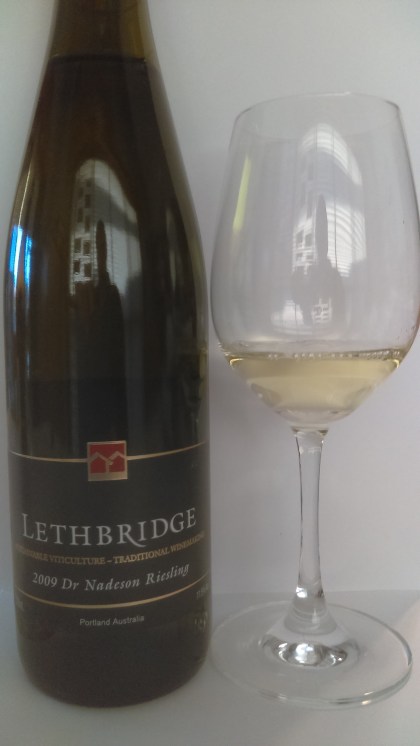
It’s a pale gold colour, and displays varietal talc, wax, mango, cantaloupe and some definite but unobjectionable petroleum. The palate shows green apple characters, some textural grip and a twist of lemony acidity. There is perhaps 10 g/l of residual sugar which adds to the package, providing intrigue to the palate . Nine years old, but the taste is still defiantly fresh.
Perhaps not a wine for technocrats (with its degree of textural grip); certainly idiosyncratic in its winemaking approach, and I firmly favour drinking this wine soon, while its vibrancy critically supports its drinkability. But the wines very slow evolution means it will last much longer.
Drink to 2020, and 88 points.
 sweetworldwines