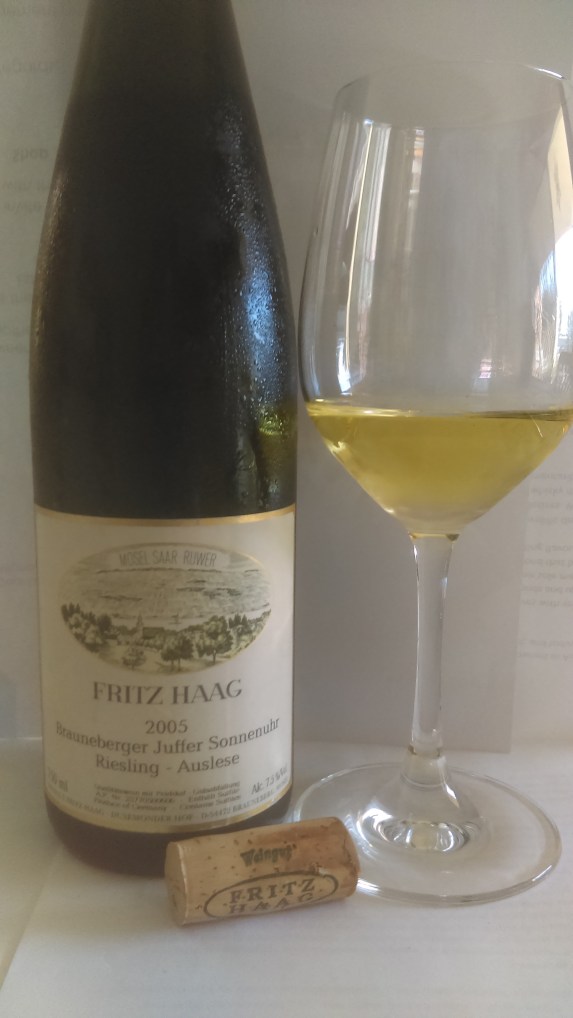
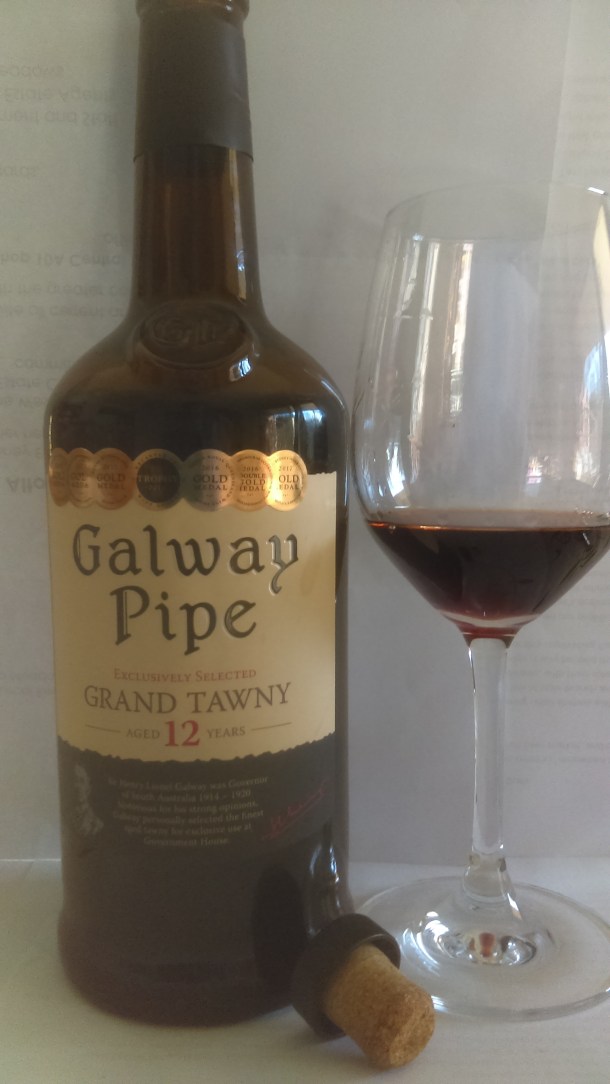
Galway Pipe Grand Tawny 17.8%

I previously assumed  this was a Yalumba wine, but the back label claims the wine was made by Beresford. Anyway, this port-style wine is readily available in Australia for between $30 and $35.

galway pipe

It’s a healthy garnet, bricky colour, and the aromas are full of dried apricot, raisin, roast hazelnut and almond, vanilla bean and mocha. That’s action aplenty!

It claims an average of 12 years age, and this is a complex wine with well-matched brandy spirit, providing rich fruitcake, nuts, rancio and vanilla flavours that unfurl with each sip. The wine is artfully constructed, balancing sweetness, richness and freshness.

In a perfect world I would prefer less of the overt vanillan characters, but the wine is a winning, late-evening drink that will generate enormous enthusiasm at a bargain price.

Drink now, and 93 points.

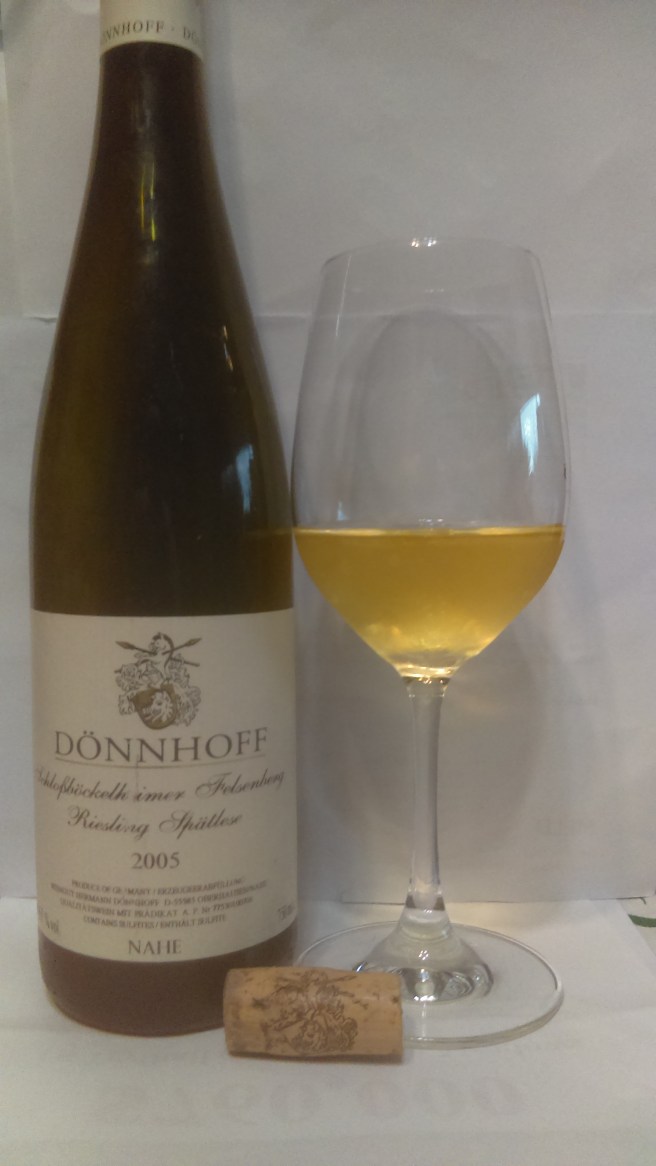
2005 Donnhoff Schlossbockenheimer Felsenberg Riesling Spatlese 8.5%

From the small Nahe region (close to Mosel), this is a good age to tackle a quality German spatlese Riesling.

2005 donnhoff spatlese

The wine’s colour is a light gold, and importantly the wine is still very fresh, showing some honeyed development, but the interplay of sugar and acidity ensures  there is plenty left in reserve. It’s a proper, typical, German sweet Riesling, with power and grace packed into its modest alcohol level.

There are some sweet ginger spice notes, candlewax and leaf, with breathing helpfully bringing out more aromatic lime and honeysuckle. The palate is viscous, but with some oiliness too, flavours closely mirroring the aromatics.

The wine is unforced, has delightful persistence  and is highly drinkable, with just some faint, but attractive bitterness adding to its charm.

Admittedly, 2005 produced many terrific wines from Germany, and we are fortunate in Australia that Cellarhand imports a wide range of Donnhoff’s wines.

Drink to 2027, and 92 points.


Facts behind iconic Australian wine labels

Professor Albert Pedant (MA Hons- Lagos, PhD – Port-au-Prince) – from the online university of Woolloomooloo,  has diligently researched the history of numerous Australian wine brands and labels. “There are extensive gaps in the records; family and staff have often put a spin on history; but meticulous searches through dusty filing cabinets, microfiche, oral histories and numerous interviews  have shown much of the branding is a mixture of spin, myth, mischief and accident; my definitive conclusions are set out below – certain to disturb and dismay the establishment. No black armbands, fake news or alternative facts here!”

Clonakilla
Long-claimed that Clonakilla refers to the name of Dr John Kirk’s Irish grandfather’s dairy farm (translated as the meadow of the church); my scholarship proves the name was inspired by the family’s shared love of ritual and obsessive viewings of World Championship wrestling on their TV. The stunning character of Killer Kowalski, and his trademark manoeuvres – the piledriver and Kowalski claw – stimulated much household study and emulation. There was also an protracted period when winemaker Tim (“Captain”) Kirk channelled the music of another “killer” –  Jerry Lee Lewis – but with guitar rather than piano.

Clonakilla thus epitomises the Kirk clan’s hero worship and Tim’s secret ambition to become a professional wrestler. As chief winemaker, Tim’s career is probably a win for oenology, but a sad loss to the gladiatorial arts.

clonakilla logo

The Clonakilla logo is purportedly taken from the 7th century Irish gospel manuscript the Book of Durrow. But its resemblance to Killer Kowalski’s championship belts is compelling.

It’s no coincidence that the very same wrestler also inspired the label Kilikanoon. Lightning can strike more than once. Certainly, the Killer has left an indelible mark on Australian wine.

Henschke Hill of Grace
henschke hog bottle

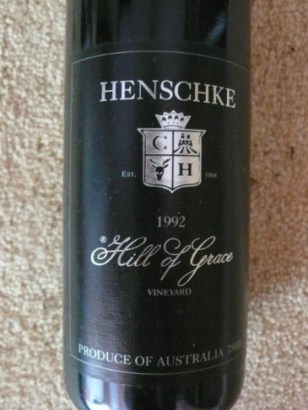
The legend insists that the famous Henschke wine Hill of Grace is a translation from the German ‘Gnadenberg’ (a region in Silesia). The truth is more prosaic; although vines were planted on the location in 1860, the site produces an extra-ordinary variety of weeds, thistles and thorns; the biological control agent deliberately introduced – rabbits- did not have the desired outcome. Instead, several different grassy cover crops -both local and imported- were – successfully-  deployed to crowd out the weeds. Thus for many years, the site was known to the family, and neighbours as Hill of Grass”.

This was the intended name for the label, and it was only due to the linguistic misunderstandings, and a degree of hearing impairment of the printer, that Hill of Grace was created. In 1958, When Cyril Henschke saw the newly-printed labels for the first time, he was torn between fury and despair. Owning a cashflow-impaired small business, he could not afford a reprint, and was gracious enough not to hold the printing firm, or the printer- a fellow congregationer -responsible for their error. Thus Hill of Grace was born- now a venerable Australian wine icon.

But the true founder of this Australian label is a long-forgotten, unknown print tradesman of ethnic German descent.

Seppelt (now Seppeltsfield) Para Port
There is no truth that “Para” was derived from the arcana of print and publishing mark-ups.
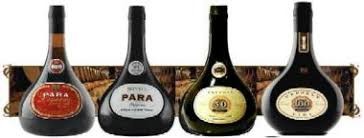
para labels

The legend attributes this Seppelts (and now Seppeltsfield) brand to the Para river in the Barossa valley; but this is erroneous. The key market for Australian wines – at that time – was England, and the Antipodean approach to branding was to create “critter labels” often featuring emus, kangaroos and other native fauna.

The group tasked with creating the name settled on Parrot Port. Further, the colourful Australian King Parrot was chosen to be depicted on the label. But economics intervened; the quoted cost of multi-coloured printed labels was formidable and weighed decisively against a new market entrant. A plainer label would fail to display the avian magnificence of this ornithological beauty.

Forced to make a hasty decision , the shorter Para was selected. It’s become famous in its variant guises, especially the extra-ordinary 100 year old “port”.

Penfolds Grange Hermitage
The official back-story is that Penfolds’ winemaker Max Schubert travelled to Bordeaux, and after returning to South Australia made the very first – experimental –  “Grange” in 1951. But where did the name come from? This question is far from straightforward.

One proposal – noted in Huon Hooke’s volume “Max Schubert winemaker” – suggested Grange was the name of the Penfold’s cottage inside the Magill vineyard- but alternate explanations surely have greater plausibility than this convenient corporate flim-flam.

penfolds grange

Due to a scarcity of high-quality Cabernet Sauvignon, Max used the grape variety Shiraz (aka Hermitage). Max would have been well aware of the famous Chapel (la Chapelle) on the Hill of Hermitage. Did Max pay direct homage here? – it’s not a huge leap of description between Chapel and Grange.

Grange is not a wordplay on Garage, and it’s not related to 3rd growth St Julian property Chateau Lagrange. It is highly unlikely that Max was aware of the gentlemens’ establishment outside La Grange Texas (also called the Chicken Ranch), brought to widespread notoriety in 1973 by the band ZZ Top.

Max Schubert typically refers to the wine as “Grange”, but he has unwittingly provided several clues, claiming his aim was to produce a wine “capable of improving year by year for a minimum of twenty years …something different and lasting….controversial and individual.”

One serious suggestion is that Max Schubert was inspired by the Australian composer and performer Percy Grainger– best known for his revival of the tune “(English) country gardens” but also a renowned connoisseur and collector of Europe’s finest wines. Could Max have originally referred to his own opus as “the Grainger”, but ultimately tired of explanations to his less-high-browed colleagues, and gradually it became the “Grainge” and then somehow the spelling was corrupted or simplified? Certainly this heritage is controversial, individual and different.  It is unclear, however, if Max was aware of Percy Grainger’s proclivity for self-flagellation and his other sado-masochistic interests.

Grange is a seaside suburb of Adelaide, where Max spent countless hours on his lesser-known pastimes, fishing from the jetty, and imbibing beer – and smoking-  at its numerous attractive hostelries. Like Marcel Proust’s madeleines,  did this humble municipal district and its numerous attractive recreational memories – perhaps a teenage romance? –  inspire Max to pay tribute, and create the wine Grange?

We have a riddle wrapped in a mystery inside an enigma; the contenders are numerous, but the true origin of Grange remains a conundrum. Further research is planned, although regrettably the current owners of this brand have so far not co-operated with my endeavours.


As Austrlia’s foremost historian, and while my vinous research is ongoing, (Wendouree and Giaconda are currently under my intense scrutiny), I am honoured to have finally set the record straight on the factual origins of these famous Australian wine brands, and shamed the writers and historians who have uncritically and recklessly promulgated the fantasies behind these labels.

My discoveries will surely impel studies of establishments in Bordeaux, Burgundy, the Rhone Valley, Rioja, Alsace, Tuscany and Piedmont – just for starters. Heads will roll – Vive la revolution!

1997 Campbells Vintage Port 18.5%

Rutherglen, 100% Touriga, a terrific year in the district and a very pleasing result.

This a much better bottle than one tried a few months ago. The cork broke, but it was in terrific shape with hardly any travel, and a quick filter did the trick.
1997 campbell's vp
Dark ruby with some amber/bricking on the meniscus, enticing aromas of blueberries, more red berry than dark, some cocoa, spice  and liquorice add to the thrill; the palate is simply lovely, not a sweet one-dimensional style, but (lovely brandy) spirit is integrated, some dense sweet fruit allied with savouriness, fruitcake, nutmeg and intense blue and dark- red fruits. Onto day 3 and there is plenty of life left in this wine, which reveals more with each sip . By no means a blockbuster, the wine has layers of complexity. An excellent result from this grape variety, used in so many of the Portuguese VPs.

Drink to 2030, and 94 points.

1996 Seppeltsfield Para Tawny 19.7%

We are not allowed to use the term “port”, but that’s the style, in this example probably using Grenache, Shiraz and Mourvedre (Mataro). Unusually for a tawny style, this wine is from a single vintage, and aged 21 years before release.
seppelt 1996 para
The Seppeltsfield (and previously Seppelt) Barossa tawny often has some green, or khaki tints- and this wine which is a bright clear amber colour- conforms. Black coffee, almond and some walnut, shortbread biscuit, rancio, and vanilla bean are beguiling scents. The palate manages to be intense and supple, with beautifully integrated brandy spirit, and has tremendous verve, the acidity balancing its rich sweetness, teasing to further tasting. All the flavours come in waves. 22 years old, and what a privilege that it’s available.

At around $80 for $750 ml (retail or at Seppeltsfield – for the 1997 vintage) – this wine is outstanding quality and value.

Decant (to freshen it up), drink now – it will keep, but not change -and 94 points.


2010 Petaluma Botrytis essence 13%

From Coonawarra, with a label showing astonishing (albeit tiny-fonted) detail,  174.7 g/l residual sugar, Sav blanc 53%, Semillon 47%, and much more about its oak handling, and vintage conditions.
2010 petaluma botrytis essence
Meanwhile the wine is a brilliant gold colour, with scents of botrytis, lime and orange marmalade; the palate is full-throttle, unctous and rich, ultra decadent, with flavours ranging through ripe stonefruit – apricot, peach – plus honey and orange. It’s a lovely drinking experience, good VFM, but a little less oak and a dash more acidity would have elevated my score.

Under screwcap, this wine has a long life ahead I but cannot see an upside in the flavour profile with further cellaring, and suspect it will taste very similar in 5 years.

Drink to 2025 and 88 points

2001 MF Richter Mulheimer Helenkloster Riesling Eiswein 9.5%

Eiswein is a rare beast; grapes are left out to freeze (picked when at least 8 degrees Celsius below freezing), running the dangers of assorted undesirable rots, birds,  and greatly reduced yields.  Picking (in Germany) usually takes place in December, and sometimes into the next year. Eiswein is  troublesome to make, and expensive to purchase, with the residual sugars generally between BA and TBA levels.

Richter (from the Mosel) is blessed with a site (Helenkloster) that usually produces an Eiswein -(sometimes more than one- that may be differentiated on the label by an ** and of course the AP number). And several Richter wines are imported into Australia, although I am more familiar with their rich Kabinetts and Spatlese Rieslings.

I visited the Richter estate in 2007 and was treated to a range of wines, a lightning tour of the winery and its museum, and left with a purchased armload including several back-vintage wines.

2001 richter eiswein

Information kindly – and promptly- provided by Dr Dirk Richter about the wine “grapes were picked on 24 December at minus 13C; 255 g/l residual sugar, 12.1 g/l acidity” and a meagre 200 litres were made. These are very serious numbers! An eiswein ** was also made with equally sobering statistics.

The wine is a light copper colour with a khaki rim; there are exotic aromas of raisin, dried fruits, even coconut. The palate is still lively, with assertive apricot, orange citrus, and with some breathing, more lime characters. Brisk, clean, dense, and delightfully decadent.

While this style can live for decades, with its inherent acidity, on the evidence of this half-bottle, I favour the conservative side of the drinking window.

Drink to 2025, and 94 points.


2009 William Downie Petit Manseng 12.5%

The grapes came from King Valley (Victoria) – a one-off wine as untimely bushfires in Victoria possibly tainted sources of Bill’s usual range of Pinot Noirs. A pretty presentation – the  wax top was easily removed, as was a diam cork, and a there is very impressive Reg Mombassa label. Petit Manseng is the key variety of the long-living sweet wines of south-west France- and I doubt I’ve tried any! Some information is here.

2009 willliam downie
But this wine is still a bright clear lemon colour; aromatics are subdued but lemon and lanolin are present. The palate has more interest- stonefruit, lime, candied peel, green apple, and quince. There is perhaps 40 g/l residual sugar, but this is very neatly absorbed in its balanced tangy acidity. Some phenolic texture rounds out the picture. This wine is right in the slot, and more time won’t add to its nuances. Unusual, and a pleasant, enjoyable surprise.

Drink to 2020 (for its brisk and refreshing aspects) and 88 points.

Merry Xmas from Stoney Goose Ridge CEO Hector Lannible

My annual message to suppliers, staff, and customers is clear – have a merry non-denominational seasonal festivity.

Another breathtaking fiscal year is almost  over, and I’m blessed that my well -deserved bonus will be sumptuous, reflecting a year of extra-ordinary achievements; the culmination of extensive and rigorous debates with the Board, the executive remuneration committee and my personal legal representatives. Truly, the bucks stop with me.

Our tax strategies once again bore fruit; with new entities established in Panama, the Bahamas and Cayman Islands . Our cross-rate triage hedging bridge mezzanine exchange exposure tiered collateralised tranches are the envy of many enlightened companies. And our numerous ongoing “discussions” with taxation authorities are a source of pride.

Stoney Goose Ridge has won many national and international awards – just a few highlights

  • Best social and new media campaign alignment strategies –Pure Blondette red wine- Thailand
  • Best innovative adhesive wine packaging –Emoh Ruo– Hong Kong
  • Platinum medallion for Pantone synergy wine labelling – Brosé – Venezuela
  • Short-listed for brand segmentation data-mining -Chicago
  • Best psychometric analytical personal development program (UK)
  • Enormous traction with our SEO and SEM performance
  • Record hits on my TED talk on “the China syndrome”
  • Best new beverage brand performance (wine) – Chamsecco® – Venice
  • Best new beverage brand performance (spirits) – The old Wood Duck – St Petersburg
  • Best new beverage brand (beer) – Seasonable Smashable – Geelong

And most importantly,

  • Record YOY sales uplift and EBITDA
  • New export to Nigeria, Cambodia and Myanmar
  • Record number of litigations initiated in numerous jurisdictions
  • Record level of damages awarded and costs retrieved, for copyright, libel, and contract breaches.
  • Record numbers of legal appeals in progress on technical grounds.
  • Various medals in wine (and beer, and spirit) shows
  • Record NPS scores, record brand recognition, recall – and brand financial valuation
  • Recognition of several wines as “emerging cult wines”.

And there is naturally, our strong community support, evidenced by matters including

  • Staff employed, and staff turnover
  • GST and other unavoidable levies paid
  • Tax relief, relocation allowances, export facilitation grants, royalty holidays, and other Government support that Stoney Goose Ridge has championed, and my charismatic networking mesmerisation has enabled
  • Support to charities – through contra, and a proportion of donations noted as “anonymous”

But at Stoney Goose Ridge we don’t rest. Our staff commit fully- or else.

I give 120% of my intellectual prowess and expect no less from my underlings and minions.

We plan ahead; in 2018 expect new products, new markets, and new ventures (even a cookbook is in progress). On a personal note, I acknowledge I can’t do it all; the commitment of my hand-picked executive team (I steer, they row), the support of my family, the care from my agent, PA, personal lawyer, media team, stylist and biographer.

Lastly, the enduring love from our customers for Stoney Goose Ridge is our greatest achievement; whether its from people reaching for our most basic entry-level wines, or the more sophisticated drinkers persuaded by our omni-channel approach to savour our premium, ultra-premium, hyper-premium, icon, uber, mega-rare and our myriad of other lifestyle segmented brands.

I recognise that competition in my chosen industry is ferociously endemic; and there is jealousy at our raging logarithmic success; there are also extensive CV’s in our slush pile, from people desperate to join our ranks. One very senior executive in a major beverage concern noted his extensive and wide-ranging experience – but we’re not interested in a jackass of all trades; we recruit congruently to fill strategic key niches.

As a family oriented company, staff will recall that annual leave is inflicted by meddling regulators – make the most of it by seeking improvements in our logistics, contracts, brand performance and so on, and return fully refreshed for the marathon tasks that will be assigned, and your increased KPI BHAG challenges. My senses are hyper-alert to your actions, and any diminution in enthusiasm, output or innovation will be crushed with astonishing rigour. But my motivational mastery and incisive guidance will continue to inspire your performances.

Once again, congratulations to those that have had their contracts renewed for their contributions in 2017, and we set sail into the stratosphere of the nouveau calendar 2018.

Raise a glass to the growing domination of Stoney Goose Ridge!

Yours passionately, Hector”

2005 Joh. Jos. Prum Wehlener Sonnenuhr Riesling Auslese (AP 03 07) 7%

IMAG0812

The wizened cork has nevertheless done its duty, but I hope my remaining bottle will be preserved for at least another 5 years.

The wines of JJ Prum are easily available in Australia; the Wehlener Sonnenuhr is my “go-to” vineyard, and the Auslese level hits my personal “sweet spot” of complexity and affordability. But the JJ Prum wines- like so many Mosel Rieslings – reward cellaring. 2005 was an exceptional vintage in the Mosel.

The colour of this Mosel wine is a bright clear light lemon; there are enticing scents of ripe red apple, dried pear, lemon, smoke, petroleum, stones and a twist of ginger. The palate is rich, clean and overwhelmingly pretty; it’s viscous with natural acidity that is refreshing, and insists that further tasting is mandatory. My guess was around 90 g/l of residual sugar, but beautifully integrated. The palate shows white honey,  red apple, some emerging lime, and of course flint. A wine that is easily approachable, enjoyable and complex.

Drink to at least 2035 , and 95 points for now – with enormous prospects for improvement in the future.