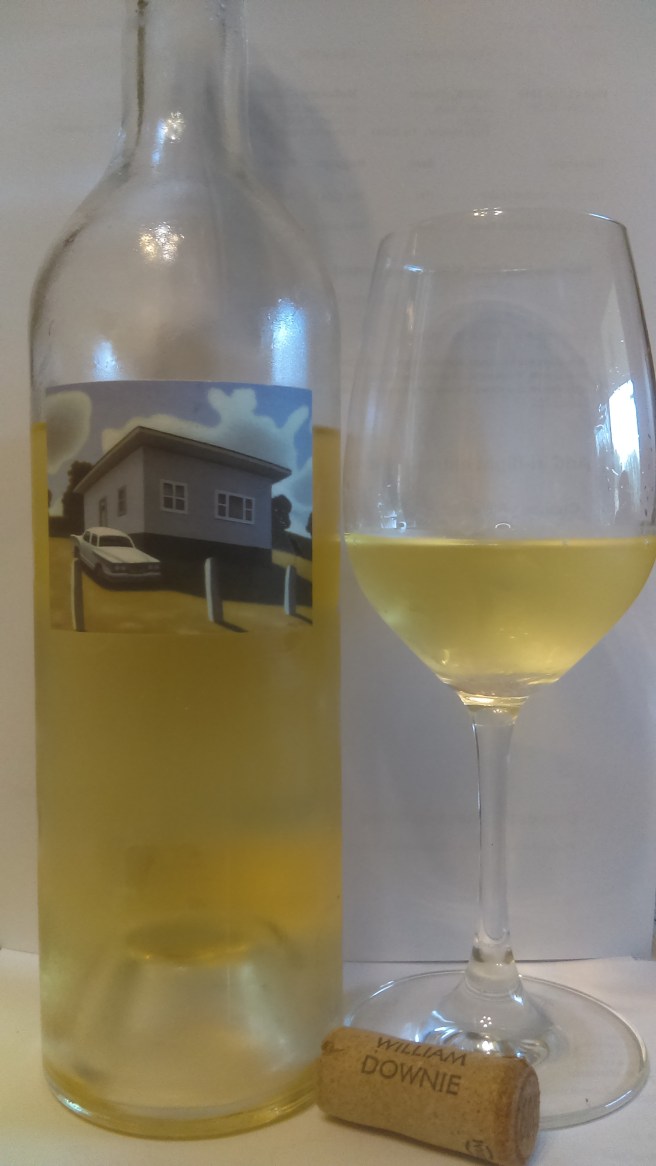
Merry Xmas from Stoney Goose Ridge CEO Hector Lannible

My annual message to suppliers, staff, and customers is clear – have a merry non-denominational seasonal festivity.

Another breathtaking fiscal year is almost  over, and I’m blessed that my well -deserved bonus will be sumptuous, reflecting a year of extra-ordinary achievements; the culmination of extensive and rigorous debates with the Board, the executive remuneration committee and my personal legal representatives. Truly, the bucks stop with me.

Our tax strategies once again bore fruit; with new entities established in Panama, the Bahamas and Cayman Islands . Our cross-rate triage hedging bridge mezzanine exchange exposure tiered collateralised tranches are the envy of many enlightened companies. And our numerous ongoing “discussions” with taxation authorities are a source of pride.

Stoney Goose Ridge has won many national and international awards – just a few highlights

  • Best social and new media campaign alignment strategies –Pure Blondette red wine- Thailand
  • Best innovative adhesive wine packaging –Emoh Ruo– Hong Kong
  • Platinum medallion for Pantone synergy wine labelling – Brosé – Venezuela
  • Short-listed for brand segmentation data-mining -Chicago
  • Best psychometric analytical personal development program (UK)
  • Enormous traction with our SEO and SEM performance
  • Record hits on my TED talk on “the China syndrome”
  • Best new beverage brand performance (wine) – Chamsecco® – Venice
  • Best new beverage brand performance (spirits) – The old Wood Duck – St Petersburg
  • Best new beverage brand (beer) – Seasonable Smashable – Geelong

And most importantly,

  • Record YOY sales uplift and EBITDA
  • New export to Nigeria, Cambodia and Myanmar
  • Record number of litigations initiated in numerous jurisdictions
  • Record level of damages awarded and costs retrieved, for copyright, libel, and contract breaches.
  • Record numbers of legal appeals in progress on technical grounds.
  • Various medals in wine (and beer, and spirit) shows
  • Record NPS scores, record brand recognition, recall – and brand financial valuation
  • Recognition of several wines as “emerging cult wines”.

And there is naturally, our strong community support, evidenced by matters including

  • Staff employed, and staff turnover
  • GST and other unavoidable levies paid
  • Tax relief, relocation allowances, export facilitation grants, royalty holidays, and other Government support that Stoney Goose Ridge has championed, and my charismatic networking mesmerisation has enabled
  • Support to charities – through contra, and a proportion of donations noted as “anonymous”

But at Stoney Goose Ridge we don’t rest. Our staff commit fully- or else.

I give 120% of my intellectual prowess and expect no less from my underlings and minions.

We plan ahead; in 2018 expect new products, new markets, and new ventures (even a cookbook is in progress). On a personal note, I acknowledge I can’t do it all; the commitment of my hand-picked executive team (I steer, they row), the support of my family, the care from my agent, PA, personal lawyer, media team, stylist and biographer.

Lastly, the enduring love from our customers for Stoney Goose Ridge is our greatest achievement; whether its from people reaching for our most basic entry-level wines, or the more sophisticated drinkers persuaded by our omni-channel approach to savour our premium, ultra-premium, hyper-premium, icon, uber, mega-rare and our myriad of other lifestyle segmented brands.

I recognise that competition in my chosen industry is ferociously endemic; and there is jealousy at our raging logarithmic success; there are also extensive CV’s in our slush pile, from people desperate to join our ranks. One very senior executive in a major beverage concern noted his extensive and wide-ranging experience – but we’re not interested in a jackass of all trades; we recruit congruently to fill strategic key niches.

As a family oriented company, staff will recall that annual leave is inflicted by meddling regulators – make the most of it by seeking improvements in our logistics, contracts, brand performance and so on, and return fully refreshed for the marathon tasks that will be assigned, and your increased KPI BHAG challenges. My senses are hyper-alert to your actions, and any diminution in enthusiasm, output or innovation will be crushed with astonishing rigour. But my motivational mastery and incisive guidance will continue to inspire your performances.

Once again, congratulations to those that have had their contracts renewed for their contributions in 2017, and we set sail into the stratosphere of the nouveau calendar 2018.

Raise a glass to the growing domination of Stoney Goose Ridge!

Yours passionately, Hector”

2005 Joh. Jos. Prum Wehlener Sonnenuhr Riesling Auslese (AP 03 07) 7%

IMAG0812

The wizened cork has nevertheless done its duty, but I hope my remaining bottle will be preserved for at least another 5 years.

The wines of JJ Prum are easily available in Australia; the Wehlener Sonnenuhr is my “go-to” vineyard, and the Auslese level hits my personal “sweet spot” of complexity and affordability. But the JJ Prum wines- like so many Mosel Rieslings – reward cellaring. 2005 was an exceptional vintage in the Mosel.

The colour of this Mosel wine is a bright clear light lemon; there are enticing scents of ripe red apple, dried pear, lemon, smoke, petroleum, stones and a twist of ginger. The palate is rich, clean and overwhelmingly pretty; it’s viscous with natural acidity that is refreshing, and insists that further tasting is mandatory. My guess was around 90 g/l of residual sugar, but beautifully integrated. The palate shows white honey,  red apple, some emerging lime, and of course flint. A wine that is easily approachable, enjoyable and complex.

Drink to at least 2035 , and 95 points for now – with enormous prospects for improvement in the future.

Lifting the lid – a class on wine fermentation and microbiology

At a brief educational class (sponsored by Lallemand’s Jason Amos) where  presenters included Eveline Bartowsky and Sam Harrop MW, I was able to try several “trial” wines; these are unfinished wines , but demonstrated complex differences when using several different yeasts, malo etc.

Where I started

  • Various yeasts exist on grapes (and in the winery) at harvest time, generally these are not very efficient, and in low numbers
  • Cultured yeast basically drives the fermentation – (temperature and other factors play a part too). The key yeasts are strains of saccharomyces cerevisiae
  • Winemakers look for efficiency of the yeasts converting the sugars -fructose and glucose- into alcohol, and “cleanness” (no VA, H2S etc)
  • Fermentation may not be steady, but can proceed sulkily – and a fear of stuck/incomplete ferments exists
  • Winemakers may use different yeast strains to ferment different varieties
  • For red wines, nice to get malo to happen at end of fermentation – or near the end; converting malic acid to lactic acid – there are more stresses and complications if this doesn’t occur (although some wineries are happy to wait until malo occurs months later).

Where I ended up

  • Different cultured yeasts make much more of an impact than I thought, both aromatically and structurally,
  • Malo in conjunction with ferment (co-inoculation) made an attractive sensory and structural difference- making the wine seems more polished, less raw, and apparently this difference persists)
  • Different malo bacteria also make a sensory difference (oenococcus oeni vs lactobacillus plantarum)
  • Co-inoculation may have some practical difficulties in a larger winery with many fermentation vessels and batches coming in several times per day.
  • So, altogether much more complex than I had assumed, with more winemaker control than previously imagined.

Further questions, and some homework

  • use of (some) whole bunch; is co-inoculation effective to the same degree?
  • use of slow fermenting yeast strains – pros and cons
  • effect of using combinations of yeast strains

All up, the session was enough to disturb my benign neglect of fermentation and its intricacies, and propel me towards seeking further information,

1997 Morris VP

An excellent year for this style in Rutherglen- Stanton & Killeen and Pfeiffer made outstanding wines.
IMAG0797
But this is the VP from Morris (correct but clumsily Morris’s on the label). The cork on this 20 year-old has performed its task – the wine (87% Shiraz, 13% Cab Sav) is a vibrant but slightly murky crimson (very little sediment when decanted); camphor, cherries, cocoa and mixed spices; the palate shows more dark fruits, especially plum; powdery tannins; a sneaky, approachable wine that looked better each time around, and positively youthful. The spirit has integrated beautifully. Warm, cuddly and no rush to drink this wine.

This wine that looked absolutely better with each assessment; complexity building – and longevity – becoming more apparent.

Drink to 2032, and 94 points

Stoney Goose Ridge debuts The Old Wood Duck, AND gives the world Two Fingers

Stoney Goose Ridge is at the leading edge cutting vanguard of innovating beverage creators; renowned as Australia’s most vibrant wine assembler; recently we moved decisively and winningly into the craft beer market; and today we pioneeringly debut two radically different alcohol-based beverages. I took the reins to steer the ship of state full-tilt into the spirit world.

There are already too many of these rag-tag ad-hoc distilled products cluttering retail shelves with shrieking self-aggrandizement, ludicrous lurid labels and hotchpotch of bizarre boutique bottle bolstering. A mix of stale bandaid brands and upstart wannabes. By and large, these flashy wonders are forgettable souped-up vins ordinaire, with their dubious sole merit enabling a hazy alcoholic glow- truly unsafe at any speed. Stoney Goose Ridge is way beyond that bottom-feeding – our new release spirits are heart-warming renditions of memorably captivating flavour profiles.

Certain spirits require long aging in barrels, which would seem a logical fit given our prolific discarding of outdated wooden containment vessels. But, this is not one of Stoney Goose Ridge’s desires. We’re agile, nimble, and speed to market is our raison d’etre and forte. So there’s zero intent to assail the whisky market, not blends, nor single malts, despite the room for innovative contributions like double malt whisky. But I have momentarily digressed meritoriously.

For the technically inclined, there are actually two types of distillation equipment used to create spirits; pot-stills, and the other kind. To the uninitiated, they both resemble hybrids of Heath Robinson and Rube Goldberg fantasies. But despite their improbable appearance, these mechanised marvels fulfil a task – rectifying and concentrating alcoholic strength. At Stoney Goose Ridge we proudly entered leasing buyback tiered mezzanine financing  for these apparatus, putting them to immediate ramped up throughput capability utilisation.

The first spirit  we debut is a Vodka. Many people, quite erroneously assume these are made from potato. Wrong! Vodka can be made from almost anything that can ferment into alcohol – grains, fruits, vegetables – so this synergistically suits Stoney Goose Ridge supplier sourcing strategies to a T.

Our first creation is The Old Wood Duck Vodka. It’s colourless, odourless, subtly flavoured and packs a wicked kick. The bottle is mega-stylish, truly ne plus ultra, quid pro pro. Catch it and give it a spin. Use in your favourite cocktail, mixed drink or neatly by itself. Like Proust’s madeleines, each sip transports me fondly back to my student residency completing my MBA at Harvard, where  I inspired, mentored and coached my team of research assistants in a multi- gold medal, prize-winning performance. The bottle and label of The Old Wood Duck are amazingly unique – yet able to be mass-produced in the volumes that our traffic forecasters have divined. The Old Wood Duck is our loving homage to the other vodka producers, inspired by our awe at their profitability margins and mark-ups. And take note of our use of the definite article. It’s not just any Old  Wood Duck, it’s The Old Wood Duck.

An outstanding match with Beluga caviar, or even other substitutes, The Old Wood Duck is affordable, graceful and ready. It’s fashionably hip and uber-stylish.

And now as a further legacy, Stoney Goose Ridge gives the world Two Fingers. Two Fingers Gin. Naturally, my guidance during product development was exhaustive, culminating in numerous branding searches preceding my penultimate decisive “go” decision. We obtained the top-secret formulaic recipe from a distinguished military veteran –  its ingredients include 11 different herbs and spices – and although I’m not meant to help our competitors, I will reveal that one botanical component is juniper. I’ve let the cat out of the bag among the pigeons, out of its shell and straight into the china shop. No need to tread gingerly, the hypermodern lifestyle taste speaks for itself.

We’ve turned the aromatics up to 11;  pronounced top notes, a smooth defined middle and a punchy bass – indeed a symphony. It rocks! The super-tasters employed during its gestational interlude from the perfume, tea, and other sensory  trades could find nothing to improve. Whether used as a mixer with soda or tonic water and so on, in cocktails – or neat – Two Fingers Gin will delight your suite of gustatory synapses.

And again, Stoney Goose Ridge found the inspiration easily. We’re weary of viewing the abhorrent nasty necrotic novelties in this market – their jarring kitschy cutesy packaging and cringe-worthy brands. For example, there is even an entire so-called category called London Dry Gin. We urge Governments to take immediate punitive action to prevent this misleading and deceptive nomenclature, as there are seriously disturbing trade practices implications. For example, gin is a liquid- how can it be dry? The science is overwhelmingly conclusive. Next, some of these gins are alarmingly not even manufactured in London. The laxity of legislative law and enforcement failures appals. But enough providing plentiful publicity for these quasi-legal operators and their corruptly contemptible cavalier morality.

Distinctively, Stoney Goose Ridge has generously supported international stars such as Jennifer Lawrence, Ed Sheeran and Lydia Ko. Within Australia, Ashleigh Barty, Anna Torv , Chris Hemsworth,  Delta Goodrem, and many more.  And our ongoing support of emerging talent – sporting, cultural, scientific and philanthropic.  Wherever anonymous philanthropic donations are made to charitable foundations, expect Stoney Goose Ridge has a finger or two in the pie, through contra, ambassadorial time, wealth management conceptual analytics, and other typically patronising endorsement endeavours.

Stoney Goose Ridge provides a  fulsome complete service with our complementary suite of phenomenal products – wines, beers and now,  spirits, proudly supporting communities with our GST payments, plus the enormous fiscal contributions we make to society via other apparently unavoidable levies.

Again we will triumph with  these boutique hand-crafted limited-batch beauties, which will sell in droves of proverbial gang-busting hot cakes, providing joie de vivre to the max, and the masses.

Stoney Goose Ridge has distinguished itself through continual ISO six-sigma excellence; this duo of two non-identical twin spirits, The Old Wood Duck, and sublime Two Fingers Gin join the family panoply of product proudly produced by professional practitioners. Personally parcelled persuasive portable POS paraphernalia will be profusely provided provisionally, pending potent promotional process performance partnership purchase plans.

Watch the spirit shelves shrink, as The Old Wood Duck and Two Fingers Gin take their putative place on the tables, cabinets, sideboards, bar carts and cupboards throughout this proud land, and our growing number of export licensed markets. Stoney Goose Ridge’s spirits will displace the puny pretenders, and grace any situation with the characteristic panache and aplomb already familiar through our existing multitudinous beers and exemplary wines.

Drink responsibly in moderation – drink Stoney Goose Ridge!
NV Lustau Pedro Ximenez “San Emilio” 17%

Amber in colour, this fortified, sherry wine from Jerez (spain) pours with honeyed viscosity.  The grapes have been sun-dried, concentrating the sugar to an amazing degree- perhaps 400 g/l. And for around $65 (full bottle), it was worth a try.

nv lustau PX

Pedro Ximenez -often shortened to just PX – can make a fairly neutral dry white wine, or via botrytis, something very sweet.  Labour costs in Australia make the mat-drying approach uneconomical.

This wine  has voluminous scents of raisin, white rum, fig, cocoa, and a pleasant touch of cough mixture. Its lush flavours include raisin, prune, fruitcake and slightly bitter mocha, and thankfully there is enough acidity to keep this wine tasting vibrant. The texture is dense.

It’s similar in some ways to Australian fortified muscats, with comparable flavour descriptors, and made in a similar solera-blended fashion.

While this style and its incredible balance between sugar and acid is highly appealing, without extended barrel aging, it can look very straightforward.

Drink now, and due to this wine’s relative simplicity, 88 points.

Stoney Goose Ridge crushes the craft beer market

Hector Lannible –“live” from the lavish launch ceremony at Bondi.

“Press, TV, radio and other media acolytes, as always, I am humbled by your presence along with the distinguished A-list guests that we have invited, plus the high-vis local trend-setters. And of course our VIP parliamentarians, mayors, and assorted dignitaries, of all gender-situations are also welcomed under traditional ancestral land commemoration respectfulness.

I’ll just say a few short words, and some long ones too, to paint the scene.

At Stoney Goose Ridge, we don’t just keep an eye on market trends; our data-crunching tragics obsess with finding nimble opportunities to boost our profitability and add significantly to my bonus.

Of course we’re well-known for our incredibly successful strata of super wines; growing market share, share of wallet and extraordinary ROI and EBIT. But we are not only fixated on wines; our mandate incorporates other beverages.

One salient trend has been growth in the “craft beer” market, which has displaced some of the traditional  beer brands. With much of our own outrageously expensive industrial equipment being critically underutilised at certain times of the year, our array of book-keepers, accountants, and auditors wanted stern action.

Plus, I’m weary of constantly disciplining our easily-distracted support crew of wine fabricators. My assessment was to exploit the agile path to synergistic joyousness – an echelon of market-beating beer-based beverages!

OF course Stoney Goose Ridge doesn’t take cavalier decisions made on whimsical gut-feel. I inspire the group of MBA-credentialed juniors that synthesise the market research, and apply remorseless statistical logic to the massed spreadsheets. It’s been the devil’s own task to ensure that these new beer brands don’t cannibalise our existing and intended wine markets, but that’s my forte in my specialised gig as the CEO.

And so, after trialling our creations with demographic disciplinary forensic fervour, we are fully ready with four new products that will take their righteous place in the elite pantheon of crafty beers.

There is little need to dwell on their technical or sensory characters; the most important efforts went into nomenclature and packaging, the incisive media campaigns and multifocal uplift sales incentives. It’s so tough to create brand names that haven’t been occupied by cyber-squatters, but that’s yet another of my monumental talents.

All these products will be available on-premise as draught on tap, stubbies and of course cans. Stoney Goose Ridge is can-do and canny, so cans make complete concrete sense. Plus we had this packaging option available through a cunning visionary purchase at a distressed bankruptcy liquidation receivership fire-sale.

Here’s the roll-call of soon-to-be household names;

  • One Tasty Blonde – a beer squarely aimed at the fashion-savvy. Easy drinking that doesn’t impact the waist-line or the bottom-line- except ours. Low carb, yet full of delight. Gluggable, especially with friends. Ask for it by name – available now.
  • Bullant Lager– authentically true-blue ridgy-didge dinkum Aussie as can be; a beer to quell the hard-earned thirst. And there is a not terribly secret ingredient incorporated in the manufacture that adds unique bitey piquancy. Be patriotic, get this quirky quencher down your gullet. Everyone’s a winner.
  • Brett’s Ale – we sometimes let the wine folk have their little idiosyncratic indulgences, and they came up with – let’s see if I can pronounce this – a brettanomcyces beer. Anyway this is strong stuff, and the target market literally just lapped it up during the marketing taste test trials, so perhaps they knew something. Truly addictive. Kudos to me for making it happen.
  • Seasonal Smashable. Fondly called “SS” by the development team, this beer uses a range of hopping varieties depending on what’s available in the market, and by style it’s an IPA-lite. Citrus, passionfruit, and not at all bitter. That’s what the autocue says. To everything, there is a season, and a time for every purpose, and the purpose is drinking. A fighting beer. Try it – you’ll like it.

Now we confront a serious challenge- many venues are locked into onerous exclusivity agreements with alternative suppliers that restrict our ability to get our awesomely new beers on tap in front of the public. But to join the party, you must face the music.  We throw down the gauntlet to extend the olive branch. For us,  It’s not a matter of life or death- it’s much more serious. Venue managers – we’ll help to get you back in the race, so you don’t miss the boat onto the paddock of dreams – our legal practitioners are standing by to overthrow outrageous contracts that discriminate against Stoney Goose Ridge.

So that’s the first four Stoney Goose Ridge beers launched, with more waiting in the wings, plus a cider in progress; we can’t let apples lie fallow when the market gate price is so low. They are itching to be plucked, and fermentised into a life-style brewed fluid. And we’re pondering timings to introduce waters, teas and other ever-healthy non-alcoholic alternatives. That should stir up our complacent competitors- just you wait and watch it happen; or wonder what happened? And did I mention spirits – whoops- ooh what a giveaway!!

But for now, be upstanding, raise your glasses and salute my team gathered behind me on the dais; photogenicity ain’t everything; talent counts; especially mine – our staff, contractors, consultants and interns  are universally hugely proud of my incisive leadership. We aim to monopolise beer shelf-space, crowd out cool-room stacks, put Stoney Goose Ridge on everyone’s lips, and give a real buzz to the punters.

We’re fanatical about our wines, as are our legions of devoted admirers; this new range of beers provides further lustre – and lucre –  to our image, reputation and brand inventory. We launch with pride, continuing the numerous endeavours Stoney Goose Ridge is notorious for”.

1988 Chateau Coutet 14%

The picture shows the cork inside the bottle – my technique with the ah-so failed.

IMAG0726

Bright medium gold colour (excellent for age); this is not the richest Barsac you will encounter, but it provides plenty of drinking pleasure. It’s still showing freshness after nearly 30 years, and while beginning to dry up, its full of interest thanks to its lovely balance. Botrytised fruit, oak and bottle age are in harmony.

This wine is a blend of 75% semillon, 23% Sauvignon blanc and 2% muscadelle, 100% barrel-fermented in new French oak – detailed in the informative Chateau Coutet website. 1988 was an excellent year in Sauternes and Barsac with widespread botrytis.

Medium bodied, and not as sweet as its modern counterparts, it’s clean and shows tropical notes (mainly pineapple) and orange rind. The palate is more oriented to barley sugar and quince paste, with some raisined, and glace fruits; plus a bit of marmalade and syrup fills the picture. A light touch of oak is present to contribute further mouthfeel and aid its complexity. Lively acidity really proves its class.

My only bottle, a speculative auction purchase – drink to 2020, although some bottles will live much, much longer and 92 points

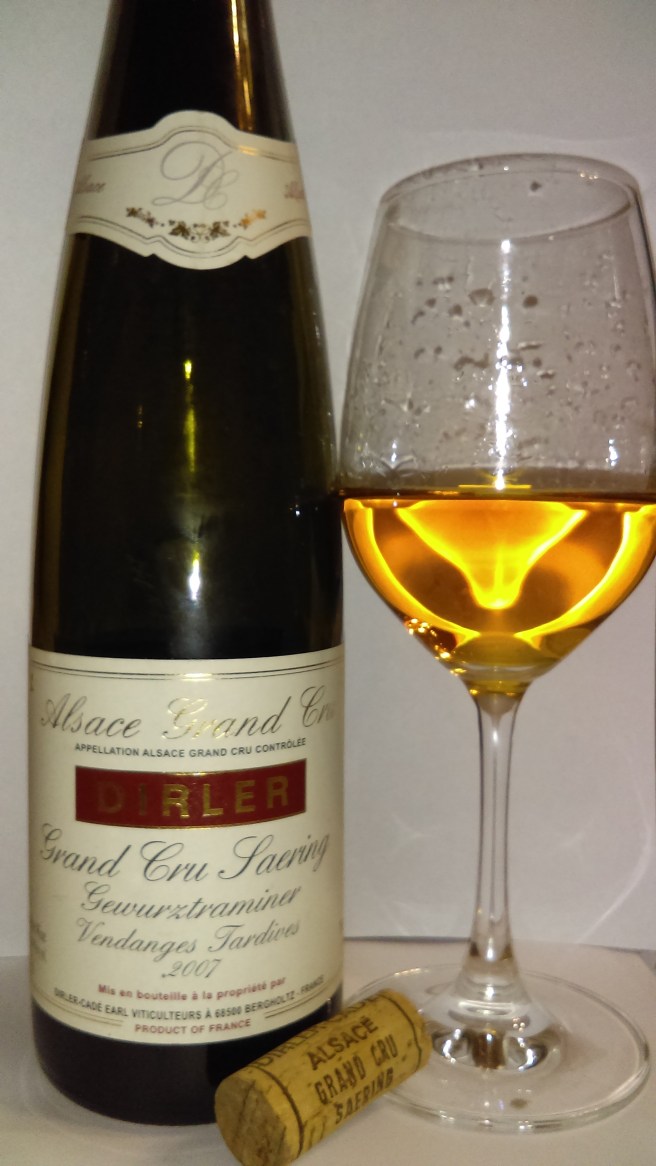
2007 Dirler Gewurtztraminer Saering vendages Tardives 14%

A late-picked wine from a Grand Cru Alsatian site.  It’s too easy to typecast Gewurtztraminer as a beginner’s wine, but it can interest more than neophytes, especially when  the wine is from Alsace.
IMAG0724
The cork was in immaculate condition, and the wine a bright clear medium  gold colour. The excitement begins- intoxicatingly floral- tropical fruits, ripe apricot, mandarine, ripe pear, musk-stick and cinnamon; the palate continues this interest- it’s extensive, with enough acidity to carry the 54 g/l of residual sugar. The wine is beginning to dry, and was likely to have been better a year or two ago (with cork vagaries, a bottle consumed a year ago was not as lively, showing some oxidation).

A faint touch of hardness probably reflects a combination of its age and alcohol level. Absolutely no complaints overall, as the bottle contents vanished rapidly.

Drink now, 91 points


Snippets, again

Maybe not thematic, but these fragments deserve a note; on the cork front, an unusual  run in the past six months yielded only 2 wines affected by taint or obvious oxidation–  a “meagre” 3.7%. Not many industries would accept this level of wastage. The degree of TCA in both wines was amazing- textbook examples.

  • 1993 Craiglee Chardonnay – replaced
  • 1996 Baileys Shiraz – no response from winery

And quick notes follow about wines that impressed

2015 Tolpuddle Chardonnay 12.5%
“Full malo” is a phrase that normally makes me run away, but served masked (of course) this Coal River valley (Tasmania) wine astonished. It’s a modern melon and smoke style- such as Oakridge or Seville Estate- cashewy oak, mineral-drenched fruit and the Tasmanian acidity powers through this utterly delicious wine.
From the Shaw and Smith stable, it’s around $60 a bottle retail – I ordered 3 bottles on the spot. Wonderful, and will hold for quite a while.

2015 Wynns Black Label Cabernet Sauvignon 13.5%
This is the 60th release of this label; a few years ago, I tasted the 1960, 1965, 1966 and 1972; there is no doubting the longevity of the style; its affordability makes it deservedly popular among wine-drinkers (not just unicorn-collectors). This release is ripe, beautifully manicured and balanced; blackcurrant and other dark fruits, chalks; it flows gently, deliciously and juicily along. Lovely, with a huge future. Coonawarra, and unforced.

2012 Giant Steps Applejack Pinot Noir 13.5%
This is a wine that nearly won the notorious Jimmy Watson trophy, but there was insufficient volume. At  5 years old, this  Yarra Valley wine has time on its side. Its amazingly fragrant, with small, succulent, sweet red berry scents, plus seasoned oak. The palate shows much more ripe strawberry, and again the oak is present, somehow making a savoury impact. But where this wine stands out is for its prodigious, long-lasting, ultra-refined finish. Another 5 years at least, and 95 points

2002 Seppelt St Peters Shiraz 14%
Wonderful wine. Cork was not the greatest visual composition, but no travel.
2002 was a cool year in Victoria, and this wine is special. My records indicate I paid $35; some key notes; the colour is deep black/red, and there is no browning even at the rim; the wine is beautifully poised with vibrant, intense fruit, oak very much a background factor. Its ripeness is spot-on; blackberry, mixed spices and mocha, some very faint herbal tannin bitterness, and just powers along. Easy, hedonistic drinking, and will remain so for another 15 years – or more. Instant gold medal score, and another example of Grampians Shiraz seduction.

1995 Guigal Hermitage
From a great year in the Northern Rhone; power+, ripe +, slinky old-vine mouthfeel. Dry herb, chalk, iron filings and spices, powdery tannins, touch of bitterness. At plateau and another 10 years will not tire it. Outstanding, 94 points


And a few rarities from a very special dinner

2002 Bollinger RD disgorged 24/6/2014
Served at a “just right” temperature in appropriate glassware (flutes are NOT proper stemware for Champagne, any kind of tulip-shaped glass is better). It’s a light straw colour; Immediate sense of class. There are scents of pastries, fruit tingles, strawberries dusted gently with icing sugar (the Pinot dominance roughly 60/40 is felt); a touch of oak/chalk/cream, a touch of almond. Then the palate lights up with exuberance, tiny bead, and the flavours just linger on, the wine seems bone dry (4 g/l is very dry even for a prestige champagne). This is just a wonder, so sensual and so compelling- finally it just powered along with more nuances with each refreshing sip. A wine that could accompany many foods, and was not elbowed aside by a truffled croquette. 96 points.

1990 Trimbach Clos st hune Riesling 14%
Approached with some trepidation as a bottle tried in 13/5/2013 unexpectedly threw me in to delivering a perfect score.

Was I delusional? Would another bottle disappoint?This wine from Alsace has a bright clear gold colour; but amazingly, almost pungently floral. Light honey, lemon peel, bottle age, flint ripeness. Palate, silky, fluffy, candied dried fruits, flint, stone, mineral. The magic combination of richness and freshness.

Another 20 years in sight. 98 points.  (Notes were similar)

1990 Jaboulet Hermitage la Chapelle 13.9%
Everyone’s favourite in a bracket of 3 Hermitages including 1990 JL Chave and 1990 Chapoutier Ermitage Le Pavilon, and so easy to love. Very dense colour, with trivial bricking; barnyard, earth, butterscotch, then the palate runs rampant with dark cherry, tar and more earth, some smoky, dried meaty aspects. Oak is entirely vanished, we’re left with a slinky vinous old-vine palate of fine, fine tannins. Memorable and contemplative – mature wines don’t really come better.
Drink to 2040, 98 points