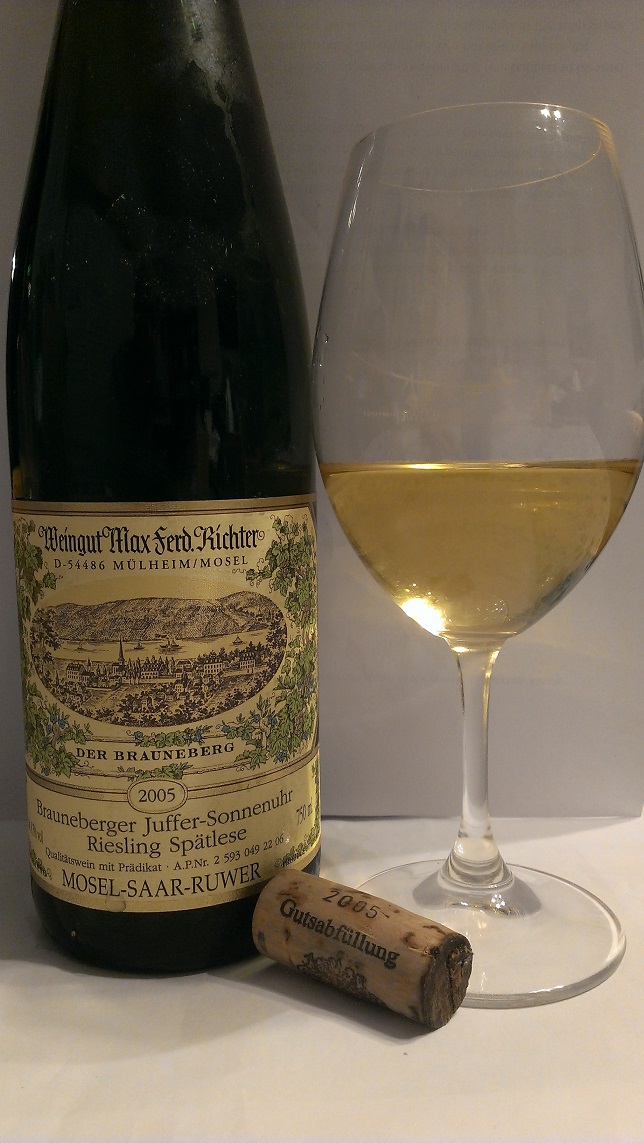
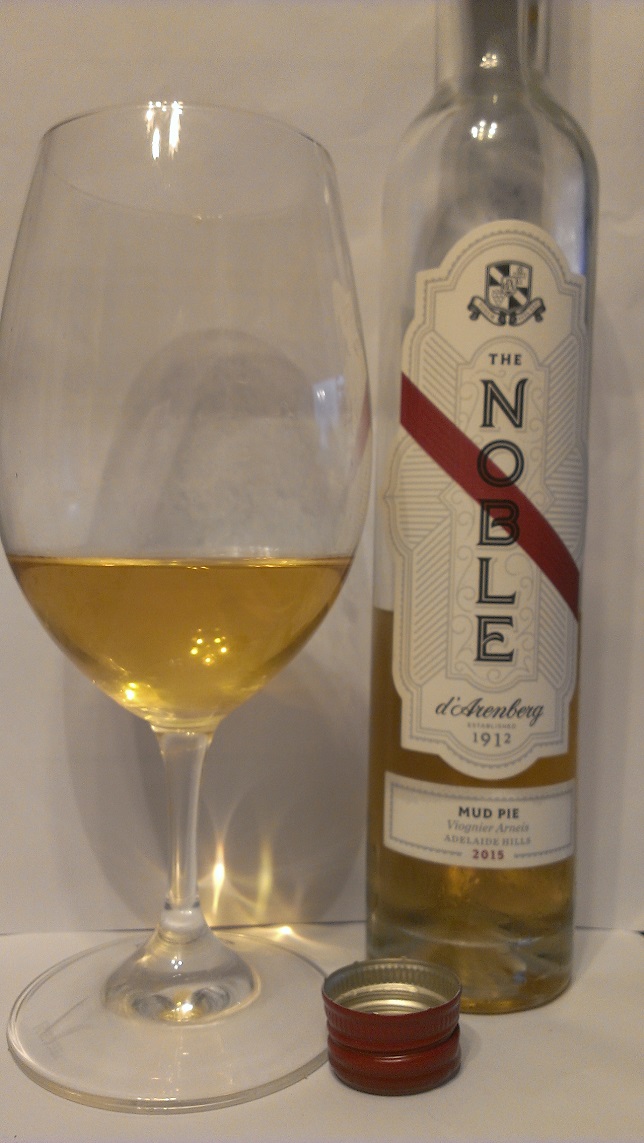
2015 D’arenberg Noble Mud pie 11.1%

95% Viognier, 5% Arneis; screwcap, 375ml RRP $20

People seem to tolerate my comments on wines that are not available- so here’s one at the start of its journey, for $20; less with careful shopping.

Viognier is a grape of Condrieu, where it makes distinctive, exotic dry white wines (and in more recent times, sweet wines too. More important is its contribution (in minor proportions)– with Shiraz- in Cote Rotie. In Australia, Yalumba has pioneered Viognier to make a dry white at varying price levels, from the humble but VGV “Y” series, through the Eden Valley range, then up to the Virgilius, (and sometimes a botrytis Viognier as well). Viognier is also used in some Cote Roties, with Clonakilla’s Shiraz Viognier generally regarded as Australia’s best.

Viognier may have vivid scents of ripe aprico -better examples show white peach- and the texture and mouthfeel make an enormous contribution to its appeal. Getting picking times correct seems critical to keep the wine brightly flavoured.

Arneis is an Italian grape variety- albeit one that I am not familiar with- but the textbook descriptors of pear, apricot and peach seem a good fit with Viognier. Arneis is another variety that is becoming hip throughout Australia, although vine age  and familiarity with appropriate growing and winemaking mean we hasten slowly.

The number of wines that D’arenberg produces from its base in South Australia’s McLaren Vale is dizzying; and the labels have their own distinctive quirks, and stories.

For the last few years, they have produced several “Noble” (botrytis-affected wines) – and this is one, from along the road in the Adelaide Hills. Using Viognier in a botrytis wine is unusual, and this blend is a one-off; how much the 5% Arneis contributes is problematic.

2015-darenberg-mud-pie

It’s a bright gold lemon colour, with aromatics of apricot, marmalade, cumquat, and dusty nutmeg botrytis spices. The palate is intensely sweet (my guess was 150 g/l of residual sugar, but a peek at the spec sheet indicated 185 g/l). Most Australian sweet wines are flabby, but thankfully here is ample acidity to maintain freshness. The palate is also complex, and very dense with some tropical fruits- candied pineapple, and some lime pie to bolster the yellow peach and ripe apricot.

I was quite impressed, with the wine demonstrating excellent value, and providing an interesting “alternative” drink that will work beautifully with desserts from fruit platters through citrus-oriented pies.

Somewhere however, the “x-factor” is missing. Drink to – conservatively- 2020, and 91 points, but the sugar/acid balance makes this wine a bracing and instructive treat.


Australian Wine Shows -random musings

The good

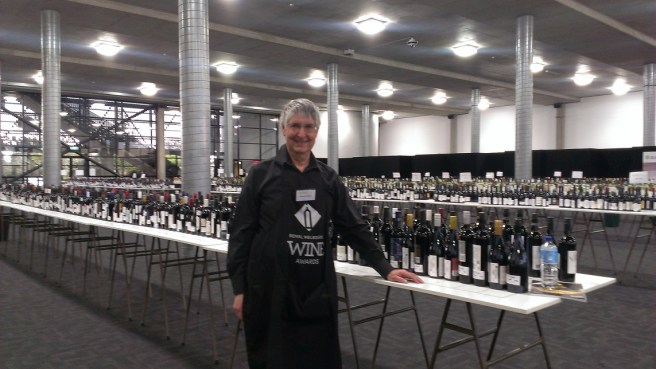
I have participated in a few wine shows as a humble steward. This involves – mainly- setting out glasses, pouring wines for the judges, and cleaning up, so there is no glamour.

But the hard work starts much earlier. Organisers/committees of the shows, amongst other matters, need to

  • Establish the classes (eg 2016 Riesling)
  • Solicit sponsors, entries, collect fees,
  • Arrange venue, glasses, select judges, associate judges and stewards
  • Receive and sort the wines
  • Collate and publish results
  • Arrange judges accommodation, meals etc
  • Arrange media, trade, exhibitor tastings etc.
trade-set-up-2

Improvements have been made over the years, including

  • Better glassware used (not the old XL5s)
  • Venues that have natural light and appropriate temperatures
  • Screwcaps – not just avoiding the overt TCA and oxidation, but many wines were slightly cork affected, making them muted
  • Reduction in the number of wines judged in one day to around 100
  • Better education of judges through threshold awareness and sensitivities
  • Greater courtesy shown to associate judges
  • Broader selection of judges (overseas, trade, media – not just winemakers)
  • Clustering of wines into regions- or varieties (so judging a class is not generally a pinballing of wine from region A, then region B, then region A etc,
  • Accommodating new varietals (eg Mediterranean and Iberian)
  • Wines from named vineyards/plots
  • Wines of provenance (same producer, same wine, different vintages; this needs a tweak so older vintages are not always the same ones!)
  • Len Evans Tutorial – which exposes winemakers and judges to world-class wines, old and new

The confusing

There seem to be many, many wine shows. In the past few months, there have been (with links to results attached)

Yarra Valley Wine Show, Halliday Chardonnay challenge, Ballarat, Rutherglen, Melbourne, Adelaide, Cool climate, Canberra regional, Geelong, McLaren Vale, HilltopsMt Barker, Clare Valley, TumbarumbaShiraz Challenge, Riesling Challenge, Sweet wine challenge, NSW wine awards, Australian Italian varieties, Limestone Coast. I have probably missed a few!

Some of these are “regional” shows, others are open, some are “focused”. No doubt each has their rationale, so we are unlikely to see any consolidations.

Keeping track of results is basically not possible, without much data entry, but here are some anomalies;

  • Use of 20 point vs 100 point judging scales. This can mean in some shows judges scores are “added” so the top score is theoretically 60 (and 57 is an outstanding result); or averaged, or agreed between judges – 100 is a theoretical top score– with 98 being an outstanding result.
  • Some shows provide scores for all wines; some provide scores for the medal-winners, and no scores for “the rest”
  • Some shows provide brief judges’ comments about some classes “excellent results for this year; medal winners show freshness, non-medal winners advanced, many over-extracted)
  • Some shows generally name the wines in a class, not just that its Winery X “wine A” and winery X “wine B”; or did not list vintages in a class of vintage fortifieds -unhelpful!
  • Some shows prohibit a judge scoring wines in a class where their own wines may appear in a line-up.

Room for improvement

But the underlying question is “why”?

Are wine shows for the benefit of consumers who lust after medals and trophies? Are wine shows for the benefit of wine-makers who gain an understanding of how their wines compare relative to their peers/competitors, and improving the calibre of wines overall? Are the results for the benefit of companies to claim general bragging rights? Are the shows to benefit the judges (and associates),  to learn views and network with the other judges, media and exhibitors? Or are the shows run as an adjunct- partly financial-  to bolster events at a regional festival or day?

As a committed fence-sitter, the Show system is an amalgam of these objectives (and probably more).

Judges are not entirely interchangeable; we all have different sensitivities- to such characters as rotundone and indole. Again, there are judges who are competent but have a lesser feel, liking or understanding of some classes. I have known winemakers reluctant to submit wines- some partly from philosophy, some for cost reasons, some who check the judging panel composition- as certain judges are deemed clueless on some varieties/styles.

Judging is demanding, hard work -concentrating, maybe spending a few minutes on each wine, describing highlights, lowlights etc. Its understandably easier to describe an excellent wine, that is gold-medal standard – or close; it’s harder to pin down why a wine that provides less excitement is worth a lesser score; wines that have a blatant fault – or more than one, are easily discarded- but still have to be scored, and described.

Confronting a class of say 40 different 2015 Merlots at 10am is not something that many judges would look forward to; or a class of rose or pinot gris; I have heard judges happily confess that that they had “room for improvement” in their understanding of sparkling wines, or fortified wines. There is thus scope for more “class specialists”. There is scope for an “opt-out” with judges able to swap panels.

Again, use of trade or media judges, especially on determination of top gold or trophies may provide some stylistic guidance, after the technical soundness, typificity and quality has been demonstrated. In most cases, they will support the panel chair’s view; but they may be called (as may the chair of judges) to resolve issues where panels are strongly divided.

Apologies that this post is just an airing of quick thoughts- perhaps there is illumination of selected issues.


2003 Pondalowie Vintage Port 19.5%

50/50 Tinta Roriz (Tempranillo) and Shiraz; 500ml bottle “fortified with selected grape spirit”, and only two barrels made- cork stained about 1/3 through.

Domenic and Krystina Morris have ample experience in Australia , and overseas, with workplace Quinta do Crasto in Portugal being perhaps an inspiration for their only fortified – so far. The Bendigo-based  Pondalowie wines are fruit-driven with oak as a complement; the reserve wines are vintage and variety-dependent. Prices are very fair.

2003-pondalowie-vpFrom a hot, low-yielding drought year in Victoria, the colour of this wine is a dense black red, with minor bricking;  Fruit-powered, with aromatics of  exuberant dark liqueur Morello cherry and some red liquorice; the palate mirrors this with some plum too, and fine, lingering chalky tannins; spirit is a bit hot to start but resolving.
Lovely drinking to 2023 and 91 points, but certainly requires a decant to remove the sediment.


Blogs, sites, resources (part 2)

Frank Zappa’s quote on rock journalism has long resonated “People who can’t write, doing interviews with people who can’t think, in order to prepare articles for people who can’t read”.

There must be something similar about wine writing; perhaps like Samuel Johnson.  “Sir, a woman’s preaching is like a dog’s walking on his hind legs. It is not done well; but you are surprised to find it done at all”. Now, If only wine writers could talk; alas, some of them do, sometimes forcing us to listen.

And once more, an excerpt from Steve Slatcher from a World of Fine wine article, with the key quote being “One result was that while the experts’ ratings correlated with price, the non-experts (customers lacking a wine education) actually preferred cheaper wines. It is a difficult sell to get those customers to invest time and money in learning about wine so they can then spend even more money on expensive wines they never used to like”.

Yet this is exactly what wine writers aim at – convincing readers to follow their own tastes and prejudices.

Here is a list of some selected – free- international sites, again for people with much spare time.

Regular posters

  • Winenous – Steve Slatcher in flight, a thinker, a  researcher,
  • Andrew Jefford on Monday (Decanter magazine). Writes with heart; tasting notes that have a admirable touch of melancholy
  • Wine anorak – Jamie Goode’s wine-ranging blog- reviews, news, welcome and refreshing material
  • Wine Detective – Sarah Ahmed’s “outside” views; the affection shines through, and some courage too.
  • Hosemaster – Ron Washam – satirical, with a US focus- not every post is not a winner, but crikey what fun when it is. (Eg Bob Dylans Nobel win)

Reference sites – general

  • CellarTracker -a wonderful resource with community reviews (but you should find “sympathetic and knowledgeable” reviewers – such as Cam Wheeler) . Payment is encouraged, and allows you to upload your wine details.
  • Wine-searcher; where can I get it- and how much? The pro version captures more retail sites; subscribing may thus save you money when buying wine!

Reference sites – specific

Most regions, and many companies, and wine retailers have their own sites; Google away, but the two sites below are among my regulars

Mosel Fine wines – by Jean Fisch and David Rayer-  I am astonished at the depth, and number of reviews; their, charm, scores,enthusiasms and knowledge have led me to many purchases, and guided appointments made in the Mosel.

Bureau du Champagne – Not wonderfully up-to-date, and ultra-protective of Champagne, but there is a vast amount of history, geography and “feel” here, if you have the patience to trawl through the links


Blogs, sites, resources (part 1)

Here’s a list of some sites and blogs that may interest  folks with more spare time than me;  I have concentrated on free sites; my list is far from complete but will gradually improve.

Australian reviews and so on

  • Chris Shanahan – Canberra-oriented, beers too. No scores, but the descriptions provide enough cues.
  • Australian wine review – Andrew Graham’s very active site, refreshingly honest with his views and scores; he’s fortunate enough to get to many vertical tatsings and other opportunities
  • Drinkster; Philip White’s site – imagine Hunter S Thompson in stream of consciousness mode about wine; I can get pleasurably lost in the full-throttle imagery
  • Grape Observer – despite Sean Mitchell’s WSET diploma, the language in the reviews is cogent and usefully abetted with the right amount of background history, theory and analysis
  • Brisbane Book Club – sporadic, but worth the odd peek; scores usually realistic, avoiding the hyper-inflation of some other places.
  • Wine reviewer – Patrick Eckel reviews many interesting wines in unexpected and useful detail; and some more extended musings are worth the detour.
  • Simple palates seriously – Terence Pang’s writing is easy to read, but there is a real sense of person and perspective here.

 NZ reviews and so on

  • NZ Wine of the week – Sue Courtney’s site, relentlessly positve, but also has excellent indixing of tasting notes, information about NZ wine areas, wine show results etc.
  • Otago daily news– Mark Henderson’s weekly wine page, provocative insights, not just reviews
  • Geoff Kelley – quite technical, but some terrific tastings here, many international benchmarking studies, amazing wines
  • Raymond Chan wine reviews – very active, good reference site for NZ – and beyond – scores are on the enthusiastic side

Australian reference sites

  • Winebiz daily wine news – a roundup of links to news snippets, PR pieces; some international (mainly NZ) too
  • Sommeliers Australia – events, education, industry jobs
  • Australian Wine Research Institute (AWRI); more of a site for winemakers, but there is lots of information tucked into the tabs
  • Langtons – it began life as an auction site, but the “price guide” area (under the resources tab) provides estimates of what the market (rightly or wrongly) believes is a fair price for thousands of different wines

 Community forums

  • Auswine is very active, with a healthy South Australian focus, and very varied contributors – a good source for “off-line” events.
  •  Australian Frequent Flyers wine lovers– enrol to reduce maddening ads; this is a great place for bargain hunters to pick up discount codes, identities of mystery wines, and some wines to avoid!

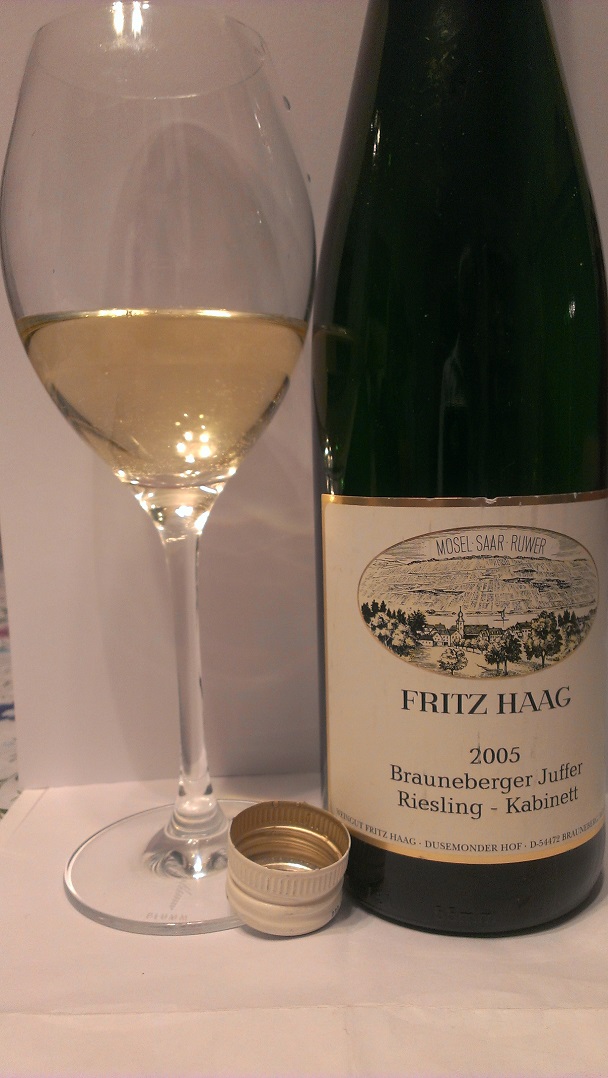
2005 Fritz Haag Brauneberger Juffer Riesling Kabinett 8.5%

Another white wine under screwcap, and age has not harmed this lovely and utterly convincing Riesling Kabinett from a sterling year in the Mosel.

2005-fritz-haag-bj-kabinett

It’s still a pale lemon colour, and there is ripe apple, some tropical guava, and some “fruit tingle” too. The palate is appropriately light for this category of sweetness, and resounds with crunchy, stony limey citrus character (“mineral” is out-of-favour, despite this word being clearcut and descriptive). Delicious, bright, tangy, with terrific length and everything under control. A benchmark from this well-known estate.

Drink to 2025, 91 points

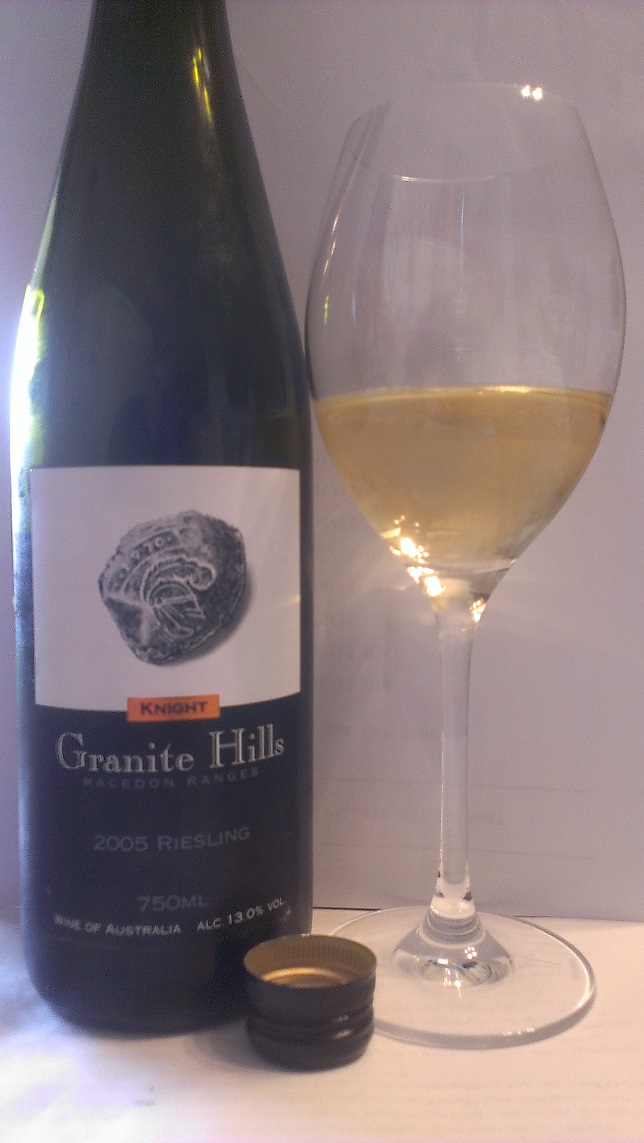
2005 Granite Hills Riesling 13%

Granite Hills produces quality Rieslings from the Macedon ranges area of Victoria, where Chardonnay, Pinot Noir and sparkling wines are much more prevalent.

Llew Knight has been making Riesling (and other varieties) for many years, and the Riesling is a often a standout- I have fond memories of the trophy-winning 1998, and the still available 2014 is excellent. Its one of the very consistent, commendable age-worthy, minerallly Victorian Rieslings, pitched at a lesser tariff than Crawford River or Seppelt Drumborg.

The drive towards Baynton features spectacular granite outcrops littering the hills, amidst dense bushland.

This wine I suspect is not completely dry, but is near-enough, with still powerful fruit.

Update! – winemaker Llew Knight has assured me the wine is completely dry, so it’s just fruit that conveys the impression of slight sweetness.

Under screwcap, time has infused the varietal expression with some faint but attractive toastiness.

2005-granite-hills-riesling

It’s a bright pale lemon colour, and strides out with abundant lemon zest, ripe red apple and a hint of lanolin. Talc, lemon, flint, viscosity and bright, lively refreshing natural acidity are the keynotes of the palate. This is a confident, complex expressive wine drinking wonderfully well. It has huge appeal and will match to a huge variety of food – Asian, poultry, seafood, creamy dishes.

Drink to 2026, and 94 points.

Films about wine, winemaking, wine drinking and wine marketing (possibly)

There are a surprising number of films made about the unwelcome effects of drinking -the Lost Weekend, and Withnail and I come to mind; and more where wine takes centre-stage- Sideways is well known, as are Mondovino, Somm, Red obsession and A good year.

I’ve ransacked my archives to provide a partial list of wine-relevant films, none of which curiously are available through the AWRI or Wine Australia, so there is a deep educational gap within the wine community..

  • The acid test
  • All creatures great and small
  • The birds
  • The colour purple
  • Do the right thing
  • Fires on the plain
  • Gone with the wind
  • The grapes of wrath
  • The greatest show on earth
  • Hail the conquering hero
  • How green was my valley
  • It’s been a hard days night
  • I walked with zombie
  • Lord of the flies
  • The miracle worker
  • Never give a sucker an even break
  • Red harvest
  • Red river
  • The ten commandments
  • The 39 Steps
  • The magnificent seven
  • True grit
  • The wild bunch
  • The wizard of Oz

These will repay close study.

NV Baileys of Glenrowan Founders classic topaque 17%

Baileys is a winery we detour to when travelling along the Hume Highway from Melbourne. Just out of Glenrowan, the visits I recall have largely been during summer heatwaves where the eucalyptus oil is heady in the air, or during winters when rain is lashing along. In both situations, the winery is a welcome relief.

For sentimental reasons (written about earlier) I have a longstanding affection for the luscious fortifieds and traditionally-styled bold  ferrous reds of Baileys. Harry Tinson’s legacy is respected by talented winemaker and custodian Paul Dahlenberg. So I should like the wine.

nv-baileys-topaque

Topaque is the revised name for the Australian fortified Tokay. Unusually for this young, fortified muscadelle style, the wine is sold in normally sized 750ml bottle (rather than the more common 375ml or 500ml). Its an amber colour, with a khaki rim; malt and digestif biscuit dominate the aromatics, with a touch of sea, seaweed and iodine adding to the intrigue. It is rich and inviting. But that’s where the highlight reel tails away; the palate displays ample but simpler butterscotch characters. While there is no doubting its sweetness, it’s a bit of a letdown after that bouquet, and overall something is missing. There is some rancio from wood aging; there is ample acidity to cut through the sweetness; I’ve struggled here and ultimately concluded that the bottle is a bit stale (a batch or storage issue); as the result does not match other tastings of this wine over the past two months.

It still represents excellent VFM, and many will appreciate this wine more than I did.

Drink now, but this bottle only merits 85 points

2008 François Chidaine Montlouis-sur-Loire Clos Habert 13%

From a small appellation opposite Vouvray, this is Chenin Blanc, but not what we are familiar with in Australia. Chris Kissack’s site is a tremendous resource.

Here, Chenin blanc is typically grown in warmer regions; and contributes fairly anonymously in blends where its acidity helps. There are some exceptions (Coriole, Peel Estate, and from New Zealand, Millton) but it’s a slender set of resources. Chenin blanc formerly was a mainstay of Houghton’s White Burgundy (which blossomed with a few years age), and I recall a truly striking 1981 St Leonards botrytis version.

Chidaine has a huge reputation, and I purchased this wine for a bargain price (under $40) a few years ago.

2008-chidaine

This wine is an exceptional experience; lemon to light gold in colour, it presents an exciting, exotic set of aromas and flavours. Quince, pineapple rind, ripe red apple, lime juice, yellow pear and freshly cut grass are all present,  It’s meshed with perhaps 20 g/l residual sugar which is swallowed by the balanced, refreshing acidity. Lastly, that set of flavours hangs around with a honeyed, thick, textured mouthfeel.

A fabulous match with varied cuisine (many Asian dishes,  fish, white meats) this VFM wine will kick goals for many more years.

Drink to 2030, 95 points