2000 Louis Sipp “couer de trie” Selection de grains nobles Pinot Gris SGN 12%

From auction, this is a 500ml bottle from Alsace – keen researchers may find some notes I made on Starforum back in 2008 “somehow carrying the pineapple, cinnamon, some light butterscotch, baked apple pie with just enough acidity – a nice wine with huge sweetness”.

Pinot gris and residual sugar is a wonderful match.
2000 louis sipp pg sgn
The cork has mercifully behaved, and at 16 years, the wine is now a deep amber colour with copper tints (no drama in a botrytis wine). It’s floral, mostly with ripe apricot, apricot jam and cinnamon spices. This is maintained on the palate, with touches of marmalade, citrus peel, and some baked apple. It’s sensual and voluptuous, the acidity continues to provide support.

While the wine may even have provided greater pleasure a few years ago, it still provides unctuous and luscious drinking- but please consume and enjoy soon.

90 points, drink to 2018.

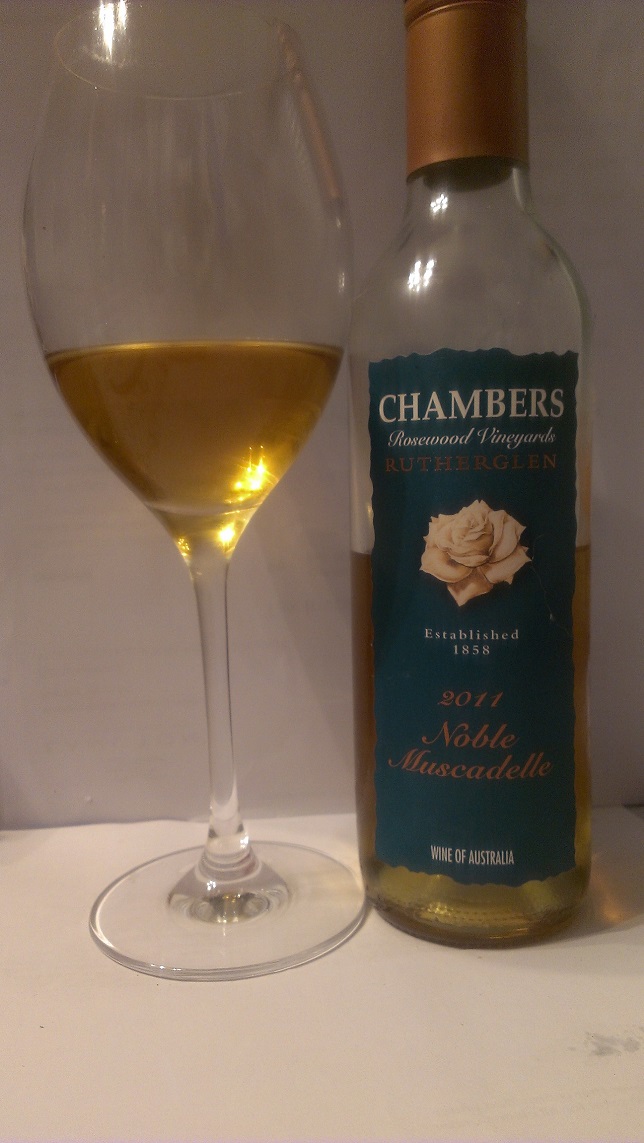
2011 Chamber’s (rosewood) Noble muscadelle, screwcap 11.3%

Chambers of Rutherglen is not the first winery that springs to mind for its sweet white wines; fortifieds yes; VFM red wines, and obscurities (anyone for Gouais) perhaps? Australia has made botrytis-affected wines from many varieties, principally Riesling and Semillon, but there have been some adventures in Sauvignon Blanc, Chenin Blanc, Chardonnay, Viognier and even Marsanne. Some of these were made deliberately, others where circumstances forced the winemaking decisions.

2011 was a pretty dire year for winemaking in Victoria, and much of Australia (although Margaret River fared well, and McLaren Vale reasonably well). There was unseasonal rain, making spraying difficult- tractors got bogged- and plenty of rot. Most red wines from Victoria lacked colour, and density. Matters were not so bleak with white wines, and there are some scintillating Chardonnays made that year in the Yarra Valley.

There have been a few late-picked or botrytised muscadelles from Rutherglen (Pfeiffer’s is known), so its not unique. Muscadelle is the variety used in making Australia’s sensational barrel-aged fortified Topaques (formerly Tokay). The late-picked style is cash-flow friendly too.

From my unreliable memory, Chambers has made this botrytis style before in 1996 and 2000, and perhaps in other years, so they have a track record, although those seasons were much kinder. I paid $15 for this half-bottle a few years ago.

2011 chambers

Its an attractive glowing deep gold colour with a hint of amber. While the bouquet is vibrant ramshackle orange marmalade, tangelo and dark honey, botrytis has performed its magic fruit concentration role on the palate, and its clearer that that flavours fall into the “dark” orange marmalade, and marginally overripe apricot fruit spectrum. The botrytis has overwhelmed any varietal characters – no bad thing. There is some bitterness too, but not enough to dissipate the wine’s pleasures.

There is considerable sweetness, and while the acid is holding this together, I would recommend drinking soon, before the phenolics take over. No embarrassment to drink; the glass seems to empty of its own volition.

Score 89 points, drink to 2019.

Stoney Goose Ridge new release – Lawyers’ Picnic

CEO Hector Lannible stated “we salute the true pioneers and creators, those happy few who have given so much to so many. Lawyers. Our company depends on their endeavours, whether prosecuting those with the temerity to use our trademarks, the inevitable disputes on our numerous cunning contracts, taking on those who defile us in social media, detailing our innovative cutting-edge employment contracts, and establishing and amplifying the complex structures underpinning our taxation minimisation strategies. They fight in numerous jurisdictions at many levels, appealing at the slightest pretext”.

“Their detractors just set up a smokescreen of red herrings – a storm in a teacup, literally. But the circus having writ, moves on”.

“We celebrate the true defenders of our financial institutions against the greed of widows, orphans, and the terminally ill. We applaud their unpopular but critical roles in protecting the rights of pharmaceutical, tobacco, gaming, utility, mining and oil companies, property developers and the multinationals to avoid tax through entirely legitimate use of labyrinthine multiple off-shore entities. And their tireless protection of the rights of individuals, their family trusts, negative gearing and so on. I commend their tireless undertakings to liquidate companies with the painstaking assistance of forensic accountants, and their ability to create phoenix companies for a meagre pittance. Their technical prowess enables our success. Lawyers – long may their baffling efforts continue”.

And it’s a new, bold start – we proudly continue our tradition of a curated back label for our latest creation.”

Lawyers’ Picnic is a limited release wine with a RRP of $19.95.

The informative back label follows

Lawyers’ Picnic- A blend of red grape varieties from premium Australian areas. 13.9% A/v

Mea culpa, mens rea corpus delecti, cogito ergo sum ad hoc pro bono.

Inter alia, force majeure ad nauseum.

Bona fide caveat emptor, compos mentis de facto ex cathedra in flagrante delicto, persona non grata lingua franca; locus dictum prima facie quasi obiter nisi quantum status quo habeas.

Sub judice sui generis de novo ultra vires.

1992 Gehrig Vintage port 18.1%

Deep ruby colour; shiraz, plus brandy spirit from one of the Rutherglen eastern “outliers”;  rustic label, but from a wondrous year in the region. Red liquorice, mingled Christmas cake spices, milk chocolate, bursting with vitality, and fine, chalky tannins.

1992 gehrig vpA careful decant was necessary to remove some  of the heavy deposit, and its a slightly old-fashioned style, where the spirit is a bit prominent and the sweetness is slightly overdone. But we’re not all clairvoyant, and this 24 year old wine provided an overload of drinking pleasures, and another 10 years will not diminish its enjoyments.

Drink to 2025, 91 points

Alsace, again

alsace may 20162001 Domaines Schlumberger Pinot Gris Vendanges Tardive 12.5%

This wine has seen better days. The colour is a dark gold, but legitimate for its variety and age. It displays red apple and brown pear aromatics, plus some hints of bruised apple oxidation.

Its quite sweet (around 100g/l), but there is enough acidity to avoid any cloying; the pear flavours flow on a viscous palate, and the message is – drink up. Ready, and enjoyable but it had the misfortune to be paired with the following wine.

87 points, drink to 2018

2007 Dirler Spiegel Gewurztraminer SGN 12%

I was terrified to open this- from the last 2 wines from this Alsace estate, one was badly oxidised, the other corked – and no response from the producer despite 2 emails. But this wine was pristine.

Light gold in colour, its resoundingly fresh, with aromas of ripe red baked apple, musk, talc, cinnamon.  The balanced palate shows more rose petal, apricot and white peach, some honey and citrus, and is richly textured, fine, clean, and there is no cloying despite the 150-odd g/l of residual sugar.

It’s an outstanding wine, combining varietal character with botrytis richness.

96 points, drink to 2023

Way back when it all began (part 1)

Here’s another ramble along memory lane, about the start of my wine journey

My parents drank wine of course, but until my early twenties, my appreciation was negligible.

Then I started on my search for knowledge, hampered by my impoverished student lifestyle, lack of well-heeled patrons or relatives and unfortunately, zero access to “trade” prices.

In the early 1980’s there were 2 dedicated Australian magazines; Wine and Spirit buying guide, and Winestate. Copies were well circulated. I was on the lookout for affordable wines of quality – now I am more interested in avoiding some wines; reading the scores but the comments have always been more useful.

There were also some wine columns in newspapers – the Age had regular columns by Mark Shield – a writer with a healthy touch of larrikin- while the Weekend Australian had columns by Len Evans, and James Halliday. There were often some “aspirational” wines, and I was often envious of the vertical, or retrospective tastings, and amazing dinners.

The handy annual one-stop buying reference was Robin Bradley’s Benson and Hedges Gold book. Plus there were dusty old books on Australian wine.

Regular, usually Saturday morning tastings, provided enormous education, sometimes with winemakers on-hand and often cut-throat purchase prices. My main haunts (although there were others) included

  • Nicks (Doncaster) and later in Swanston street
  • High Y cellars (Ashburton)
  • Dan Murphy (Prahran, and later Alphington, and later again Ascot Vale)
  • Boccaccio cellars (Kensington)
  • Richmond Hill cellars
  • Sutherland cellars (in Banana alley, an early advocate of WA wines)
  • Templestowe Cellars

An annual treat was tasting the Penfolds range, and  I usually settled on purchase of a few bottles of Kalimna and the 389. Grange was sometimes available for tasting, but beyond my finances.

There were some “big” tastings – a selection included

  • Expovin at the fantastic Exhibition buildings
  • Exhibition of Victorian Winemakers at assorted venues
  • Winery Walkabout at Rutherglen (plus the “ride the Rutherglen red” train)

Many of these are just fragmentary memories now; some events continue, with a swag of regional celebrations. The proliferation of  winery cellar doors has possibly diminished the appeal of these large public events, although numerous regional  celebrations exist.

I remember live wine auctions at Fowles in Port Melbourne, and MW in Brunswick. Auctions are online now of course.

That’s a start, and there will be further instalments, that may reawaken readers’ reminiscences!

2010 Buller “Beverford gold” botrytis Semillon (10%), 375 ml, screwcap

Its a clear bright advanced gold colour. Curiously the back label matched my description pretty well. Stewed apricot, pear juice, botrytis dust and cinnamon. This smart wine is drinking very well, with enormous (almost ridiculously decadent) residual sugar in balance with its cleansing acidity. Some emergent hardness and brassiness suggest consumption over the next few years, but a lovely treat for those who have some bottles of this wine – very fairly priced when it was released.

Drink to 2018, 91 points

2010 buller botrytis seillon


Guilty pleasures and objectivity in tastings

There are wines that have more interest than their score indicates. These will be wines with a story.

The story could be

  • Some personal relationship with the winemaker, or winery
  • A purchase from a special place, or time, or price, including wines from overseas that went into the luggage
  • Some rarity from mailing lists,  or a peculiar bargain, perhaps trying some barrels at a winery, or something from “under the counter”
  • Some revisiting of an earlier experience

My guilty pleasures include

Baileys of Glenrowan. We always seemed to visit when it was searingly hot, so we’d welcome a break from the non-air-conditioned car, and the old tasting room was refreshingly cool. Alternately, the days would be wintry, and the log fire inside was very inviting.

Later I remember tasting the Founder Liqueur wines, and the “HJT” fortifieds and heroic red wines – wines that had the ferrous “iron filings” profile. The 1992 Shiraz wines are still going strong, with the ripe blackberry fruit winning the battle with the typically deep tannins – something that could not always be relied on. 1975 was another year with this fruit power

Petaluma Riesling. The 1980 Petaluma Riesling was a wine where I have consumed far more than my fair share. This was because a nearby wine shop (long closed) had the wine for sale for around $10 per bottle. My partner and I would drink a bottle, marvel at it, then return at some stage to buy a further bottle or two for drinking. Our usual “budget” drinking white wine at the time was the Wynns “high Eden” Riesling.

Leo Buring. At an early Expovin in Melbourne’s Exhibition buildings, John Vickery politely asked if I wanted to try some Rieslings. I jumped at this opportunity and recall trying some wines from early 1970’s including some  ”show” wines.

Brown Brothers. Again at Expovin, I think Huon Hooke showed a range of perhaps 6 different Noble Rieslings. A fantastic insight into cellaring capabilities and vintage variation, and a tremendous exercise in brand building by Brown Brothers.

Chambers (Rutherglen). Another winery we visited when I was young, with the red wines often stored in an old fridge, with the instruction from Bill Chambers to “help yourselves”. Again I can only remember visiting on stinking hot days. It turned out that my father had worked as a labourer at the winery in the 1940’s as a recent migrant with rudimentary English.

And of course there were the visits to the original Dan Murphy cellars in Prahran (its now a JB Hi-fi store).

There are also  wines where we have a negative perception; the cellar doors that treated people rudely, served derisory samples, or only showed their basic wines, or where their prices heavily exceeded retail.  And those that had dire levels of TCA and made refunds difficult – or impossible. Or the wines that have had rave reviews and been disappointing, where the hype exceeded the experience.

These all colour our attempts at objectivity.

The impact is that the nostalgia confounds “objective” scoring to a considerable degree.  I carry around some affections for these wines named above, and other wines  – from the places where I have picked grapes, cleaned (lots and lots of cleaning) , filled barrels, foot-trod grapes, and so on. And then consider that I selected these places based on something, and they put up with my efforts.

For those other scribblers that are awash with samples, and assess them in a masked format – there is a further challenge to demonstrate objectivity in what is chosen for weekly, or irregular articles. It cannot be achieved- we are creatures surrounded by our history and habits, that influence what we taste, what we buy, and what we write.
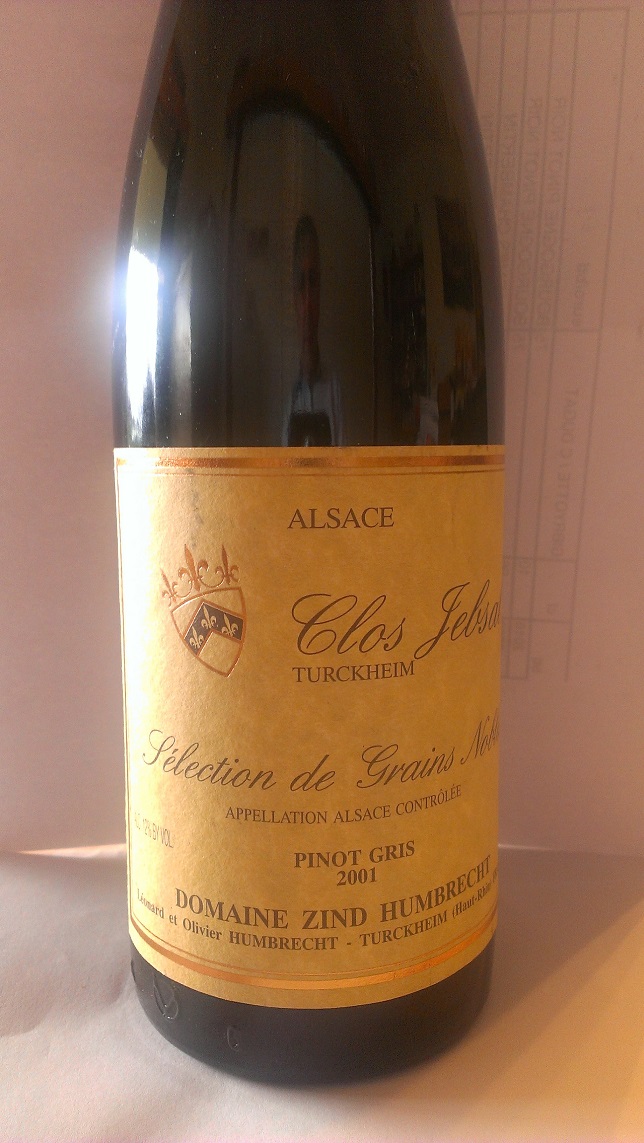
1985 Taylor’s Vintage Port 20.5%

1985 was widely declared, but generally regarded as an “average” VP year, rather than one of the greats. After the expected heavy sediment was decanted (and with just over 2 hours breathing), the wine was clear and its colour still more ruby than garnet, presenting as much younger than its true age.

1985 taylors vp

Aromatically, pronounced rose petal and pomegranate co-existed, with some sweet spices and light mocha – a highly encouraging set of characters. The spirit had integrated beautifully with the fruit after its extended bottle maturation; the alcohol did not intrude and the texture was supple and lip-smacking. The mocha was more apparent on the long palate, but this balanced wine is on an extended and delicious drinking plateau.

Drink to 2030; 94 points.

One from Pfalz, and a Ch Filhot retaste

2005 Bassermann-Jordan Forster Jesuitengarten Riesling Spatlese 9%

A wonderful year in Germany, this wine provides extravagant drinking pleasure, even though its from the less-regarded Pfalz area. It still retains a bright lemon colour, and ripples with energy. Lemon zest, apple and flint thrill, with some brown pear and semi-tropical fruit added on the palate. Plenty of time ahead.

2005 basserman spatlese

93 points, and delicious drinking now until 2025

2005 Ch Filhot 14%

I tried this a few months ago, giving it 92 points and a drinking window to 2025.

The wine tasted last week was still a bright amber colour with lemon citrus, nectarine, vanilla bean and quince battling joyously. It is amazingly lush without betraying its origin, and clearly came from a very ripe year. This time – and this bottle- I was wishing for a touch more acidity  as the overwhelming sweetness edged towards, but avoided cloying. No regrets, as this is an authentic Sauternes style, but not scaling the heights of the previous tasting.

Drink to 2020, 90 points.