2008 R Haart Goldtropchen Kabinett Riesling 8.5%

An excellent wine from well-regarded winemaker, from a terrific site in the nondescript Piesport village of the Mosel.

Still lemon in colour, its from a year that has always been “user-friendly”, skipping the usual Riesling dull patch that often settles after a few years and last a few more.

2008 haart kab

Red apple and pear, tropical fruits approaching ripe pineapple, and there are more stonefruit characters on the very long palate, and intriguing marzipan notes. Its quite sweet for a Kabinett, but has the acidity to keep it balanced. So delicate, so fresh and so interesting. The contents of the glass magically disappear.

Why wait when it drinks so deliciously?

Drink to 2021, 91 points.

April fools’ day – Australia’s most expensive wine now available

Australia’s most expensive wine released today- April 1 2016 –  $1288.88

Brendan Miller-gorge interviews winemaker Ivan Messerine and Wine Ecstasy’s Chief Marketing Manager Shane Burn-Harris, and discuss the just-released 2014 Ecstasy 1®.

What does the wine taste like, and when will it be drinking at its peak?

Shane- I best defer to Ivan on this for his technical expertise, but I was blown away. I’ve tried the best in the world; this is in its own league.

Ivan – That is a tough question; it would be like trying to explain ballet to someone blind and deaf. Perhaps I can start by saying it’s like no other wine; it has a startling purity; the bouquet is overwhelming, the palate exquisite. It will become one of your most treasured memories.

While Ecstasy 1® can be savoured with extreme pleasure now, that same sensory experience – magnified-  will be available throughout the next fifty years.

What is the variety or blend?

Shane- naturally that is commercial in confidence, but the truly unique blend includes Shiraz, Gruner Veltliner and Arneis, plus more. Ivan spent hundreds of hours testing, tweaking – amazing. It truly shows his talent for sourcing special grapes, his mastery of blending, and his intuitive use of the latest technologies.

Can we discuss the price?

Shane- Well for a wine of this calibre, and our target audience, it’s extraordinary value. The consumers will have a magnificent experience, there are so many wonderful stories behind the wine, the people, the places.

The cost is much more than say Henschke’s Hill of Grace, or Penfolds Grange – what justifies that?

Ivan – it is a real zeitgeist; the wine parcels were suffused with love – the musical influences included David Bowie, Glen Frey, Allen Toussaint. Our standards are Olympian. Many winemakers literally begged for what we rejected.

Shane – Ecstasy 1® is magnificently packaged, the labelling is an artwork in itself, the bottle shape is so elegant too; each bottle is individually numbered, and there are several anti-fraud initiatives involved, microchips, barcode, and a few that must remain secret. Comparisons with other Australian wines are odious; we are proud to represent Australia against our very few peers overseas. There are larger format bottles too, magnums, imperials, and, we have smaller, sample packages available.

What do the wine critics think?

Shane -We refuse to submit to the tyranny of the traditional ill-informed scribblers. Nevertheless, we submitted our wine anonymously at a prestigious international wine competition, where it won its class.

Ivan, where have you worked in the Australian wine industry?

Ivan – it’s not where you work or how much experience you have, it’s your talent, ambition and opportunities. I’ve made wine in Oodnadatta and Orange, the Barossa, Bendigo and Beenleigh. This spectacular wine is blended from parcels from every Australian State.

Didn’t that happen with the Centenary of Australian Federation wine?

Shane- that was just a gimmick. Australian defamation laws prevent me from telling the whole story. Our wine is entirely different. Ecstasy 1® has the mystic synergy of very particular regional specialties.

It’s an unusual name for a wine? How did the name Ecstasy 1® eventuate?

Shane- we are so proud of the name. It came through extensive, thorough market trialling and numerous customer focus groups, all supported by our legal support partners. It was a labour of true love, reflecting our care and concern for our brand, and our customers. The aura and image of Ecstasy 1® is self-evident. The same degree of concern is also reflected in the label, which went through numerous creative design iterations with the collaboration of cutting-edge packaging supply consultants.

And the final result- Ecstasy 1® is something the entire creative team will remain proud of throughout their careers.

Will you be able to sell all the wine? How much was made?

Shane – we have pre-orders from a number of prominent business identities in several countries including Russia, China and the Americas, plus well known celebrities in show business-  I must protect their privacy and not even hint at who they are. A very limited quantity of the wine was made, barely enough for a modest return on the firm’s lengthy investment, and hopefully enough to provide the opportunity for many people to try the wine.

I mentioned the samples – we haven’t determined the final price yet, but likely to be in the range of $88 to $100 depending on quantity, so very affordable. Each package comes with a certificate of authenticity, product disclaimer, DVD and PIN, download instructions, plus Youtube explanations.

How big are the samples?

Ivan – 5 ml each. This allows the best opportunity for as many people as possible to try our creation, and then I’m sure they will want more.

Shane- Purchasers of the samples will jump the queue and have a guaranteed opportunity to purchase an allocation of 1 bottle at our standard price, provided the sample is consumed within 1 month of purchase. They make an amazing gift. The ampoule is ISO certified.

Where can people purchase the wine?

Shane – we do not need the unnecessary supply chain distribution channel overhead of wholesalers, distributors and retailers. We are driven to keep the pricing affordable. We are negotiating with several exclusive luxury high-end retail boutiques which have the ability to showcase Ecstasy 1® in an appropriate environment. And naturally, our friendly and informative website, so our customers can have a very personal, individual relationship and customise their freight, insurance and gift options.

Ecstasy 1® will not be available through the usual, boring and superseded wine retail channels.

Your company isn’t well known – what can you tell us about its history?

Shane – it’s a private company, with some surprisingly well known people in the syndicate; we’ve been working in the background for years and this wine provided us with the opportunity to make a worldwide splash. It’s the culmination of our dreams ….well so far.

Are there other wines “in the pipeline”?

Ivan – we’d love to do it again, but it naturally depends on availability of very special grapes, and the presence of very special magic. We have been running continuous trials, but so far, my assistants and I have not yet found the appropriate conditions. But, we are confident that we will be able to equal, or surpass what we affectionately call “Blend 1”.

Shane –We need greater volumes, so our product can reach the large audience it deserves. In my years working for HIH, Enron, Qintex, Ansett, One.tel, Pyramid, and more recently with the Shane Warne Foundation, Dick Smith and the Essendon Football Club, we know market conditions can be tough. We expect a lot of envy from others in the wine industry, and jealousy about the calibre of our wine. We even expect tantrums, ridicule and criticism – but we are above that.

Ecstasy 1® is actually not Australia’s most expensive wine. Some wines in the secondary market have higher prices, but they are just relics, wines to collect because of their rarity – they will never be consumed, except by uncaring oligarchs and sycophantic wine writers.

Ecstasy 1® is certainly, and justifiably Australia’s most expensive new-release wine, and deserves its proven success. In hindsight, we wish we had set the price significantly higher, as we anticipate major problems in satisfying ongoing demand, due to limited stock.

Ivan and Shane -thank you for your time and insights into this magnificent achievement.

Please note, this article is satirical and entirely fictitious.

April fools’ day – preview

How often have you read something like this?

Its a challenge for the creative marketers to avoid much of the hyperbolic terminology, and for writers to avoid regurgitating this drivel.

News from Stony Goose Ridge!

Lou Cipher has left Stony Goose Ridge to become export manager of Australia’s second largest DIY funeral company. New Stony Goose Ridge CEO Hector Lannible (former Marketing Manager of Acme Keyhole Manufacturing) says “Lou’s legacy is a wine that truly stands out from the pack. As we expected, it’s selling gangbusters- like hot cakes. Whether at your fine wine retailer, or superior restaurant, ask for it by name”.

2015 Stony Goose Ridge Winemaker’s SGR Special Classic Chairman’s Centenary Triple Crown best barriques Anzac Limited Edition Show night-harvest Reward Super Premium minimal handling Deluxe Estate Range Phar Lap Foundation “s” Collection smooth cool climate Exclusive Fine Museum Badgeholders International Print Art Series hand-picked Proprietor’s Exceptional jewel Quality lost Jumbuck Splendid Autumn Charity Grand Slam old Lone Gumtree Hill long drought Ancestral bold Rare Merit boutique Executive Choice low Sulphur Legendary Apex 5 Generations Custom Masters spur-pruned Flagship Federation foot-stamped Elite Partners Anniversary Mount Saint Bruce Ironstone Bespoke Genuine small batch Supreme Family blessed Elemental Hommage Collectors Stampede deep Red Carpet perfect surprise Cuvee individual Heritage clones DV8/XS2 Vintage Extra Gold Cup Broken Fence basket press Prime Export Grade aspirational Millennium Proud Dream Team Signature feng shui  accountant’s fright Patriarch’s Ultimate Personal Ultra Garagiste Reserve Prize Bin 666 Crowleys’ Own high altitude Ancient dry creek snake gully Home Single Block Q Devil’s Derelict crooked rows bush vine Royal Cellar d’or Commemorative Alluvial reef Vicar’s Graveyard Memorial Hero Celebration Printers Errata miracle Great Champion Secret Wisdom double frosted Match Race Podium non-irrigated Superior Sailor’s Ghost extremely low yield Pioneer fairytale imperial Opal Terroir Squatters’ awesome destiny Black Velvet ungrafted Summit Billabong Label Traditional method Unfiltered Select Private Pinnacle Icon Eureka Stockade barrel-fermented wild yeast Synergistic Grenache/Mourvedre.

(RRP $9.95)

Two young VP styles

2009 Buller’s VP
Buller’s (Rutherglen) VPs have proven cellaring potential – I have tasted examples with more than 30 years bottle age. I opened this embryonic wine as I purchased several  bottles at a bargain price. Buller’s table wines never excited me, but when visiting we always spent time at the bird park- irresistible to my children, who usually found some feathers to collect.

The wine is spookily dense black crimson in colour, and both the fruit and sweet spirit are battling joyously. Flavours are more than just simple plum jam; there is red liquorice, tar, and other very dark fruits. Oak is properly transient. Its a supple textured wine, with a very lingering finish – difficult to resist. Everything is in place to provide pleasure over the next 3 decades, and a long decant is recommended if opening anytime over the next 10 years.

A terrific result, regardless of its bargain-basement price.

Drink 2023- 2030, score 90 points

1998 morris vp

1998 Morris Vintage Port 18.8 %

This wine from Rutherglen made by David Morris has won a few trophies and gold medals at Rutherglen and Melbourne, so it’s no slouch. Disappointingly, it has a puny 3.7cm cork, which nevertheless has done its duty.

Variety not known, likely Shiraz with some Durif (or vice-versa) but not really relevant, its a dense and weighty wine; colour is a deep blood plum; its shows floral red liquorice with headsy, well integrated spirit; flavours are all dark fruits, plum, milk chocolate with a touch of fine chalk and talc. It seems slightly old-school, and if a touch drier would have merited even more praise, but truly a style I enjoy and wholeheartedly support. It shows some real class- vibrant, smooth, and inviting with potential for improvement over the next 15 years.

Drink to 2030, score 93 points


Sauternes, again

In recent weeks, I’ve enjoyed 3 excellent sauternes from different vintages – from full-sized bottles.

The underlying question is “what is the right age to drink sauternes?”. There must be some allowance made for half vs full bottle size, producer and vintage, but is there even a rule of thumb?

Certainly we would aim to avoid immature wines, wines that are nowhere near their optimum; similarly we want to avoid drinking relics, whose best times are well past.

I want to see interplay of fruit flavours and development, with the desirable attributes of balance, length, concentration and a sense of place.

Sauternes have the ability to mature for a long time; their regime of high alcohol, medium sugar – say 120 to 150 g/l, low acid contrast to say a Mosel Riesling equivalent BA with its low alcohol and high acid; but both contain the stuffing to ensure a long life – cork permitting.

So 3 different vintages with ratings and general comments from Wine Spectator Sauternes vintage chart

1995 87, drink- sweet and balanced, uneven quality

1998 88, drink- elegant, refined and delicious

2005 93, hold- opulent and structured with underlying finesse

vitsoc feb 2016

1995 Ch Suduiraut 13%

90% Semillon, 10% sauvignon blanc in Preignac. Amber/gold colour, but alive with pear, apricot, marmalade and vanilla bean. Fully ready, and its churlish to mention how a 21- year-old wine needs a touch more acidity to provide better refreshment, and an even higher score; being tasted next to the de Fargues did it no favours, but in its own right – no problem!

Drink now-2020; 93 points

1998 Ch de Fargues 13.5%

Owned by the de Lur Saluces family, the wine (80% semillon, 20% sauvignon blanc) is from a highly regarded property -whose wines I have not previously tried- made in the same fanatical and meticulously low yielding methods as Ch D’Yquem. Lighter in colour than the Suduiraut, this wine is a stunner, very ripe and sweet with a lime-juice and guava palate, refreshing acidity and the finest ultra-silky palate.

Drink to 2025, 96 points

2005 ch la tour blanche

2005 Ch La Tour blanche 14%

Approx 80% Semillon, 15% sauvignon blanc, 5% muscadelle, from Bommes. Gold/Amber colour, barley sugar, vanilla, citrus and poached pear. Ripe, with grippy balanced phenolics. Almond meal, and some complex tropical fruit reverberate on a long creamy palate. Fantastic fresh wine, with buckets of time ahead.

Drink to 2025, 95 points

High scores, and these wines often come up at auction with prices that are – relatively speaking, value for money (the 1995 Suduiraut and the 2005 La Tour Blanche for under $100). And my conclusion for optimum decadent drinking? From lesser years, 10-15 years; from best years 15-20 years, with numerous exceptions.

A night of Alsace whites

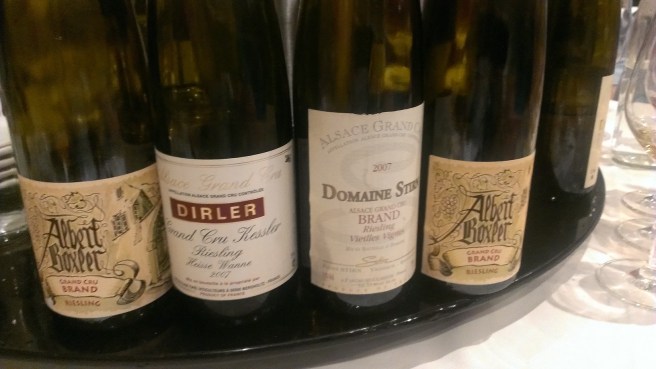
A group of enthusiasts aimed to explore mostly wines from 2007, except for the bracket of sweet wines at the end.

Alsace is in France near the German border, so its flipped a number of times. A cool Continental climate, and shelter from the Vosges mountains means it’s very dry. The wines can get very ripe, and often some sugar is retained to keep the wines balanced. Frustratingly, this means it’s difficult to tell in advance how dry/sweet any wine will be, and what food matches work.  Many wines are more textural and phenolic than Australians are comfortable with.

There are 51 grand crus sites – too many, and too large. The sweeter wines Vendage Tardive (VT) and Selection de grands Nobles (SGN) carry a significant premium price.

2007 Boxler Sommerberg Pinot Gris 13%

2010 Jean-luc Mader Schlossberg Pinot Gris (sweet) 11.5%

Off to a good start, with both wines gold in colour, the Boxler (approx. 30 g/l rs) viscous, displaying pear juice, limes, ginger and nutmeg spices, marzipan and citrus peel on the palate – drink to 2020, score 93).  The sweeter Mader was not as forthcoming on the bouquet, with dark honey to the fore, but had a finer, longer creamy mouthfilling palate, and was the groups preferred wine (drink to 2022, score 94 points).

alsace 2016 pg and gwt

2005 Zind-Humbrecht Hengst Gewurztraminer 14.5%

2007 Sorg Eichberg Gewurztraminer 13.3%

2007 Dirler Cade Kitterle Gewurztraminer 14%

The three wines all showed their varietal character. ZH rows their own boat, with high alcohols on most wines, this one showing rose, honeysuckle and musk, its length partly contributed by its alcohol, and the palate beginning to dry out (37 g/l rs).  Drink up, 85 points. The Sorg looked more “feminine”, gently textured, but some bitterness detracted (drink to 2018, 88 points). The Dirler (41 g/l rs) was the group’s preference, some apple and tropical fruits on its bouquet, toffee, honey, and an attractive touch of apricot on the palate; altogether lovely (drink to 2020, 91 points)

alsace 2016 rieslings

2007 Stirn Brand Riesling 13%

2007 Dirler Cade Kessler “heisse wanne” Riesling 13.5%

2007 Boxler Brand Riesling 13%

2007 Boxler Brand “K” (kirchberg) Riesling 13.7%

The Stirn seemed a bit awkward initially, austerity and some petroleum over-riding its flintiness. But it limbered up, with limes, white flowers and minerals emerging (drink to 2020, score 91 points).  The Dirler was our first casualty – blue cheese, butterscotch and oxidation too noticeable for me. The group favourite Boxler (18 g/l rs) was a delight; dried red apple, cinnamon and other spices, terrific length and lip-smacking texture (drink to 2025, 94 points). The Boxler “twin” was the 4 g/l rs “K”; with a similar slinky supple palate, but the higher alcohol made its presence felt Drink to 2020, 91 points).

Then it was a true gamble with a bracket of deliberately sweet wines, and individual desserts.

alsace 2016 sweeties. jpg

2009 Stirn Muscat VT 12.5%

2007 Dirler Saering Gewurztraminer VT 14%

1998 Zind-humbrecht Clos Windsbuhl Pinot Gris 13.5%

1997 Hugel Sporen Gewurztraminer SGN 13%

1997 Louis Sipp Osterberg Gewurztraminer VT 13%

The Stirn was a restrained style but full of interest; grapey, fruitcake spices, poached pear, and Lemon peel (drink to 2020, 90 points)

Zind-humbrecht (71 g/l rs) was affected by hessiany TCA – a shame as there was plenty going on underneath. The Louis Sipp was badly oxidised.

The Dirler (54 g/l rs) looked slightly bruised-apple-oxidised, and a little hard and burnt; but still provided some drinking enjoyment with stewed apricots, orange blossom and some savouriness on the palate. There will be better bottles.

The Hugel (103 g/l rs) was a classy wine; even though the colour was amber, it had the luminous glow that often brings up the expectation of excitement.  And it delivered – citrus peel, marmalade, dark honey, on an unctuous balanced palate. And will keep for many more years (to 2023, 96 points)

Overall, the wines were ready to drink, (although the Boxlers look age-worthy) with cellaring a bit of a gamble. A very enjoyable evening, despite cork problems making 3 of the 14 bottles undrinkable, and one more slightly affected– a disgrace.

1990 Craiglee Shiraz

“selected and bottled at Craiglee exclusively for Walter’s wine bar”

Apparently a few barrels were kept in oak for a few months longer while the standard Craiglee Shiraz went on to win 27 gold medals and a clutch of trophies (is there another Australian non-fortified wine with a better show record?). I extricated this remnant bottle during a cleanup of the Craiglee stocks, and had no clue that it was ever made (1990-1993 apparently).

I never got to Walters, even when located first in Rathdowne Street Carlton as “Maria and Walters”, but have been very fortunate to taste the 1990 Craiglee Shiraz many times, most recently in mid-January. I cannot discern the difference in the Walter’s selection. Its a 26 year-old wine from Sunbury Victoria, in stunning condition made by long-time winemaker Pat Carmody.

1990 craiglee shiraz

I broke the cork, but it had performed its duty.

The deep colour is more ruby than garnet; while there is clearly bottle development, the wine in still vibrant and fresh (and I would have guessed late 90’s). Its magically balanced, with sweet ripe raspberry and dark cherry aromatics and flavours swamping faint dusty oak. Yet this fruit-centred con concentrated medium- bodied wine is savoury and succulent with faint gamey nuances., and mingled peppers and spices. Long, long finish (>18 seconds).

An astonishing achievement and an eye-opener for those more familiar with traditional South Australian Shiraz; you can have depth of flavour without jamminess. Its more akin to a Northern Rhone wine in style. An utterly delicious drinking privilege, with the evidence pointing to at least another 10 years of life, cork permitting.

Drink to 2025, 96 points

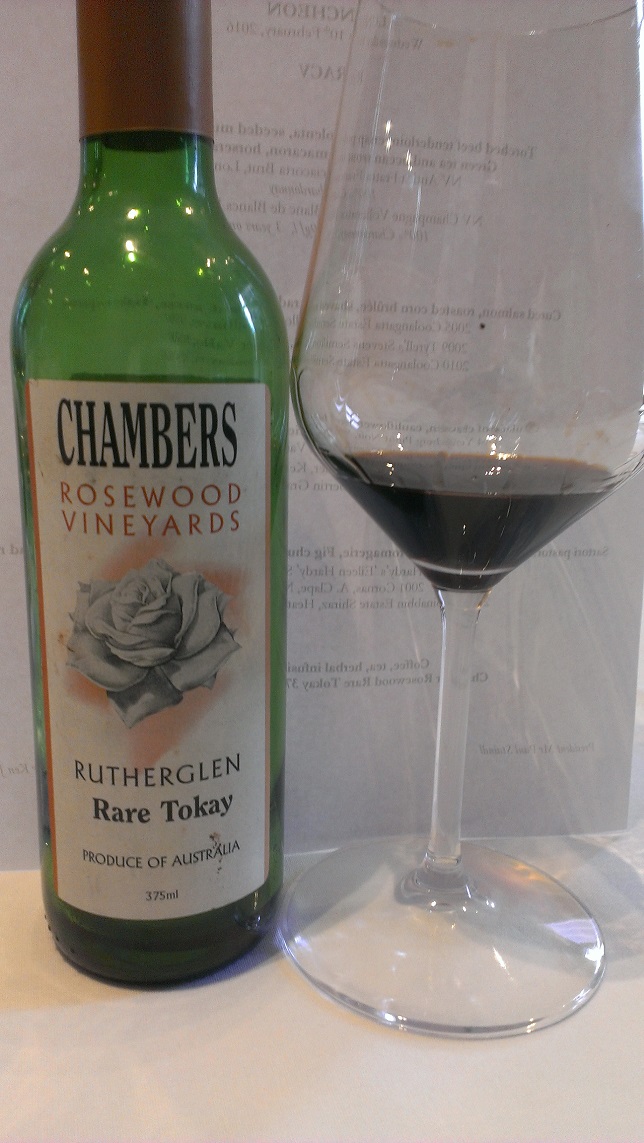
NV Chambers rosewood rare tokay (17%)

What’s in a name? This wine is labelled as Tokay, made from Muscadelle grapes , and the style is generally now called Topaque.

Chambers Rosewood is a long-established winery in Rutherglen. I used to travel there with my parents, and the welcome was “wine is in the fridge on the verandah – help yourselves” from legend Bill Chambers. You poured into “shot-glasses” and most wine was available by the bottle and flagon.

Despite modernisation over the years, there is still a baffling – and large range of wines available to taste, with some varieties I haven’t seen elsewhere.

nv chambers tokay

A lovely lunchtime treat (served blind, as usual).

The first thing that impresses is the colour, a dark motor oil, brown yet still with a green/khaki rim. Great age suspected, and it was viscous, reluctant to swirl. Then it amazes with just how much flavour can be compressed into its volume; there is the varietal muscadelle tea and malt, plus some almond and mocha; (no butterscotch here though, another typical descriptor). And it goes on, just defying my efforts to keep smelling and stop sipping.  If only I could have a bigger glass! And a bewildering long finish; amazing.

Its the top quality tier – “rare” which describes these luscious beauties well. They have had many years maturing in barrels, become denser and richer.

But these decadent Rutherglen fortifieds are not just about aged material; there is the mastery to blend in some younger, fresher material; so the density and concentration is not cloying – a treasure. The price ($250 per half bottle), in world terms is fair. A half bottle would be nicely shared with 4 people, and provide an outstanding sensory experience.

Drink now – 98 points!


1990 Campbells Touriga Vintage Port 18%

How could I resist trying this Rutherglen VP made from Touriga? Stanton and Killeen are well known for their use of Portuguese varieties in their VPs’s since 1997, but Chris Pfeiffer earlier made wines for Lindeman in the late 1970’s and early 1980’s using Touriga, Gran Noir and maybe other Portuguese varieties sourced from just over the NSW border in Corowa – I don’t know if these plantings still exist.

1990 campbells vp

For this wine, the cork has performed, and the label is retro and functionally brutal.

But I can’t discern Touriga in this Campbells’ wine, and would have punted it being Shiraz (its likely to have minor components of Shiraz and Durif). It’s sweet but well within normal bounds for the style. It’s a dense red colour with some trivial bricking on the meniscus. The (brandy) spirit is well integrated. The dominant character is dark cherry, backed with some straw/dried herb and orange peel, perhaps a touch of cough mixture and cola. It’s smooth, rich and raisiny, mellow and just what’s needed on a muggy Melbourne night. Drink over the next few years before the fruit recedes.

Drink to 2020, score 88 points

Sparkling reds extravaganza

Just one evening after Australia day, a small group tried 8 sparkling reds (aka sparkling Burgundy). It’s not quite a unique Australian style, but near enough; many European tasters are perplexed. It’s a style that seeks to balance ripe fruit, and acidity. Residual sugar via liqueuring, typically  with “port” styles  between 15-30 g/l being common – and necessary – to balance the tannins. Time post-disgorgement helps, although “how long?” is a matter of personal preference.

Sparkling reds are a surprisingly food-friendly style; anything “gamy” succeeds; turkey, duck, pork, some cheeses, or merely as an interlude; even beef succeeds; I am not at all in favour of deployment as a “breakfast style”, or with bacon and eggs; this underplays its potential seriousness and quality.

Time on lees helps, but earthy and mushroom aspects seem to emerge up after about 10 years; 15-20 years on lees seems too much based on the few samples I’ve had. Brett needs close attention, as it thrives in the environment of sugar.

The interplay of these elements, plus temperature makes a big difference.

Extended time on lees means there is more chance that the wine has had several winemakers involved through its path to release.

Australia has generally used Shiraz for the style, but I’ve seen examples with Cabernet Sauvignon, Durif, Pinot noir and Merlot, plus assorted blends. Wines were served in brackets of two, and my notes are impressions, not fully contemplative.

2008 Castagna (Beechworth 13.5%) – 89 points

NV Rockford (Barossa) disgorged August 2010 – 92 points

The immediately noticeable difference is that the Rockford seems richer and sweeter. It’s creamier, oakier with raspberry red fruits. A real crowd-pleaser, while the drier Castagna showed some light mushroom, and fine mousse.

I have had worrisome experiences with leakage with Rockford in the past; this bottle was pristine.

2005 Peregrine ridge (Heathcote) 14% – not rated

2005 Peregrine ridge (Heathcote, late disgorgement, 6.5 years on lees) 14% – 94 points

This was a useful exercise, with the later-disgorged style showing a creamy texture, raspberries, violets and Its had well-deserved success in some wine shows. Lovely drinking, and perhaps even better with a little less r/s.  I thought the standard release was very dull in comparison – a faulty bottle is suspected.

2002 Andersons (Rutherglen) 14.5% – 96 points

1998 Leasingham Classic Clare 14% – not rated

The Anderson’s is a lurid healthy bright red colour. Dense, creamy with has balanced mushroom, its bursting with ripe blackberry dark fruits; there is compelling deli meats and charcuterie, and spiciness. To my bafflement, its still available at cellar-door for a derisory $49. Lots of well-merited show bling. Extraordinarily good VFM.

The Leasingham has alas, died.

1991 Seppelt Show (Grampians) 13%, 6.5 years on lees – 96 points

2004 Seppelt Show (Grampians)  13.5% 8 years on lees- 96 points

It’s just as well these two wines were not masked, as they were just so good and so different. Seppelt has a long history with sparking reds, even their standard vintage sparkling red (available for less than $20 to canny buyers) will surprise – even better if it was under crown seal)

The 1991 was at a lovely stage; certainly more developed with some honey, hay, camphor, truffle, leather and dried mushroom. But fruit is still present; a very appealing package, but to drink, not to keep.

The 2004, from the St Peters, Imperial and McKenzie blocks) is a ripper, albeit embryonic. Its very ripe and somehow balances bright red berry fruits with a gentle touch of capsicum and tomato-leaf, without veering into greenness. The plate is darker, some chocolates, an array of mixed spices and so finely manicured!  Leave it for 5 years to soften, and it will be very, very special. Or leave for much longer, safe with a crown seal to make it almost indestructible.

All in all, however, a stimulating set of wines, that deserve those terrific scores.