2005 Zind-Humbrecht Heimbourg Pinot Gris SGN 10%

zind sgn

The selection de grains noble (SGN) from Alsace. I guessed at 190 g/l; but is 219 g/l.

I struggle to define Pinot Gris; sometimes its pear-like, with more body than  riesling but throw in botrytis and its all too difficult. This wine is  at BA sweetness levels and the oiliness and honey elements could easily lead to choosing this as a Mosel wine; there are some phenolic aspects, nothing untowards.

Pale colour revealing some musk and lemon sherbet and botrytis spices, very sweet pear and apricot but held together by magic acidity; marvellous texture and balance, so clean – will live for another 20 years. Score 95+.

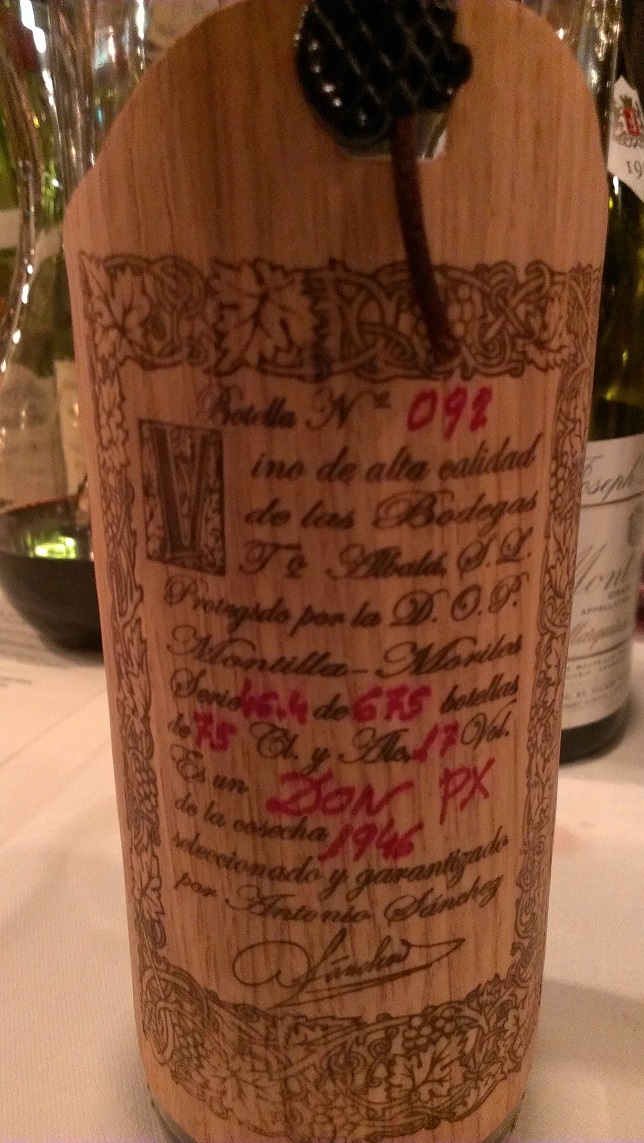
1946 Toro Albala Don PX Convento Seleccion

Apparently like a colheita, a single vintage Pedro Ximinez barrel-aged for many years. Prolonged barrel age will increase a wine’s acidity, alcohol (although the label only claimed 17%a/v), sugar and VA  – the challenge is to maintain freshness.

toro a

The wine itself was unbelievably dense black with some khaki on the rim; stuffed with raisin, roses and mocha. And not at all painful to drink.

But, it does not deserve 100 Parker points – 92 from me.

I continue to hope that the world doesn’t outprice my fondness for Australia’s best muscats and topaques, and there is much better value around than its roughly $400 price at auction.

1989 Chateau Coutet Madame

100% Semillon from barsac. The Madame is not made every year- indeed it seldom appears.

1988 coutet a

I was looking forward to trying this after tasting the standard 1989 Ch Coutet in 2012, but the cork deity decided otherwise. The wine was faintly but definitely adversely affected by TCA. Underneath were layers of orange blossom, marmalade, spearmint and clean acid. What a shame that cork taint made this wine unenjoyable – at least for me.

Tasting JJ Prum Rieslings again

I have liked the style of JJ Prum since I began to become seriously interested in German Rieslings around 2006. JJ Prum are seriously structured wines, made in a reductive style. This means they can look downright ugly when young, and decanting is strongly recommended. A quick tasting of some JJ Prum wines from several vintages at Prince Wine Store was welcome. Very brief notes below, but the tasting reinforced my prejudices! And the wines were too good to spit.

2011 JJ Prum Kabinett – entry level, quite reductive, but showing spearmint and red apple

2009 JJ Prum Graacher Himmelreich Kabinett – still reductive, but more flesh, texture and white peach.

2010 JJ Prum Graacher Himmelreich Spatlese – a high acid year, and a beautifully detailed wine. Some smoke, tropical fruit not quite veering into pineapple, lovely texture, balanced. Will convert the uninitiated; stylish, delicious

2003 JJ Prum Bernkastler Badstube Auslese – a dismally hot year in Europe (that I witnessed). Yet again however, the better makers with better sites have no complaints – the wines just needed time. This wine is ready for business at 12 years age (and a bit more acid would have added to its appeal).

2011 JJ Prum Bernkastler Badstube Auslese – Super wine at such a young age, potent, long, classic minerally style. Mixed white and yellow stonefruits.

2012 JJ Prum Graacher Himmelreich Auslese – Denser, crunchy style, rich, lush, balanced.

2013 JJ Prum Bernkastler Badstube Auslese – a year of low yields, and mostly at the Auslese level. Citrus peel, sherbet, vibrant, creamy. Lovely.

2013 JJ Prum Bernkastler Wehlener Sonnenuhr Auslese. My “go-to” vineyard for Prum. Shows more mineral red apple and purity; fleshy, textural, a delight.

2013 JJ Prum Bernkastler Wehlener Sonnenuhr Auslese Goldkap. A more intense selection; Has real drive, tongue-coating silky richness, extensive length; overwhelming, and so much promise for revisiting in 10 or more years.

2002 Zind-humbrecht Gewurtztraminer Hengst

ZH reduced

Deep gold, but what a hedonistic melange on the bouquet! Honey, cinnamon and other baking spices, musk, white flowers. Its very concentrated with enough acidity to carry the 41 g/l sugar. ZH rows their own boat – this wine is 15% a/v, but is in balance; phenolics add interest and texture. Amazing vitality for a 13 y/o aromatic wine, and a very suitable match for the roast chicken. Cannot see improvement but it will provide a few more years of drinking pleasure. 95= points


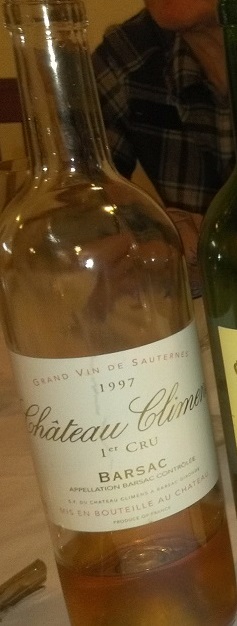
1997 Ch Climens

1997 ch climens

Gold in colour, apricots and oranges and cream, citrus and spices. 100 g/l residual sugar, so it’s not a blockbuster, nor overwhelming in sweetness. Clean, all is in balance and the wine has a rich mouthfeel with genuine palate length. Faintly dry finish suggests it’s ready to drink, although the maker’s track record suggests it could surprise by lasting (much) longer. 94= points


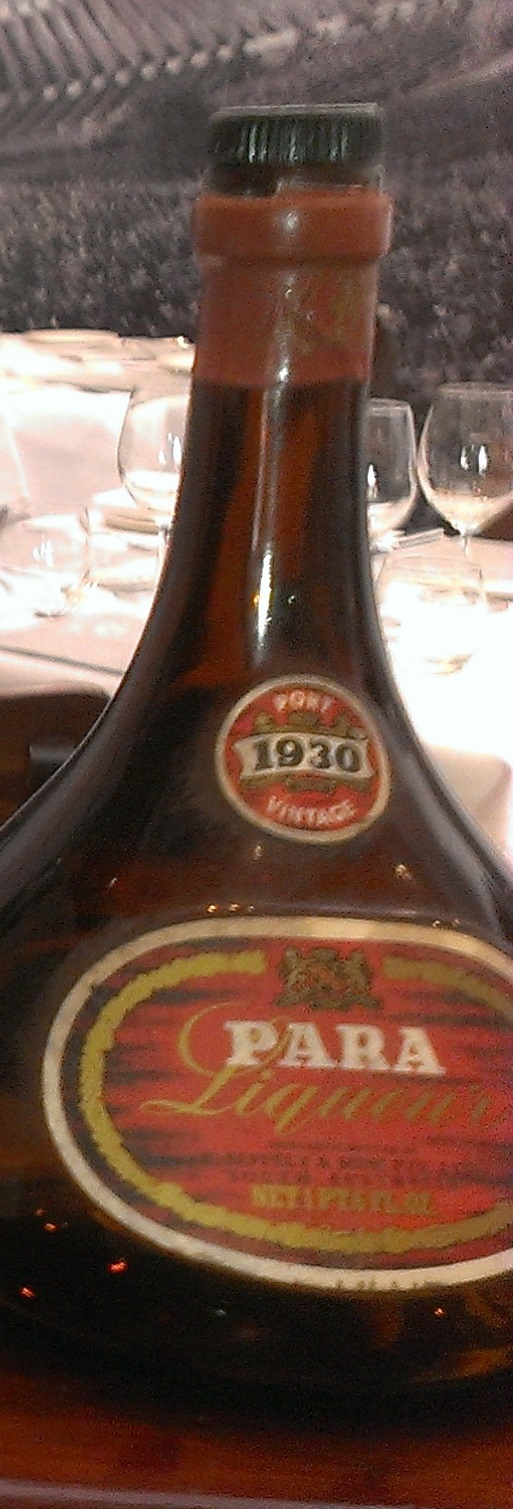
1930 Seppelt Para Liqueur Port

1930 seppelt para

This wine is available through auction, and is in a squat bottle.

Its believed to be bottled around 1955 from stocks at least 21 years old, predominantly from the 1930 vintage, and Grenache dominant. This was part of the series that included 1927, 1930, 1933, 1939, 1944, and 1947. (There was another series bearing the names of separate members of the very extended Seppelt family).

The prevailing wisdom is that Seppelt reverted to calling later blends 101, 102, up to 127, resuming with a 1976 when perhaps their records were such that they could amply demonstrate the vintage nature of the base.

These wines are matured in barrels, and the gradual oxidation (and evaporation) over time increases the sugar, the alcohol, and the VA. The wines do vary, despite their prolonged aging. The winemaker has numerous blending decisions as there may be varying sizes of barrels (and their location on top, outside, or middle of stack), plus the amount freshening required.  I had a very educational tasting a few years ago at Seppeltsfield where I tried a mini-vertical of 1989, 1990 and my preferred 1991.

Naturally the 1930 wine has thrown a crust, so the 2 cautions are –the wine needs some decant time to breathe, and some filtering to remove the worst of the sediment. In the glass it has the absolutely typical Seppelt khaki/green colour. It’s rich, vibrant and long in the mouth, with a welcome cleansing alcohol and acid kick (perhaps 22%). It’s a treat to drink these venerable wines, remembering that most of those involved are no longer alive.

Riesling riot (Melbourne – 8 Feb 2015)

What great opportunity to try a big, big range of Riesling, mainly 2014 which have turned out very well indeed.

There was .almost enough room between the exhibitors, and very nearly, almost enough spittoons. Some producers put on older wines, and geographically included usa, Austria, Germany, NZ and Oz. Finally there was plenty of food – not just cheeses, but bread, meats, and oysters. Best of all, the food was included in the ticket price. Now if I only could have had a latte….

I tried 87 wines in just over 2 hours, and there were plenty I didn’t get to

Impressions, alphabetically

Brundlmayer (austria) You get what you pay for, the best of the 3 wines was the 2013 “reserve” – superb wine

Cherubino. I don’t have much experience with Larry’s wines but the 2014 Porongorups was ultra-fine and expressive

Crawford river; 2013 was a brilliant wine

Donnhof (nahe) 2013 Oberhauser Leisterberg Kabinett, was delicious

DR Loosen; again you get what you pay for, The 2013 Wehelener Sonnenuhr Kabinett was a step up on the bernkastler Lay Kabinett; the ws spatlese a further advance- gorgeous.

Eden Hall. Liked the 2014 and 2010, did not like the 2011.

Egon Muller (mosel) Their wines can be frighteningly expensive, as might be expected from their place in the hierarchy of German wines 2013 Scharzhof Kabinett and 2013  Spatlese were terrific

Framingham (NZ) There were 2 wines I actively disliked; but the 2013 “classic: and even more so the 2014 Noble (with notes of ginger and limes) – were very very good

Mt Horrocks. Another winery whose wines I only know via reputation. 2014 and the 2014 Cordon cut – in particular- were very impressive.

Henschke – 2014 “julius” is a super fresh, ultra-aromatic wine.

Hugel – Kudos for showing 08, 09 and 10 Jubilee Riesling. Of these the 10 was by far the best – rich and mouth-filling

Jim Barry; 2014 Lodge Hill clearly superior to their standard, and great value; the 2013 Florita is a distinguished vineyard and a wine with power still to uncoil; the 2007 Florita is at a nice “in-between” stage; fresh but showing some development.

Knappstein; a range of single sites, of which the 2014 Ackland was utter classical Clare limes; the others Bryskys Hill. Slate Creek and the Insider were lesser wines (the latter 2 with some skin contact, which in my view didn’t help, adds to texture but I think coarsens the bouquet.)

Mitchell -Under-rated! A terrific set from the standard 2014, a 2006 and the special block 2007 mcNicol.

Mt Majura (Canberra) 2014 pristine, and a 2005 was still amazingly fresh

O’leary walker; I preferred the 2014 Waterville to the Polish Hill; its denser and more powerful. The one-off 2012 cane cut was a wine of exotic spices and potpourri; another gram of acid would make this a killer.

Peter Lehman, As expected, the 2009 Wigan was a smart wine; but the 2014 H&V is the “almost-Wigan” and is another great value Riesling

Pikes -Great show results recently; the awesome 2014 Merle leaves the -pretty damn good- standard in its wake. Neil recommends his 2002, 2005, and 2012 wines as his favourites. The 2014 Gaelic Cemetery is more phenolic, but the “black” has the fruit density to carry t.

Pressing Matters (tasmania) Great press, great show results too; the 2012 R9 is stunning.

Robert Weil (rheingau) Can do no wrong, The 2013 Grafenberg GG shows how good a slow-ripened Riesling can be- not likely to be cheap!

Rebholz (pfalz)-I preferred the 2011 GG to the 2012 GG; packed with stony mineral flavors combined with delicate refined palate. Stylish, possibly even affordable….

Treasury; 2014 is the year of musk and sherbet; 2014 Leonay Eden Valley just had more finesse than the reliable standard Eden Valley. If you want a wine to confound people, I was thrilled with the 2013 “Leopold” from Tasmania; just like a crunchy Granny Smith apple, searing acid.

2013 Seppelt Great Western – a cellar-door only wine, packed with minerals and some well-judged residual sugar- will be long lived.

Vickery The man is a legend, but the 2 2014 wines did not have the “x” factor.

Wilson. Another excellent set of wines with the 2014 “wilson” better than the watervale or DJW.

Wines by KT. The 2014 “churinga” had real drive and power. Yum

PS – Spoke with a number of the OS contingent; even though some of their wines are under screwcap, I think in the hearts they think Aussies are a bit weird in their preference for screwcap; its also possible that the winemakers don’t want corks but are outgunned by the marketing arms

Some education on a bottling line

bottling line

Its been roughly 25 years since I learned of the heartbreak and processes involved in bottling wines, and I was overdue some further education on a portable line (one that moves form winery to winery) The winemaker prepares the wine, supplies bottles, capsules, label, cartons, and the machinery takes over (to provide membrane filtration and fill the bottles). This still means that very repetitive manual labour has to

  • Load empty bottles onto the conveyer
  • Assemble cartons and inserts
  • Pack the filled bottles into cartons
  • Load cartons onto pallets

Each task is tough.

The pace is relentless.  So, sore back, sore feet, sore hands and a more modern understanding of the exercise.