Mixed drinks, recent short impressions

2003 Joh Jos Prum Wehlener Sonnenuhr Riesling Auslese 8%
Very pale lemon in colour, there is an array of the usual petroleum (not kero), and faint smokiness mixed with tropical fruits of mango, passionfruit, a pull of citrus, flint and warm spices. The palate is sweet, fresh, viscous  and long-lasting. The wine got better as it sat in the glass.

Its not easy to resist the style, one of my favourite Mosel vineyards plus the combination of freshness and bottle-aged complexities. It’s a triumph of old vines and winemaking nous over the heatwave European 2003 vintage.

95 points, and drink to 2030.

2014 Chateau La Tour blanche 14%
Sauternes (83% semillon, 12% sauvignon blanc, 5% Muscadelle; 130 g/l r/s)

A great VFM Sauternes producer, and a wonderful result from an excellent vintage. Light gold in colour, the wine displayed vibrant nettle, stonefruit, pineapple rind and bright lemon icing sugar. The palate showed more barley-sugar, and some vanilla pod to add to the aromatics. Rich, sweet, balanced with much more pleasure to cover over the next ten to fifteen years.

The range of fruit flavours, the complexity and balance makes the wine a delight.

94 points, and drink to 2030 (at least)

2014 Chateau Lafaurie-Peyraguey
Sauternes (93% Semillon, 6% sauvignon blanc, 1% Muscadelle)

Served (masked) at the same occasion as the La Tour Blanche above, this wine looked darker in colour, showed greater – and simpler- tropical fruits, and custard apple. The palate was sweet, fresh and supple, but with greater oak presence, some hardness, and some bitterness. Time may help, but the contrast did not help its cause.

87 points, drink to 2023.

1952 Saltram Pinnacle selection Show Muscat 18.8%
Barossa muscat, stored in small oak, believed to have been bottled sometime in the 1980’s.

Colour (after decanting) was a bright khaki, and the wine showed caramel, toffee, mocha. Some raisin character, and a degree of vanillan oak and rancio.

Served masked as usual, the mix of attributes made it difficult to decide style between muscat and tawny; the lushness pushing for muscat, the rancio pointing to tawny. Revealed as muscat,  the wine itself was excellent, and a nice piece of Barossa history.

90 points, drink now.

2003 Taylor Fladgate Vintage Port
A devastatingly hot year in Europe, but most Port producers declared the vintage. Cork – or storage- struck; the bottle I sampled was strong, powerful in colour, but the flavour impact was tertiary mixed mocha and coffee grounds; and the wine looked plain, young, raw and lacking finesse. A hasty look at remnants from another two bottles opened showed more expected fruit flavours of violets and dark cherry, but time and the amount left conspired against further contemplation

Not rated, but I will have other opportunities!
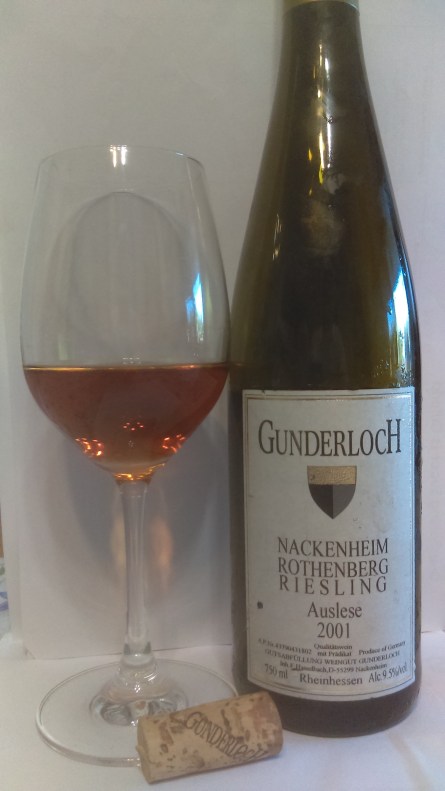
2001 Gunderloch Nackenheim Rothenberg Riesling Auslese (goldcap) 9.5%

The cork had behaved; its colour was copper; but in this case evidence of botrytis, not oxidation. I’m not very familiar with the Rheinhessen area of Germany; haven’t visited, and haven’t tasted much – more homework is needed!

The Rheinhessen is  Germany’s largest wine-growing area, often used  in making mainly innocuous white wines, but has undergone a re-evaluation with some very serious winemakers (such as Keller).

Its Australian importer Cellarhand has some helpful notes on the producer, site and winemaker here. The gold capsule indicates the wine is “more” than a basic Auslese.

2001 gunderloch auslese gc

The wine presents with raisin, red apple, dark honey, orange peel, and fruitcake spices, plus a hint of syrup and wax; the palate is vibrant and unctuous; stonefruit impressions add to the mix. Bounteous residual sugar is balanced by acidity; the compelling richness and freshness tempts further sipping, analysis and enjoyment. No hurry to drink (cork permitting).

94 points, and drink to 2028 (cork permitting).

2007 Knebel Winninger Rottgen Auslese Riesling 7%

From a half bottle, the cork shows some wine travel- no qualms; the label is cellar-scuffed, but the contents are much more important.

knebel 2007


The colour is bright gold, with abundant, tantalising stewed apricot, cinnamon spice,  pineapple and dark honey. This is class! Reinhard and Beate Knebel  (Mosel, Germany)  have no trouble delivering wines with an abundance of richness, but with the harmonious balancing acid to provide delight.

The palate is palatial and unctuous (with 190 g/l of residual sugar, somewhat atypically abundant for an Auslese, but I am not complaining). Apricot, quince, honey, wrapped with cinnamon and faint vanilla pod spices. Fresh and  smooth, from a fairly typical recent Mosel vintage, this is a startling reminder of the lush featherlight excellence of a sweet Riesling,  full of flavour with modest alcohol.

Match with a fruit platter or by just by itself for delightful contemplation.

Drink to 2030, 95 points and I am jealous of anyone that has some bottles remaining.

2007 Emrich-Schonleber Monziger Fruhlingplatzchen Riesling Auslese #17 9%

Another enjoyable wine from the upper Nahe in Germany.  From Stephen Reinhardt‘s terrific reference book  “The finest wines of Germany”  comes the tribute that the family has “maintained parcels in the steepest sites…and restored a number of top parcels that had been abandoned for decades…since they were suitable neither for mechanisation nor for high yields”, ending with Werner Schonleber’s claim that “quality comes from torture”.

Fruhlingplazchen translates as “Spring’s little place” and is mainly blue slate.

2007 emrich

This wine is a deep gold colour, exhibiting ripe apricot, yellow peach skin, and quince aromas. The palate is unctuous and honeyed, with a touch of tropical pineapple, plus cinnamon spiciness. There is a strong line of mineral and a delicious persistence.  Notes from the importer reveal the wine has 113 g/l of residual sugar, in balance with its acidity. Altogether lovely.

From the half-bottle, drink to 2023 and 94 points.

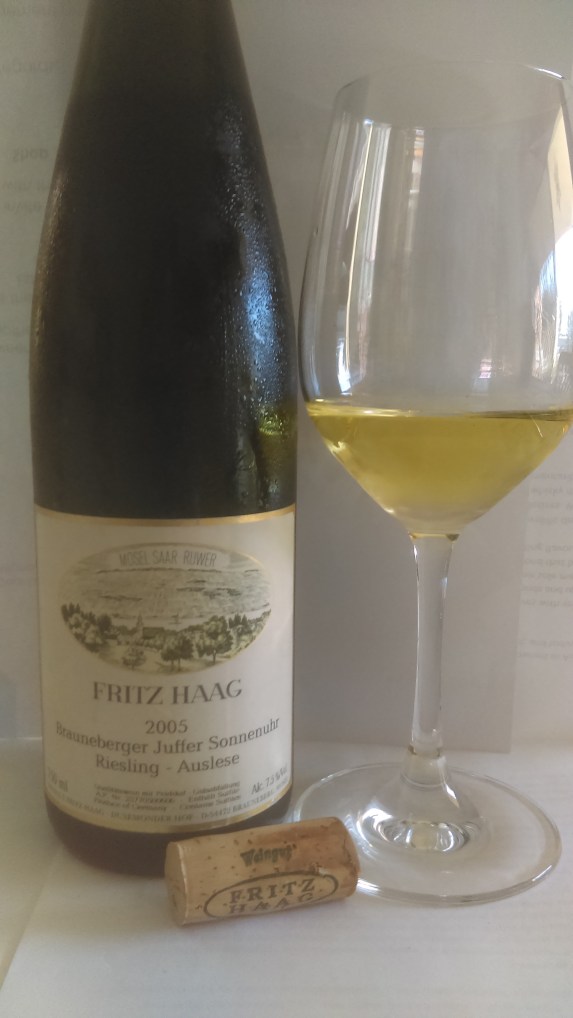
2005 Fritz Haag Brauneberger Juffer Sonnenuhr Riesling Auslese #6, 7.5%

This wine is still a clear and bright pale straw colour, with voluminous aromas of petroleum, kiwi-fruit, green melon, lime, some waxiness, and a touch of camphor too.

2005 fritz haag bjs auslese

The palate is poised and effortless, concentrated , with more lemon and light tropical flavours added to the mix. Its the kind of wine that puts me on high alert as it slides along and teases the senses, freshness and balance a key attribute.

Fritz Haag is one of the top Mosel estates, and this wine was a lovely example of Riesling with some bottle maturity, and naturally capable of much further aging. My suspicion is that the residual sugar level is around 80 g/l.

Drink to 2028 and 93 points.


2005 Joh. Jos. Prum Wehlener Sonnenuhr Riesling Auslese (AP 03 07) 7%

IMAG0812

The wizened cork has nevertheless done its duty, but I hope my remaining bottle will be preserved for at least another 5 years.

The wines of JJ Prum are easily available in Australia; the Wehlener Sonnenuhr is my “go-to” vineyard, and the Auslese level hits my personal “sweet spot” of complexity and affordability. But the JJ Prum wines- like so many Mosel Rieslings – reward cellaring. 2005 was an exceptional vintage in the Mosel.

The colour of this Mosel wine is a bright clear light lemon; there are enticing scents of ripe red apple, dried pear, lemon, smoke, petroleum, stones and a twist of ginger. The palate is rich, clean and overwhelmingly pretty; it’s viscous with natural acidity that is refreshing, and insists that further tasting is mandatory. My guess was around 90 g/l of residual sugar, but beautifully integrated. The palate shows white honey,  red apple, some emerging lime, and of course flint. A wine that is easily approachable, enjoyable and complex.

Drink to at least 2035 , and 95 points for now – with enormous prospects for improvement in the future.

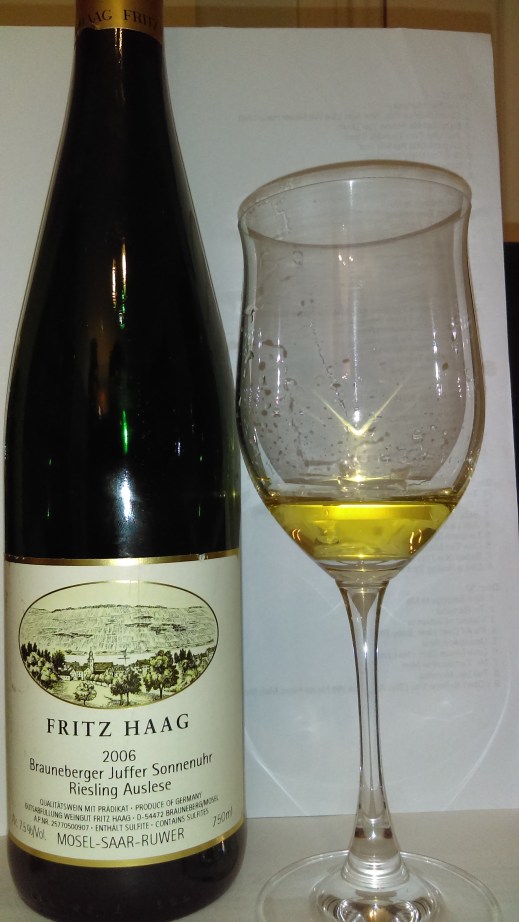
2006 Fritz Haag Brauneberger Juffer Sonnenuhr Riesling Auslese goldcap #9, 7.5%

This is wonderful estate, and a magnificent site (commonly abbreviated to BJS). The goldcap indicates a richer selection -other wineries may employ different colour, or lengths of capsules, or stars to show “extra”.

2006 in the Mosel was a high botrytis vintage, but as usual, better makers achieved better results.

IMAG0687

The wine itself is a bright lemon/gold, and has some – entirely harmless- tartrate crystals. The bouquet sang with tropical fruits – mango and more, plus ripe pear, apricot and citrus, and steeliness.

The palate is bursting with vitality, with more passionfruit and stonefruits – principally apricot and yellow peach. Dense, and mouthfilling, the flavours are very persistent, and the high degree of residual sugar ( perhaps 130g/l) is in harmony with the minerally acidity. Pure, fresh Riesling with a long future.

Alas, my only bottle – drink to 2032, and a well-deserved 93 points

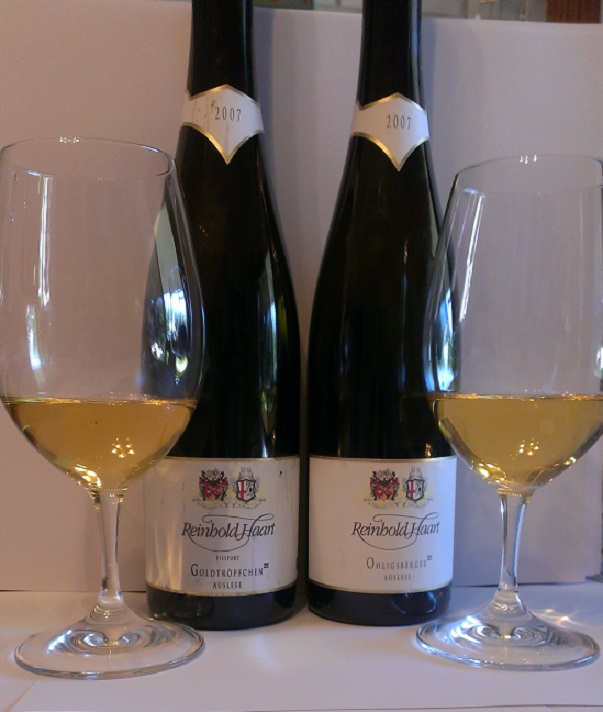
Fraternal twins – 2007 Reinhold Haart Riesling Auslese

Two Mosel Rieslings were tasted blind; the exercise was “spot the difference”; keeping tasters on full alert. Similarities were present, but the difficult task was in defining where, what (and why).

The wines presented were

  • 2007 Reinhold Haart Piesport Goldtropchen Riesling Auslese 7.8%                           119 g/l, 7.7 acid,                                             94 points,  drink to 2023
  • 2007 Reinhold Haart Wintricher Ohligsberg Riesling Auslese 7.4%                             127 g/l, 8.3 acid,                                             95 points, drink to 2028

The wines had sufficient distinctiveness to warrant separate bottlings; the Goldtropchen displaying smoky, yellow peach, a touch of green plum and red apple, mineral and redcurrant, silky and delicious; Ohligsberg brighter, more linear, finer, slightly sweeter, with similar descriptors plus some yellow-skin apple and slightly greater persistence. The complex interplay between acidity and residual sugar came into play, with the Ohligsberg seeming much sweeter than the analytics indicate. Both had nervy acidic drive to balance the considerable residual sugar.

2007-haart-twins

Piesport has had its reputation tarnished in the past- possibly due to excessive yield and inappropriate sites; Haart is one of the brigade determinedly correcting this legacy.

Two absolutely delicious, balanced, wines at a lovely stage in their development.  The  residual sugar is high for the Auslese category; with Ohligsberg shading the Goldtropchen for complexity and pleasure, but both wines offered delights that will continue into the future.

A fresh fruit platter was an ideal accompaniment.

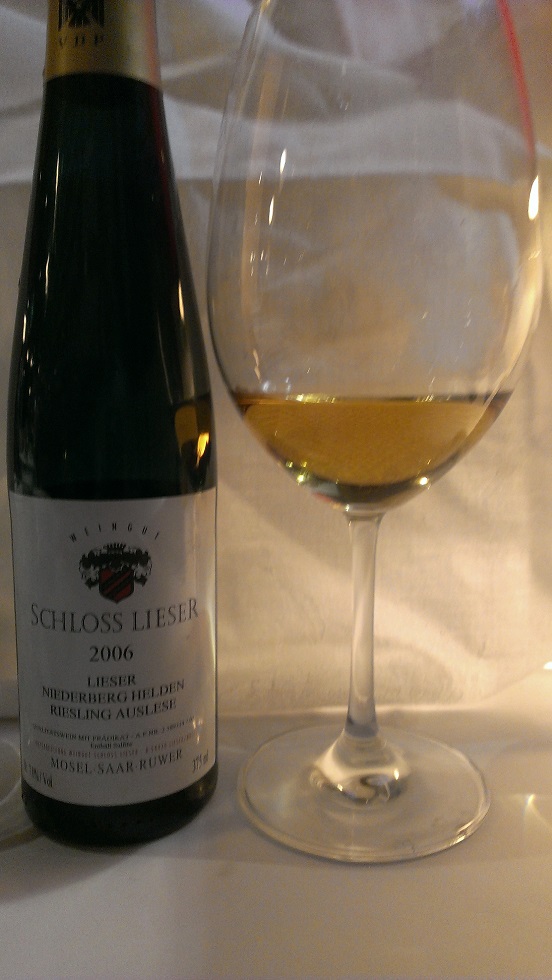
2006 Schloss Lieser Niederberg Helden Riesling auslese long goldkap 7%

Goldkap (or gold capsule) indicates more sweetness, the “long” also shows more; on this bottle the front and back lablels do not display any extra words – at least for this vintage-  so one must look at the capsule colour, and be able to compare with a “standard” Schloss Lieser auslese goldkap. Trust me on this until I find other bottles and display a comparison photograph.

Golden in colour, with dusty botrytis and apricot marmalade notes present. Viscous with oranges, grass and green nettle joust with the very rich melon and stonefruits. 185 g/l residual sugar, yet the trademark Mosel acidity ensures this is a bracingly refreshing and balanced wine with time in reserve. It’s a marvel on how long the flavours dwell in the mouth, teasing to want more pleasure, while the sensory gratification still lingers.

2006 schloss aus lgk

What is an appropriate food – if any- to accompany this wine? Avoid anything creamy – have a fresh fruit platter, or a fruit tart, but leave plenty of time for contemplation and admiration.

Drink to 2028, score 94.