2016 Cookoothama Darlington Point Botrytis Semillon 11%

From the Riverina, New South Wales, where the De Bortoli Noble One produces the best known example of a consistently excellent botrytis Semillon style. The Cookoothama is however, a more affordable option, and at around $22 for a half-bottle, is outstanding value.

The wine is a bright light gold colour, with voluminous scents of orange blossom, ripe apricot, vanilla icing and lime and orange marmalade. This wine is exuberant on the palate, very rich, sweet, powerful and flavour-packed, with enough acidity to avoid any cloying sensations.

This wine has enough power to match most desserts (avoid chocolate though) and is utterly delicious.

This is a wine that I would enjoy while it demonstrates its youthful precocity; a few years won’t hurt, but it’s beautifully pitched for short-term enjoyment.

Drink to 2023, and 92 points

2010 Petaluma Botrytis essence 13%

From Coonawarra, with a label showing astonishing (albeit tiny-fonted) detail,  174.7 g/l residual sugar, Sav blanc 53%, Semillon 47%, and much more about its oak handling, and vintage conditions.
2010 petaluma botrytis essence
Meanwhile the wine is a brilliant gold colour, with scents of botrytis, lime and orange marmalade; the palate is full-throttle, unctous and rich, ultra decadent, with flavours ranging through ripe stonefruit – apricot, peach – plus honey and orange. It’s a lovely drinking experience, good VFM, but a little less oak and a dash more acidity would have elevated my score.

Under screwcap, this wine has a long life ahead I but cannot see an upside in the flavour profile with further cellaring, and suspect it will taste very similar in 5 years.

Drink to 2025 and 88 points

1988 Chateau Coutet 14%

The picture shows the cork inside the bottle – my technique with the ah-so failed.

IMAG0726

Bright medium gold colour (excellent for age); this is not the richest Barsac you will encounter, but it provides plenty of drinking pleasure. It’s still showing freshness after nearly 30 years, and while beginning to dry up, its full of interest thanks to its lovely balance. Botrytised fruit, oak and bottle age are in harmony.

This wine is a blend of 75% semillon, 23% Sauvignon blanc and 2% muscadelle, 100% barrel-fermented in new French oak – detailed in the informative Chateau Coutet website. 1988 was an excellent year in Sauternes and Barsac with widespread botrytis.

Medium bodied, and not as sweet as its modern counterparts, it’s clean and shows tropical notes (mainly pineapple) and orange rind. The palate is more oriented to barley sugar and quince paste, with some raisined, and glace fruits; plus a bit of marmalade and syrup fills the picture. A light touch of oak is present to contribute further mouthfeel and aid its complexity. Lively acidity really proves its class.

My only bottle, a speculative auction purchase – drink to 2020, although some bottles will live much, much longer and 92 points

2015 D’arenberg Noble Mud pie 11.1%

95% Viognier, 5% Arneis; screwcap, 375ml RRP $20

People seem to tolerate my comments on wines that are not available- so here’s one at the start of its journey, for $20; less with careful shopping.

Viognier is a grape of Condrieu, where it makes distinctive, exotic dry white wines (and in more recent times, sweet wines too. More important is its contribution (in minor proportions)– with Shiraz- in Cote Rotie. In Australia, Yalumba has pioneered Viognier to make a dry white at varying price levels, from the humble but VGV “Y” series, through the Eden Valley range, then up to the Virgilius, (and sometimes a botrytis Viognier as well). Viognier is also used in some Cote Roties, with Clonakilla’s Shiraz Viognier generally regarded as Australia’s best.

Viognier may have vivid scents of ripe aprico -better examples show white peach- and the texture and mouthfeel make an enormous contribution to its appeal. Getting picking times correct seems critical to keep the wine brightly flavoured.

Arneis is an Italian grape variety- albeit one that I am not familiar with- but the textbook descriptors of pear, apricot and peach seem a good fit with Viognier. Arneis is another variety that is becoming hip throughout Australia, although vine age  and familiarity with appropriate growing and winemaking mean we hasten slowly.

The number of wines that D’arenberg produces from its base in South Australia’s McLaren Vale is dizzying; and the labels have their own distinctive quirks, and stories.

For the last few years, they have produced several “Noble” (botrytis-affected wines) – and this is one, from along the road in the Adelaide Hills. Using Viognier in a botrytis wine is unusual, and this blend is a one-off; how much the 5% Arneis contributes is problematic.
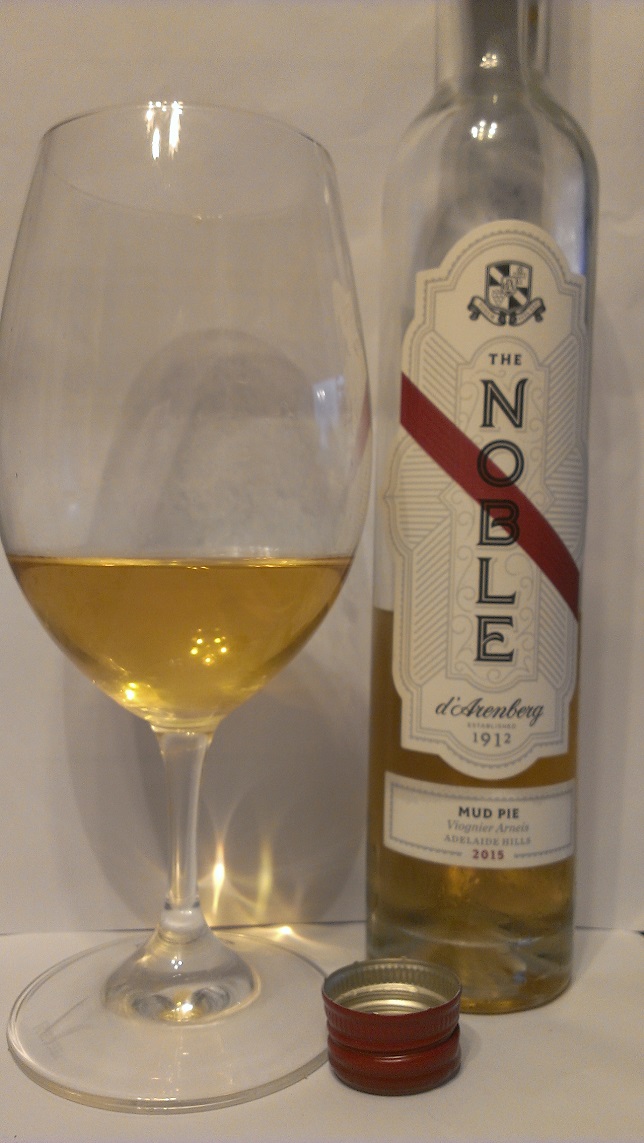
2015-darenberg-mud-pie

It’s a bright gold lemon colour, with aromatics of apricot, marmalade, cumquat, and dusty nutmeg botrytis spices. The palate is intensely sweet (my guess was 150 g/l of residual sugar, but a peek at the spec sheet indicated 185 g/l). Most Australian sweet wines are flabby, but thankfully here is ample acidity to maintain freshness. The palate is also complex, and very dense with some tropical fruits- candied pineapple, and some lime pie to bolster the yellow peach and ripe apricot.

I was quite impressed, with the wine demonstrating excellent value, and providing an interesting “alternative” drink that will work beautifully with desserts from fruit platters through citrus-oriented pies.

Somewhere however, the “x-factor” is missing. Drink to – conservatively- 2020, and 91 points, but the sugar/acid balance makes this wine a bracing and instructive treat.


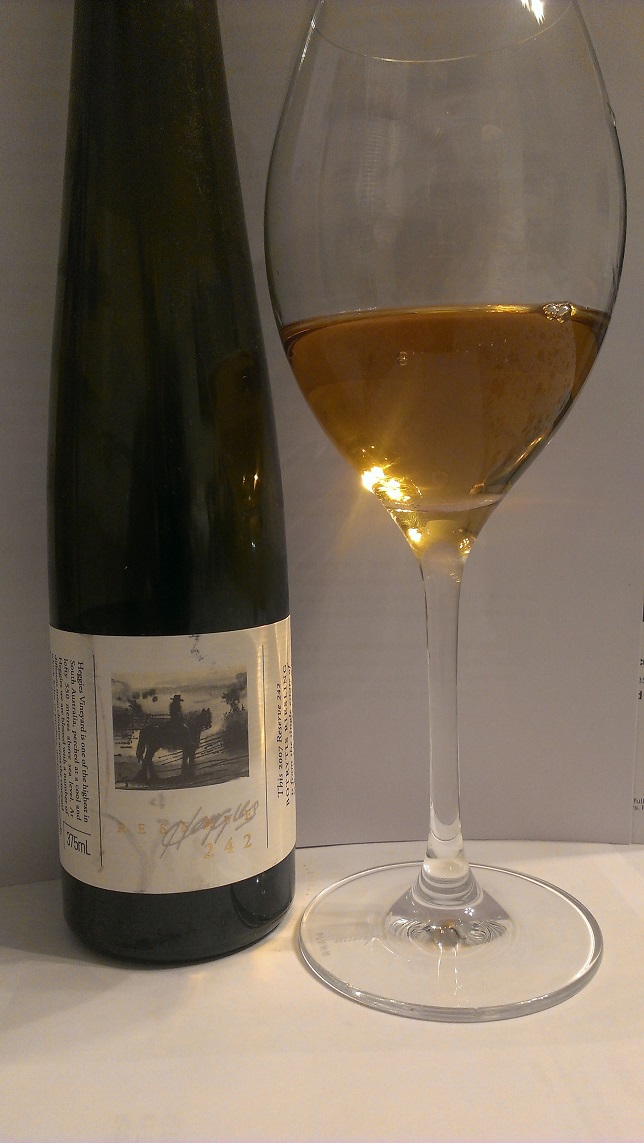
2007 Heggies “242” botrytis Riesling 8.1% (screwcap)

From the Eden Valley in South Australia, this remarkable wine achieved 242 g/l of residual sugar, hence the “242” on the label.

I have not been a fan of the dry Heggies Riesling, usually finding it a bit clumsy, although bottle age usually helps.

This wine is however, something special.

2007 heggies

It has a deep bright gold colour, and powerful aromatics of apricot, passionfruit and lime. The palate is super-lush, and mouth-filling with some lemon-peel candiness, backed by the ripe apricot marmalade flavours, ripe red apple and dried pear. There is some almond-meal semi-nutty character as well (highly unlikely to be from oak).

This wine is intense, lingering, cleansing and delicious, with the monster botrytis not diminishing varietal character. Complex, and damn fine. Botrytis is generally a nuisance in Australia, and this wine is a lovely expression of care in the vineyard, and the winery successfully transiting into bottle. Age has charmed, not harmed.

Drink to 2025, 94 well-deserved points

2000 Louis Sipp “couer de trie” Selection de grains nobles Pinot Gris SGN 12%

From auction, this is a 500ml bottle from Alsace – keen researchers may find some notes I made on Starforum back in 2008 “somehow carrying the pineapple, cinnamon, some light butterscotch, baked apple pie with just enough acidity – a nice wine with huge sweetness”.

Pinot gris and residual sugar is a wonderful match.
2000 louis sipp pg sgn
The cork has mercifully behaved, and at 16 years, the wine is now a deep amber colour with copper tints (no drama in a botrytis wine). It’s floral, mostly with ripe apricot, apricot jam and cinnamon spices. This is maintained on the palate, with touches of marmalade, citrus peel, and some baked apple. It’s sensual and voluptuous, the acidity continues to provide support.

While the wine may even have provided greater pleasure a few years ago, it still provides unctuous and luscious drinking- but please consume and enjoy soon.

90 points, drink to 2018.

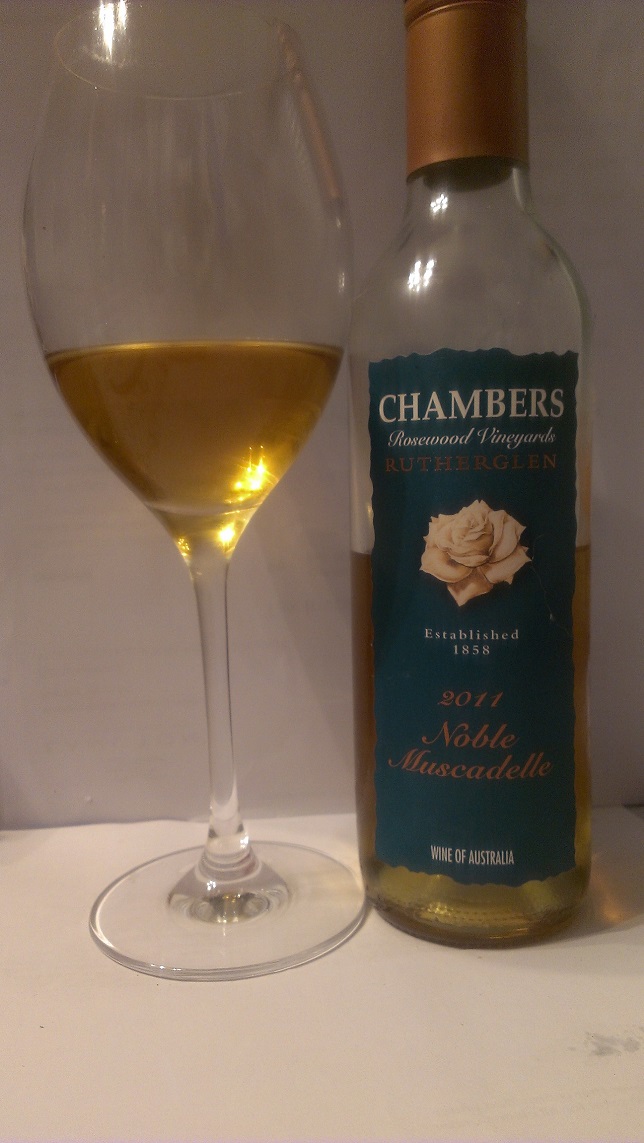
2011 Chamber’s (rosewood) Noble muscadelle, screwcap 11.3%

Chambers of Rutherglen is not the first winery that springs to mind for its sweet white wines; fortifieds yes; VFM red wines, and obscurities (anyone for Gouais) perhaps? Australia has made botrytis-affected wines from many varieties, principally Riesling and Semillon, but there have been some adventures in Sauvignon Blanc, Chenin Blanc, Chardonnay, Viognier and even Marsanne. Some of these were made deliberately, others where circumstances forced the winemaking decisions.

2011 was a pretty dire year for winemaking in Victoria, and much of Australia (although Margaret River fared well, and McLaren Vale reasonably well). There was unseasonal rain, making spraying difficult- tractors got bogged- and plenty of rot. Most red wines from Victoria lacked colour, and density. Matters were not so bleak with white wines, and there are some scintillating Chardonnays made that year in the Yarra Valley.

There have been a few late-picked or botrytised muscadelles from Rutherglen (Pfeiffer’s is known), so its not unique. Muscadelle is the variety used in making Australia’s sensational barrel-aged fortified Topaques (formerly Tokay). The late-picked style is cash-flow friendly too.

From my unreliable memory, Chambers has made this botrytis style before in 1996 and 2000, and perhaps in other years, so they have a track record, although those seasons were much kinder. I paid $15 for this half-bottle a few years ago.

2011 chambers

Its an attractive glowing deep gold colour with a hint of amber. While the bouquet is vibrant ramshackle orange marmalade, tangelo and dark honey, botrytis has performed its magic fruit concentration role on the palate, and its clearer that that flavours fall into the “dark” orange marmalade, and marginally overripe apricot fruit spectrum. The botrytis has overwhelmed any varietal characters – no bad thing. There is some bitterness too, but not enough to dissipate the wine’s pleasures.

There is considerable sweetness, and while the acid is holding this together, I would recommend drinking soon, before the phenolics take over. No embarrassment to drink; the glass seems to empty of its own volition.

Score 89 points, drink to 2019.