Random recent drinking

2010 Ch La Tour blanche 14% (sauternes)
80% Semillon, 15% Sav Blanc, 5% Muscadelle, 130 g/l rs
A chateau that overdelivers on bang-for buck, there is stonefruit, barley-sugar, just-ripe apricot and cumquat. Oak plays in the background and this is delicious.
93 points, and irresistible to 2025, or longer.

2007 Joh Jos Prum Graacher Himmelreich Riesling Auslese AP29,  7.5%
Ripe red apple, petroleum, minerals.Crunchy, some fruit rind notes too on the palate, bracing, lovely tingly, pebbly drive.
The 2007 Mosel Rieslings have emerged from their shell and are providing rewarding hedonistic drinking
92 points, and drink to 2030 or beyond

2004 Ch Climens 13.5%, (Barsac)
Glue smells accompany apricot cream and almond. Very sweet, but with a some bitterness too. It had the misfortune to be contrasted with the next wine, and while this half-bottle was eminently drinkable,
86 points. Perhaps an underperforming bottle.

2005 Ch Doisy-daene 14% (Barsac)
Another VFM producer, and the wine shows nutmeg and cinnamon spices, pineapple and vanilla. Classic palate length, with sweetness and acidity just right.
93 points, and drink to 2028.

2005 Joh. Jos. Prum Wehlener Sonnenuhr Riesling Auslese (AP 03 07) 7%

IMAG0812

The wizened cork has nevertheless done its duty, but I hope my remaining bottle will be preserved for at least another 5 years.

The wines of JJ Prum are easily available in Australia; the Wehlener Sonnenuhr is my “go-to” vineyard, and the Auslese level hits my personal “sweet spot” of complexity and affordability. But the JJ Prum wines- like so many Mosel Rieslings – reward cellaring. 2005 was an exceptional vintage in the Mosel.

The colour of this Mosel wine is a bright clear light lemon; there are enticing scents of ripe red apple, dried pear, lemon, smoke, petroleum, stones and a twist of ginger. The palate is rich, clean and overwhelmingly pretty; it’s viscous with natural acidity that is refreshing, and insists that further tasting is mandatory. My guess was around 90 g/l of residual sugar, but beautifully integrated. The palate shows white honey,  red apple, some emerging lime, and of course flint. A wine that is easily approachable, enjoyable and complex.

Drink to at least 2035 , and 95 points for now – with enormous prospects for improvement in the future.

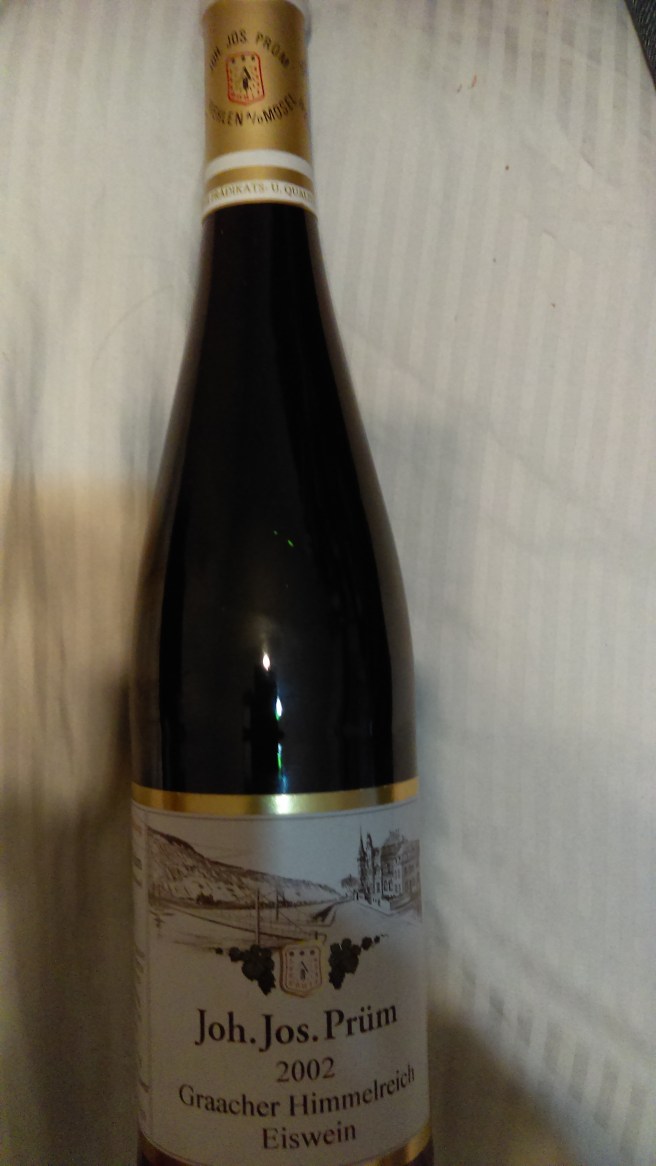
2002 JJ Prum Graacher Himmelreich Riesling Eiswein 7.5%

Weingut Joh Jos Prum is one of the most renowned Mosel estates. Stephan Reinhardt’s comments about drinking JJ Prum “ is to enjoy a springtime of the heart and mind…a combination of lightness, finesse, elegance and (most of all) energy…these are gracious, charming wines”. JJ Prum wines can be a bit sulky at initially; sometimes a bit reductive.  Time, and a decant work wonders. Their longevity is extraordinary.

Eiswein is the legally-defined term that refers to a non-chaptalized wine made from grapes picked with at least 110-128° Oechsle (the minimum level depends on the region and the grape variety) at a temperature below -7°C and which has also passed a sensorial test by the authorities. Eiswein is a sweet to noble-sweet wine, with >130 g/l of residual sugar. Botrytis plays no part in the style – it is just essence of Riesling. Occasionally the harvest can extend into the “next” calendar year, but the wine is labelled as the previous year. Eiswein is uncommon, tantalising and expensive.

IMAG0002

This wine is still a pale lemon colour; the enduring mystery is how such a myriad of flavours is contained in a low-alcohol wine. There are “spinal-tap-esque” exaggerated florals; mixed tropical fruits and candle-wax, lemon essence and lime “run-off”. Then a rush of ripe red apple, and nutmeg spices. So dense, and the pure stony flavours persist for minutes, dwindling to some stonefruits and perhaps light apricot.  Eiswein is indeed rare, and the residual sugar in this wine is not known – 200 g/l? but the acidity carries this with aplomb. Fabulous.

Drink to 2040, and 98 points

Mosel musings

Its not easy to take notes when on holidays, and with limited access to the internet. A few thoughts follow. Photos may be added later.

There are dozens of wineries in Bernkastel, and hundreds in the surrounding areas. Most are small, so the wines are not exported. Insider knowledge is needed to determine makers of decent wines. And the larger wineries may make more than 50 different wines each year, so what is available to taste and for sale can cover multiple vintages, sites, levels of quality; and it is certainly not feasible to try every possible wine, so we relied on the abilities of the hosts to take us through a range of wines. Further, although English was spoken everywhere we went (and my partner Robyn is fluent in German) there are only so many questions that can reasonably be asked, and notes scrawled in a limited time. The logistics to get any purchased wines back to Australia are awkward- I felt guilty buying so little.

The Mosel area is based around the  winding Mosel River, so it is quite a long area, with vines planted mostly on “the good side” of the river. This means the wines swap sides as the river meanders. Slopes can be death-defying, and it’s amazing how the vines can be cared for under such conditions. There are many paths suitable for cycling too.

Many wineries are only available to visit by appointment, and the car GPS was invaluable! Once opened, bottles can be safely refrigerated without degrading for at least one week (not a capability I seem to need).

The Mosel has had a dream run without poor vintages since the late 1980’s. This came to a crashing end in 2013 and 2014, vintages that winemakers described as “difficult” or worse. Buy with caution.

A special mention needs to be made of Rieslinghaus (formerly called Porn) in Bernkastel. There were >20 wines available by the glass, of varying vintages, makers etc. In addition, bottles, magnums etc were available for sale at very fair prices and covering again a range of vintages from makers such as JJ Prum, Schloss Lieser, Willi Haag and many more – plus some “auction” wines. This was an excellent resource – although we were busy revisiting wines purchased on our last trip in 2009. And this time around we wanted to try some different makers to gain a portrait of style (previous visits included MF Richter, Willi Schaefer, JJ Prum, R Haart, Dr Loosen).

A few random dinner wines -with scanty impressions included

fe riesling

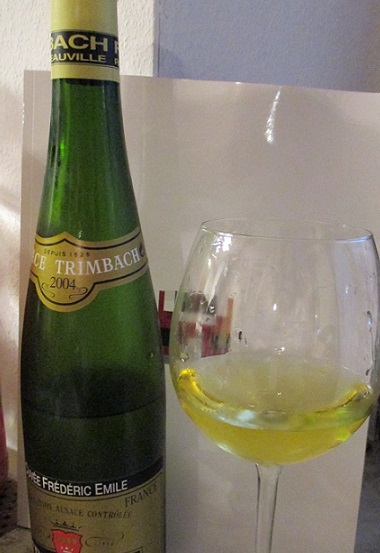
2004 Trimbach Frederick Emile Riesling – We had to start with a dry wine, and one from Alsace; delightful, pale, spicy, stony, dry. Drink now – 2025, score 93

bernkastel dinner wines

2003 JJ Prum Wehlener Sonnenuhr spatlese; this was a very hot vintage, and many wineries struggled; Prum described the wines as “sulky” and that the sites would take time to overcome the vintage vagaries – rich, mouthfilling, lush sweet tropical fruits, ready. Drink to 2020, score 90

2004 JJ Prum Wehlener Sonnenuhr spatlese; very different! Lively acidity and more classical limes, apple and energy. Drink to 2025, score 93

2004 JJ Prum Wehlener Sonnenuhr Kabinett; acidity powers this wine; minerals, lively; Here we are with an older Kabinett that will endure for at least another 5 years, but can’t quibble with drinking it; drink to 2020, score 90

2007 R Haart Kreutzwingert Piesporter feinherb 12.5%; Happy to drink this, although its drying out a bit. Red berries, stonefruit, white peach, and orange bitters.  Drink now, score 87

2008 R Haart Goldtropchen Auslese; 2008 seems to be the vintage that never retreated into its shell; this is a very sweet wine where the bottle mysteriously seemed to empty rapidly. I cannot really see further improvement and am happy to drink with its now – although the wine will hold. Drink to 2023, score 91.

2010 Schloss Lieser juffer sonnenuhr spatlese.  A year of high acidity, but once again the wine had the pleasurable balance of acid, sweetness and texture. Drink to 2025, score 93

Tasting JJ Prum Rieslings again

I have liked the style of JJ Prum since I began to become seriously interested in German Rieslings around 2006. JJ Prum are seriously structured wines, made in a reductive style. This means they can look downright ugly when young, and decanting is strongly recommended. A quick tasting of some JJ Prum wines from several vintages at Prince Wine Store was welcome. Very brief notes below, but the tasting reinforced my prejudices! And the wines were too good to spit.

2011 JJ Prum Kabinett – entry level, quite reductive, but showing spearmint and red apple

2009 JJ Prum Graacher Himmelreich Kabinett – still reductive, but more flesh, texture and white peach.

2010 JJ Prum Graacher Himmelreich Spatlese – a high acid year, and a beautifully detailed wine. Some smoke, tropical fruit not quite veering into pineapple, lovely texture, balanced. Will convert the uninitiated; stylish, delicious

2003 JJ Prum Bernkastler Badstube Auslese – a dismally hot year in Europe (that I witnessed). Yet again however, the better makers with better sites have no complaints – the wines just needed time. This wine is ready for business at 12 years age (and a bit more acid would have added to its appeal).

2011 JJ Prum Bernkastler Badstube Auslese – Super wine at such a young age, potent, long, classic minerally style. Mixed white and yellow stonefruits.

2012 JJ Prum Graacher Himmelreich Auslese – Denser, crunchy style, rich, lush, balanced.

2013 JJ Prum Bernkastler Badstube Auslese – a year of low yields, and mostly at the Auslese level. Citrus peel, sherbet, vibrant, creamy. Lovely.

2013 JJ Prum Bernkastler Wehlener Sonnenuhr Auslese. My “go-to” vineyard for Prum. Shows more mineral red apple and purity; fleshy, textural, a delight.

2013 JJ Prum Bernkastler Wehlener Sonnenuhr Auslese Goldkap. A more intense selection; Has real drive, tongue-coating silky richness, extensive length; overwhelming, and so much promise for revisiting in 10 or more years.