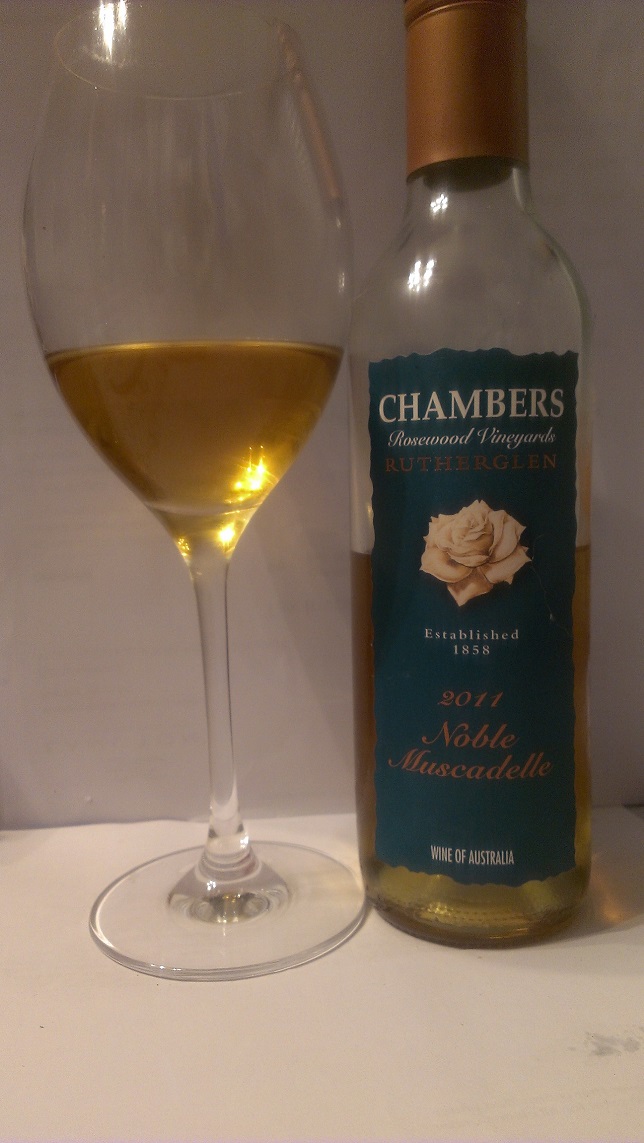
2011 Chamber’s (rosewood) Noble muscadelle, screwcap 11.3%

Chambers of Rutherglen is not the first winery that springs to mind for its sweet white wines; fortifieds yes; VFM red wines, and obscurities (anyone for Gouais) perhaps? Australia has made botrytis-affected wines from many varieties, principally Riesling and Semillon, but there have been some adventures in Sauvignon Blanc, Chenin Blanc, Chardonnay, Viognier and even Marsanne. Some of these were made deliberately, others where circumstances forced the winemaking decisions.

2011 was a pretty dire year for winemaking in Victoria, and much of Australia (although Margaret River fared well, and McLaren Vale reasonably well). There was unseasonal rain, making spraying difficult- tractors got bogged- and plenty of rot. Most red wines from Victoria lacked colour, and density. Matters were not so bleak with white wines, and there are some scintillating Chardonnays made that year in the Yarra Valley.

There have been a few late-picked or botrytised muscadelles from Rutherglen (Pfeiffer’s is known), so its not unique. Muscadelle is the variety used in making Australia’s sensational barrel-aged fortified Topaques (formerly Tokay). The late-picked style is cash-flow friendly too.

From my unreliable memory, Chambers has made this botrytis style before in 1996 and 2000, and perhaps in other years, so they have a track record, although those seasons were much kinder. I paid $15 for this half-bottle a few years ago.

2011 chambers

Its an attractive glowing deep gold colour with a hint of amber. While the bouquet is vibrant ramshackle orange marmalade, tangelo and dark honey, botrytis has performed its magic fruit concentration role on the palate, and its clearer that that flavours fall into the “dark” orange marmalade, and marginally overripe apricot fruit spectrum. The botrytis has overwhelmed any varietal characters – no bad thing. There is some bitterness too, but not enough to dissipate the wine’s pleasures.

There is considerable sweetness, and while the acid is holding this together, I would recommend drinking soon, before the phenolics take over. No embarrassment to drink; the glass seems to empty of its own volition.

Score 89 points, drink to 2019.

1992 Gehrig Vintage port 18.1%

Deep ruby colour; shiraz, plus brandy spirit from one of the Rutherglen eastern “outliers”;  rustic label, but from a wondrous year in the region. Red liquorice, mingled Christmas cake spices, milk chocolate, bursting with vitality, and fine, chalky tannins.

1992 gehrig vpA careful decant was necessary to remove some  of the heavy deposit, and its a slightly old-fashioned style, where the spirit is a bit prominent and the sweetness is slightly overdone. But we’re not all clairvoyant, and this 24 year old wine provided an overload of drinking pleasures, and another 10 years will not diminish its enjoyments.
Drink to 2025, 91 points

Two young VP styles

2009 Buller’s VP
Buller’s (Rutherglen) VPs have proven cellaring potential – I have tasted examples with more than 30 years bottle age. I opened this embryonic wine as I purchased several  bottles at a bargain price. Buller’s table wines never excited me, but when visiting we always spent time at the bird park- irresistible to my children, who usually found some feathers to collect.

The wine is spookily dense black crimson in colour, and both the fruit and sweet spirit are battling joyously. Flavours are more than just simple plum jam; there is red liquorice, tar, and other very dark fruits. Oak is properly transient. Its a supple textured wine, with a very lingering finish – difficult to resist. Everything is in place to provide pleasure over the next 3 decades, and a long decant is recommended if opening anytime over the next 10 years.

A terrific result, regardless of its bargain-basement price.

Drink 2023- 2030, score 90 points

1998 morris vp

1998 Morris Vintage Port 18.8 %

This wine from Rutherglen made by David Morris has won a few trophies and gold medals at Rutherglen and Melbourne, so it’s no slouch. Disappointingly, it has a puny 3.7cm cork, which nevertheless has done its duty.

Variety not known, likely Shiraz with some Durif (or vice-versa) but not really relevant, its a dense and weighty wine; colour is a deep blood plum; its shows floral red liquorice with headsy, well integrated spirit; flavours are all dark fruits, plum, milk chocolate with a touch of fine chalk and talc. It seems slightly old-school, and if a touch drier would have merited even more praise, but truly a style I enjoy and wholeheartedly support. It shows some real class- vibrant, smooth, and inviting with potential for improvement over the next 15 years.

Drink to 2030, score 93 points


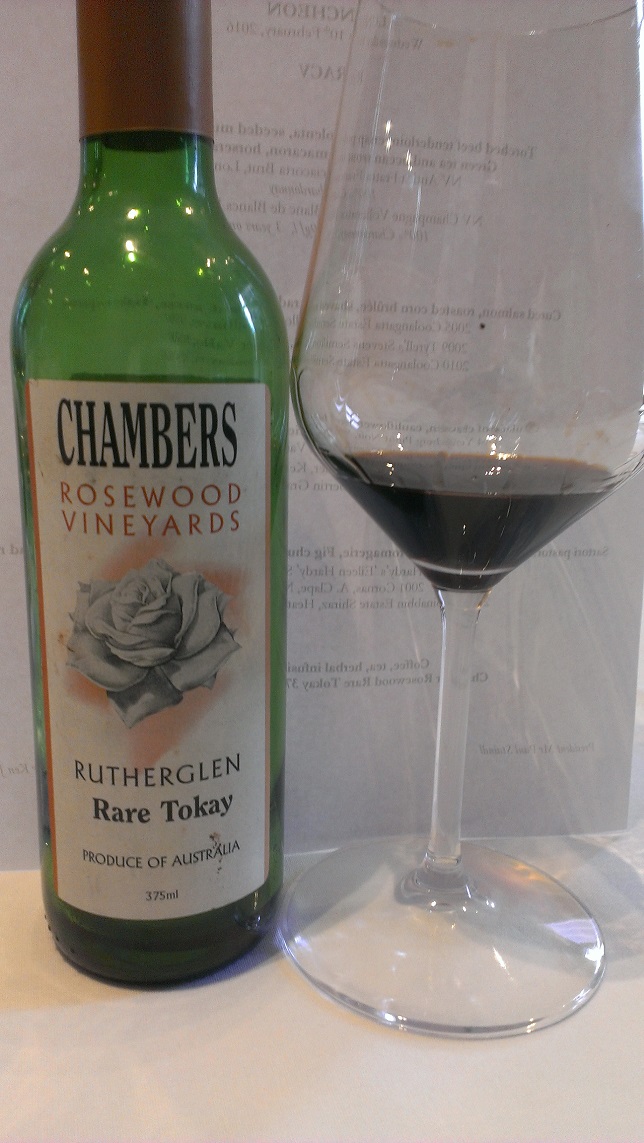
NV Chambers rosewood rare tokay (17%)

What’s in a name? This wine is labelled as Tokay, made from Muscadelle grapes , and the style is generally now called Topaque.

Chambers Rosewood is a long-established winery in Rutherglen. I used to travel there with my parents, and the welcome was “wine is in the fridge on the verandah – help yourselves” from legend Bill Chambers. You poured into “shot-glasses” and most wine was available by the bottle and flagon.

Despite modernisation over the years, there is still a baffling – and large range of wines available to taste, with some varieties I haven’t seen elsewhere.

nv chambers tokay

A lovely lunchtime treat (served blind, as usual).

The first thing that impresses is the colour, a dark motor oil, brown yet still with a green/khaki rim. Great age suspected, and it was viscous, reluctant to swirl. Then it amazes with just how much flavour can be compressed into its volume; there is the varietal muscadelle tea and malt, plus some almond and mocha; (no butterscotch here though, another typical descriptor). And it goes on, just defying my efforts to keep smelling and stop sipping.  If only I could have a bigger glass! And a bewildering long finish; amazing.

Its the top quality tier – “rare” which describes these luscious beauties well. They have had many years maturing in barrels, become denser and richer.

But these decadent Rutherglen fortifieds are not just about aged material; there is the mastery to blend in some younger, fresher material; so the density and concentration is not cloying – a treasure. The price ($250 per half bottle), in world terms is fair. A half bottle would be nicely shared with 4 people, and provide an outstanding sensory experience.

Drink now – 98 points!


1990 Campbells Touriga Vintage Port 18%

How could I resist trying this Rutherglen VP made from Touriga? Stanton and Killeen are well known for their use of Portuguese varieties in their VPs’s since 1997, but Chris Pfeiffer earlier made wines for Lindeman in the late 1970’s and early 1980’s using Touriga, Gran Noir and maybe other Portuguese varieties sourced from just over the NSW border in Corowa – I don’t know if these plantings still exist.

1990 campbells vp

For this wine, the cork has performed, and the label is retro and functionally brutal.

But I can’t discern Touriga in this Campbells’ wine, and would have punted it being Shiraz (its likely to have minor components of Shiraz and Durif). It’s sweet but well within normal bounds for the style. It’s a dense red colour with some trivial bricking on the meniscus. The (brandy) spirit is well integrated. The dominant character is dark cherry, backed with some straw/dried herb and orange peel, perhaps a touch of cough mixture and cola. It’s smooth, rich and raisiny, mellow and just what’s needed on a muggy Melbourne night. Drink over the next few years before the fruit recedes.

Drink to 2020, score 88 points

1981 All Saints Vintage Port

This was a recent auction purchase, so I am doing myself no favours by recommending this wine.

1981 all saints vp

It looks like a “lab label”, complete with a minor spelling mistake for the eagle-eyed. The cork has performed its duty.

All Saints is located near Rutherglen (albeit nearer Wahgunyah). Its history is replete with numerous label, marketing and winemaking changes, and it’s now run as an independent spin-off from Brown Brothers. But there was never any doubt about its store of old material. I recall my parents staying at the Riverside Motel, and All Saints was always one of our destinations; down the long tree-lined gravel road, through to the amazing castle-like façade; inside the gloom, coolness and numerous large barrels, before tackling a vast range of wines of bewildering quality, from forgettable to sensational.

The Vintage ports from All Saints have held up remarkably well, with excellent recent tasting results going back to the 1960’s.

This wine is Shiraz based, and it’s colour is a medium density brick red, with some definite browning. (and minimal sediment). Yet it is still full of character – there is ripe plummy fruit, gentle mocha flavours with a touch of raisin, and the fruit has coped with the spirit. Not as sweet as many, it’s a wine of civility that is drinking admirably, with lingering crisp acidity.

There is no capacity for improvement, but at 35 years, its ready!

Drink to 2020 (although it will hold), score 90 points

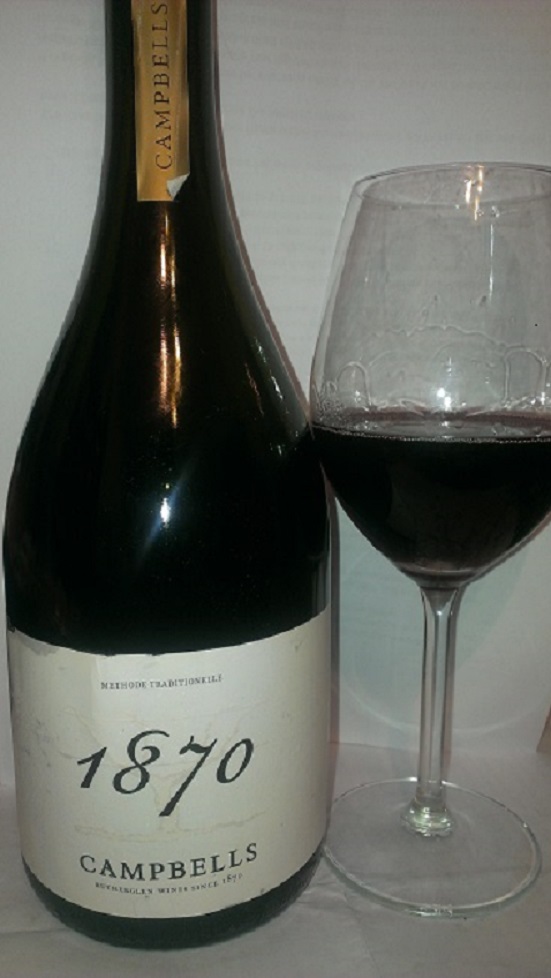
Campbell’s “1870” sparkling shiraz 14%

With a crown seal – hooray.  This was a one-off from Campbells of Rutherglen released a few years back that we paid $55 for- must have been in a good mood. (so its more serious than the Campbells $30 nv sparkling red).

The label claims its blended from vintages going back 40 years – likely Shiraz. Its vigorous in the glass, deeply coloured, lightening on the rim. It boasts an array of savoury, earthy scents – mulberry and perhaps aniseed, and old leather, with a faint touch of mushroom . The palate mirrors this, thankfully drier than most wines made in this style, with clean acidity, and welcome creaminess.  Residual sugar is difficult with sparkling reds- I think around 15 g/l is needed to balance the tannins; more than 25 is unwelcome; guessing that is around 20g/l.

nv campbells sparkling red

Another glass beckons….. yes there are wines with better QPR , but well worth a try.

Drink now- 2020, score 89 (92 with duck!)

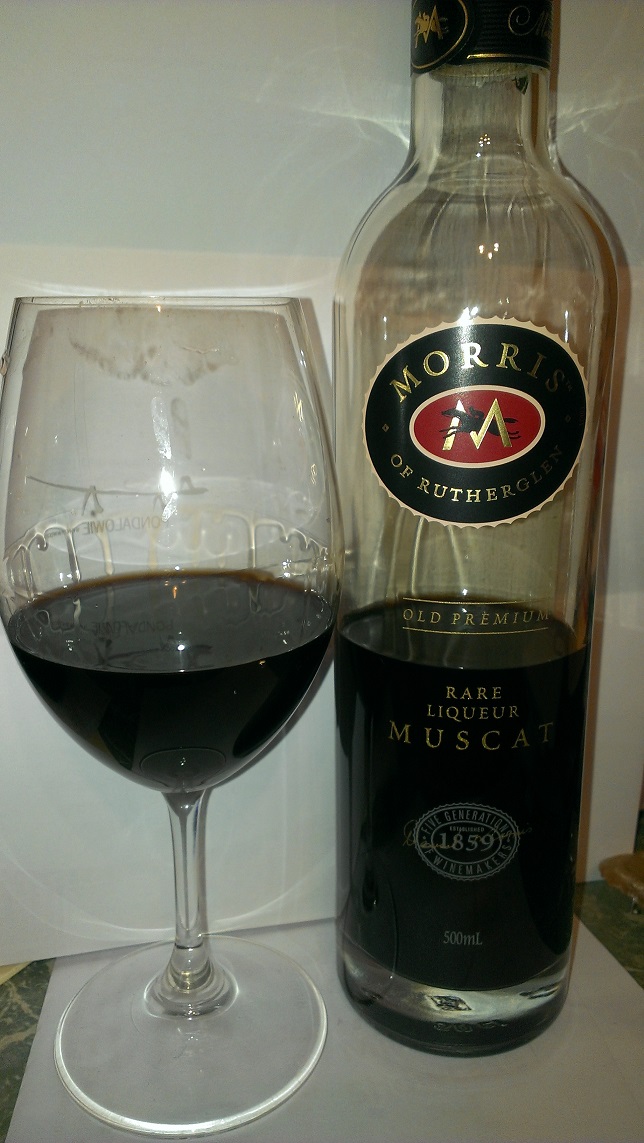
Morris (old premium) Rare Liqueur Muscat

The colour is a deep, clear khaki/brown.

It pours slowly- like motor oil -into the glass. demonstrating its aged concentration. It smells of stewed raisins, and strong dark coffee. There is a streak of cleansing acidity that accompanies the mixed flavours of raisin, almond and mocha. The wine (17% a/v) dwells in the mouth, sticking to all parts.

This Rutherglen muscat falls into the “rare” classification. The price at cellar-door is a very respectable and fair $75, which means canny buyers can acquire the wine for around $60.

morris rare muscat

A bottle doesn’t seem to last long in my household.

This hedonistic world-class style deserves 94 points, while perhaps some judicious freshening with younger material could add to the aromatics.

NV Morris cellar reserve grand liqueur tokay 17%

This is a style that Australians should be patriotic about. It’s recently been rebadged the ghastly “topaque”, to avoid any confusion with the Hungarian Tokay, and is made from muscadelle. It’s a fortified wine, made with neutral spirit, and has extensive barrel aging. The classification scheme from the Rutherglen area ascends from Rutherglen, Classic, grand, then rare, largely based on years in barrel, but with a committee assessing submissions – older does not been better – as a bit of judicious freshening can really make a difference. As a guide, the Grand classification is usually around 10-20 years old on average, and may be upwards of 250 g/l residual sugar. This is one of the styles I perform impromptu kitchen bench blends with.

This particular wine is available at Morris cellar-door only for $50; $40 for club members

morris grand top 1

The typical memory prompts include cold tea, malt, toffee and butterscotch ; while Muscat veers more into raisins. Telling them apart is never a certainty. A little is alleged to go a long way, but the style is irresistible to me, and one glass leads to another. Many North-east Victorian wineries make this style, such as All Saints, Baileys, Bullers, Campbells and Chambers. Morris is the one most attuned to my sensitivities – or the one that seems to float my boat.

There is no real food match- heretics may pour over ice cream, some will try strong hard cheeses, nuts and black coffee; but the winning match is an open fire and pleasant conversation, The wine was made by David Morris, but no doubt incorporates heritage work by his father the legendary Mick Morris, and beyond!

It’s a deep dark khaki colour with an amber/olive rim; it’s viscous and somewhat reluctant to pour. It oozes into the glass hesitantly, the words” rich and luscious” do not do justice to the length and depth of flavours, this wine seems all about toffee and malt; there is bracing cleansing acidy that defies a person to stop sipping.

Score 94 points

It’s frightening to consider that there is a further quality echelon (rare) to come, and even more awesome that there are other special bottlings at prices beyond my means. If I win a lottery yes – but I would need to first buy a ticket.