Two very different Oz fortifieds (inc one fail)

seppelt 1983 para

1983 Seppelt Para Liqueur (single vintage Tawny) 20.5%
Barossa, released around 2004, with no further improvement once bottled. Grenache, likely with Shiraz (and maybe something else). A bit of breathing helps. Gosh this is good.

In the familiar bell-shaped bottle, the colour was a deep khaki with a telltale olive green rim,  Floral and decadent, displaying very fire brandy spirit; caramel, vanilla and almond. Fresh and delicious, mocha, spices, salinity, and citrus peel, with a generous, lasting set of flavours. I have reviewed the 1976 and 1991 before – the line provides marvels of consistent pleasure, with the 2003 available on the Seppeltsfield website for $105.

Drink now (but any decent unopened bottle will safely keep).  94. points.

1977 morris VP

1977 Morris Vintage Port
Rutherglen (70% Shiraz, 30% Bastardo -aka Touriga)
Faded label, with a marginally raised cork, and the level was high shoulder but no dramas.

Still a deep red/black colour! Mocha, brandy, sweet brambles and blackberry; palate is sweet and syrupy, but defiantly fresh, sweet fruit and mellowness. Indestructible.

There were – alas – some cork artefacts present – I struggled to disentangle cork taint from corky/woodiness, and about and hour later reluctantly conceded that that very low-grade TCA was present, But very few would still resist drinking the wine. Such is life under the arbitrary hands of cork deities. Despite this “fail”, other bottles are worth seeking out.

No score but drink to 2035.

One terrific recent dinner

2011 jj prum ws spatlese

2011 JJ Prum Wehelener Sonnenuhr Riesling Spatlese 8.5%
Mosel, AP#28

Unmistakably German. Some reduction, but still shimmering with stonefruit, tropical notes, nettles, lime and flint with residual sugar seamlessly folded into a lightweight and delicious frame, that enfolds the palate. Great maker, and a great site, displayed to advantage.

Drink to 2030, 93 points

1994 Seppelt Show Sparkling Shiraz 13.5%
Great Western, Victoria. St Peters vineyard, (late) disgorged in October 2008, 28g/l residual sugar. Crown seal, and all the better! Notes below are not from tasting “blind’.

Mature but respectable colour, plenty of bubbles; mulberry, blackcurrant, dark cherry earthiness, light mushroom, and brimming with vitality. Its hard to believe there are better examples of this indestructible style around. As a bonus, my notes and score were consistent with my 2019 tasting note.

Drink to 2035, 95 points

2004 dow bomfim

2004 Dows Quinta do Bonfim (VP) 20%
Portugal – and technically a “single quinta”.

Usually, but not always from non-declared years (a decision of the producer- with Quinta do Noval an iconoclast now declaring every year).  Some single quintas are absolutely top wines, such as Grahams Stone Terraces. Usually, the single quinta makes up a large proportion of the declared vintages.

Decent colour for its assumed 20ish-year age; with blueberry, redcurrant, red liquorice, plentiful fruit here, and plentiful chalky tannin. The alcohol and spirit suggest Portugal, but the accessibility of the fruit suggests Oz origins (and I wrongly selected this option). In any event, the single quintas represent compelling VFM with monster enjoyment at an earlier age than the declared VPs can deliver. If only these single quinta were easier to find in Australia!

Drink to 2034, and 92 points

Two local, two not

2003 Ch La Tour Blanche 13%
Sauternes.
Deep gold colour; then citrus, minerals, quince, marmalade, apricot and stonefruit. Palate shows all this, plus some frangipani and balanced bitterness. Oak becomes more prominent with time, and a little more acidity would be welcome, but given its age and monster VFM, this was a damn enjoyable drink (and an insane 178 g/l rs).

Drink to 2028; 92 points

Seppelt Show Vintage Port GR151/153 20%
Barossa/McLaren Vale (tasted blind)
Bricky mature colour; VP style with high for style alcohol. Mellow, mocha, brown spices and nutmeg, liquorice and yet still with crispness and plenty of tannin to hold interest. Reasonably sweet, but lots of savouriness too. Hmm, first thought was Oz, but the ripeness, spirit quality, tannin and alcohol wrongly diverted me to Portugal. I punted on around 1990. The reveal proved it to be 45 years old, and a label covered in bling. Excellent wine (and I was fortunate to taste the slightly better bottle).

Drink to 2030 – 93 points

1949 saltram white port

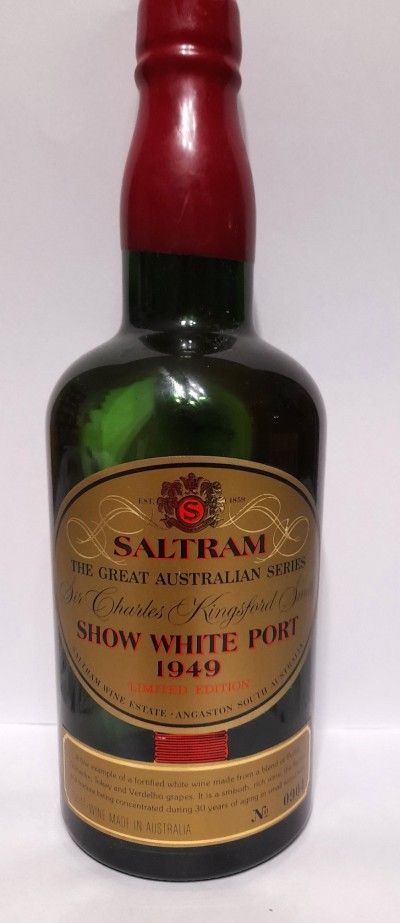
1949 Saltram Show White Port 19.5%
Barossa Valley, Bottle #0934 (tasted blind)
Bricky, lots of raisin, and a spice-bucket with rancio, and plentiful vanilla, so a Tawny style. High quality spirit. My guess was 20 years in oak. The reveal was that this wine spent 30 years in small oak,  released in the 1980s and unusually was a blend of Pedro, Grenache, Takay and Verdelho, so based on white grapes. A curio for sure, The back label contained a lot of information about aviator Sir Charles Kingsford Smith, but further wine detail was scanty (plus the cork was very ordinary).

Drink now, 90 points (more if you like the style)

2000 cockburn canais

2000 Cockburn Quinta dos canais Vintage Port 20%
Portugal, and another producer I can’t recall tasting before (a 1955 tried in 2015 was faulty).

Dense colour, then fig, plum, dark cherry plus voluminous spices. Concentrated, fruit-driven with moderate tannins, blueberry, Sweeter than most Portuguese, but with the power to thrive. Just some “burnt” characters for me that didn’t bother the other tasters one jot. Plenty of time ahead.

Drink to 2035, 92 points

Two South Australian vintage fortifieds

2002 d'arenberg vp

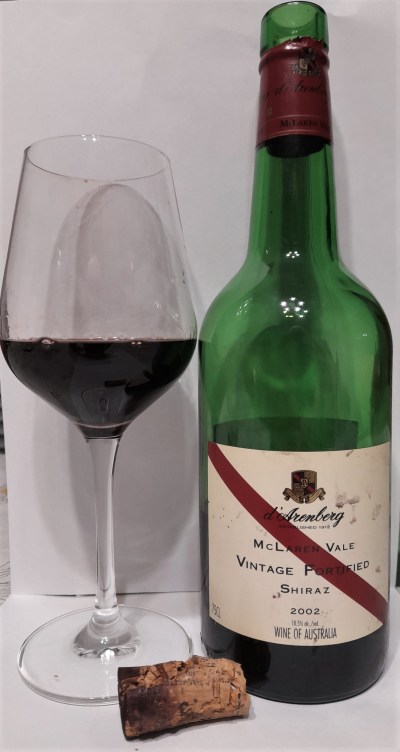
2002 d’arenberg Vintage fortified Shiraz 18.5%
McLaren Vale.

Last year I tried to visit D’arenberg to see the notorious cube, plus try some of their gigantic range of eclectically-named wines.  Their baffling website defeated my booking attempts, and the door-keeper was reluctant, and then in fact unable to assist. Who needs usability when the website looks attractive?? My conclusion was “never again”. But here is one of their wines…

This bottle was purchased a few months ago at auction for a meagre $23, so another bargain (and bonus points for being a cool vintage).

Battered cork, but the wine has survived 21 years. Loads of sediment.
Deep black colour, bricking but Ok; Dark fruits, red liquorice, fine brandy, plentiful spices. The palate has ripe, sweet dark fruits, fruit-peel characters and very refined “milk chocolate” tannins – altogether a memorable little package. Time ahead too, cork permitting.

Drink to 2030, 92 points, and 92 points.

1972 seppelt vp

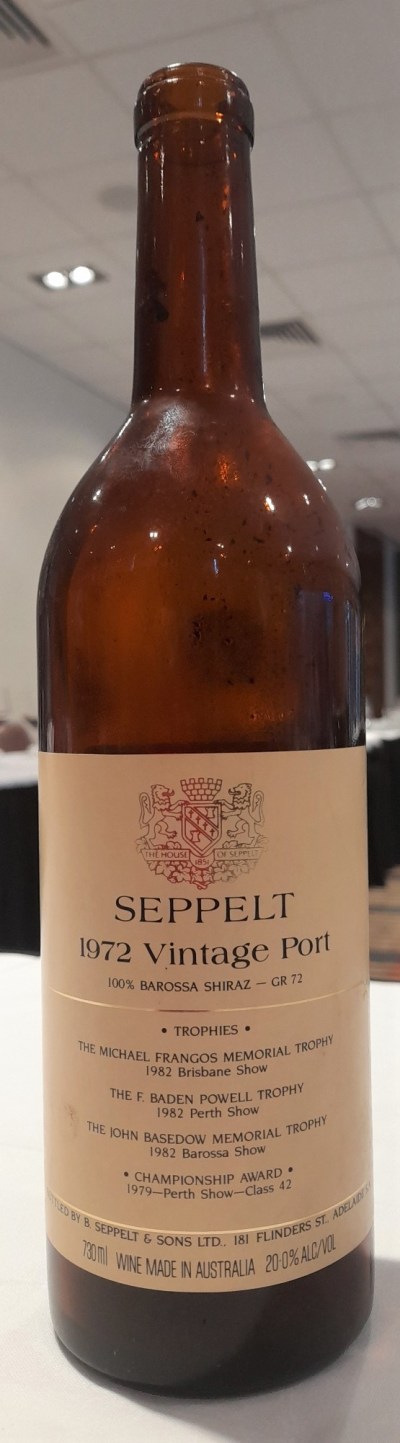
1972 Seppelt Barossa Vintage Port GR72 20%
Shiraz, Barossa Valley

Served blind. Ruby with some bricking and evidently significant age.
Ripe, sweet, old-fashioned, cuddly, delicious. Australian, brandy spirit (although one winemaker thought neutral SVR). Very, very fine and lingering. Creamy and just some complexing hints of oloroso sherry.

A different bottle showed as slightly more youthful. I guessed mid-1970s, and from North-east Victoria, but when unveiled -a terrific treat as a 50 y/o with great wine show results.

Drink to 2035, and 94 points

Two less common Australian fortifieds

1976 seppelt para

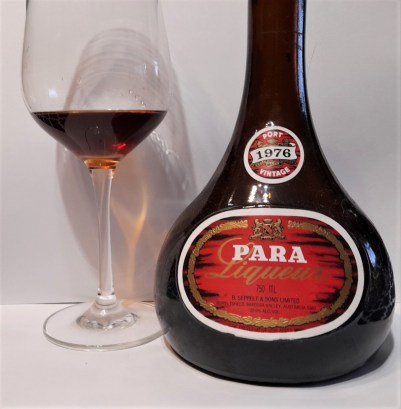
1976 Seppelt Para Liqueur 22%
Barossa, predominantly grenache with some Shiraz and Mataro.

Most of these Seppelt tawny styles have a lovely amber/khaki colour with an olive green rim – the handbell/lantern shaped bottle is distinctive, but a minor storage hazard- though most will be kept on their original cardboard boxes.

This is not a 46 year old wine! Vintage Paras were released in 1922, 1925, 1927, 1930, 1933, 1939, 1944 and 1947. Labelling laws and imperfect records meant the year referred to the oldest component. The “101” was released in 1975, with an average age around 28 years. The numbered series continued up to “126”, but the releases were slightly more often than annually. This 1976 vintage wine was released in 2004, (aged in oak perhaps 28 years) and has been resting in bottle – and not improving- for nearly 20 years.

It smells ripe with citrus peel, mixed roasted nuts, fine caramel, fruitcake spices and quality brandy spirit. It’s lush on the palate, with some mocha creaminess, and a warm and decadent finish. The style is under-rated, and the quality is exemplary.

There will be some vintage variation with varying degrees of ripeness, minor spirit tweaks, and the usual artful blending from barrels of different sizes, and heights in the stacks. There are plenty of variables to keep across. The current release (from Seppelts) is the 2001, available for $95.

Match with sparkling conversation, contemplative music or a witty movie.

Drink now, 94 points.

20 yo de bortoli black noble

De Bortoli 20 years old Black Noble 18.5%
Bottle #585. Released in mid-2018 ($90) to celebrate 90 years of de Bortoli winemaking. Average age 20 years, and made from incredibly ripe botrytised Semillon,  fortified and barrel -aged. Botrytis is often accompanied by volatile acidity, which makes its presence felt strongly here.

It’s a very dark treacly/espresso colour (indicating barrel age), with citrus and espresso, dried fruits and dusty fruitcake spices.

The palate has the nuttiness, an extra mocha shot and abundant spices, It’s turbo-charged with sweetness, acidy and power. It’s a monster step up from the widely available 10 y/o black noble. There is no getting away from the VA, but when there is so much intensity, flavour, lusciousness, and pleasure that I become a convert.

Drink now, 94 points.

Two different Port styles, two countries

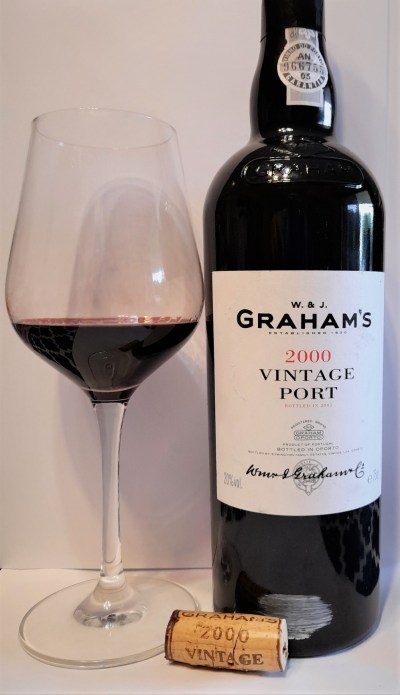
2000 graham's vp

2000 Graham’s Vintage Port 20%
Cork in great condition, and the wine has a youthful deep crimson colour; bracingly fresh and floral raspberry and faint musk; palate with rich cherry liqueur and blue fruits ; terrific calibre of spirit, chalks and almond; has entered a decent drinking stage of a long, long, life. Graham’s reputed to be at the sweeter end of Portuguese VPs- but there were no complaints at the table.

Drink to 2040, 93 points – with more to come.

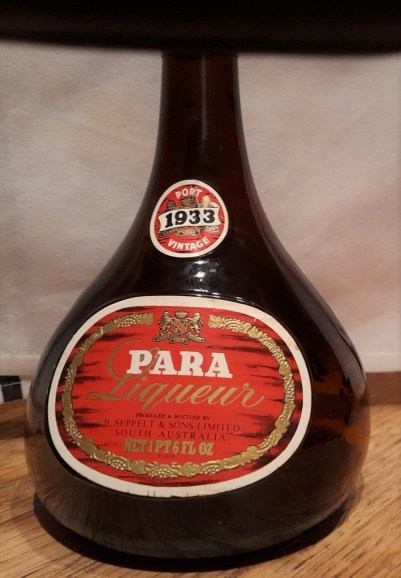
1933 para

1933 Seppelt Para Liqueur Port
1933 merely represents the oldest material in this barrel-matured tawny blend, which was released around 1962. At that tender time, there was no requirement to list alcohol, and its composition is likely to be some mix of grenache, shiraz and Mataro, with an average age guessed at 25 years.

There is the unmistakable squat bottle; but the colour did not show the tell-tale Seppelt khaki/green. It revealed more vanilla characters than expected for this style. However, it was fresher than several previous examples, and showed an array of dried fruits, almond and caramel, with a touch of mocha. Aged Barossa Valley material, and it’s always a treat to look at some history.

Drink now, 92 points.

Two older Australian Barossa fortifieds

1976 Penfolds Vintage Port

Bottle #5637 (Barossa Shiraz).  I’ve never seen or tasted this wine before- the Penfolds “rewards of Patience” book only mentions the tawny styles. Sweet but supple; red liquorice, aniseed, salted almonds, clean spirit, and this was easily consumed. Traditional, and enjoyable.

Drink to 2026, 91 points.

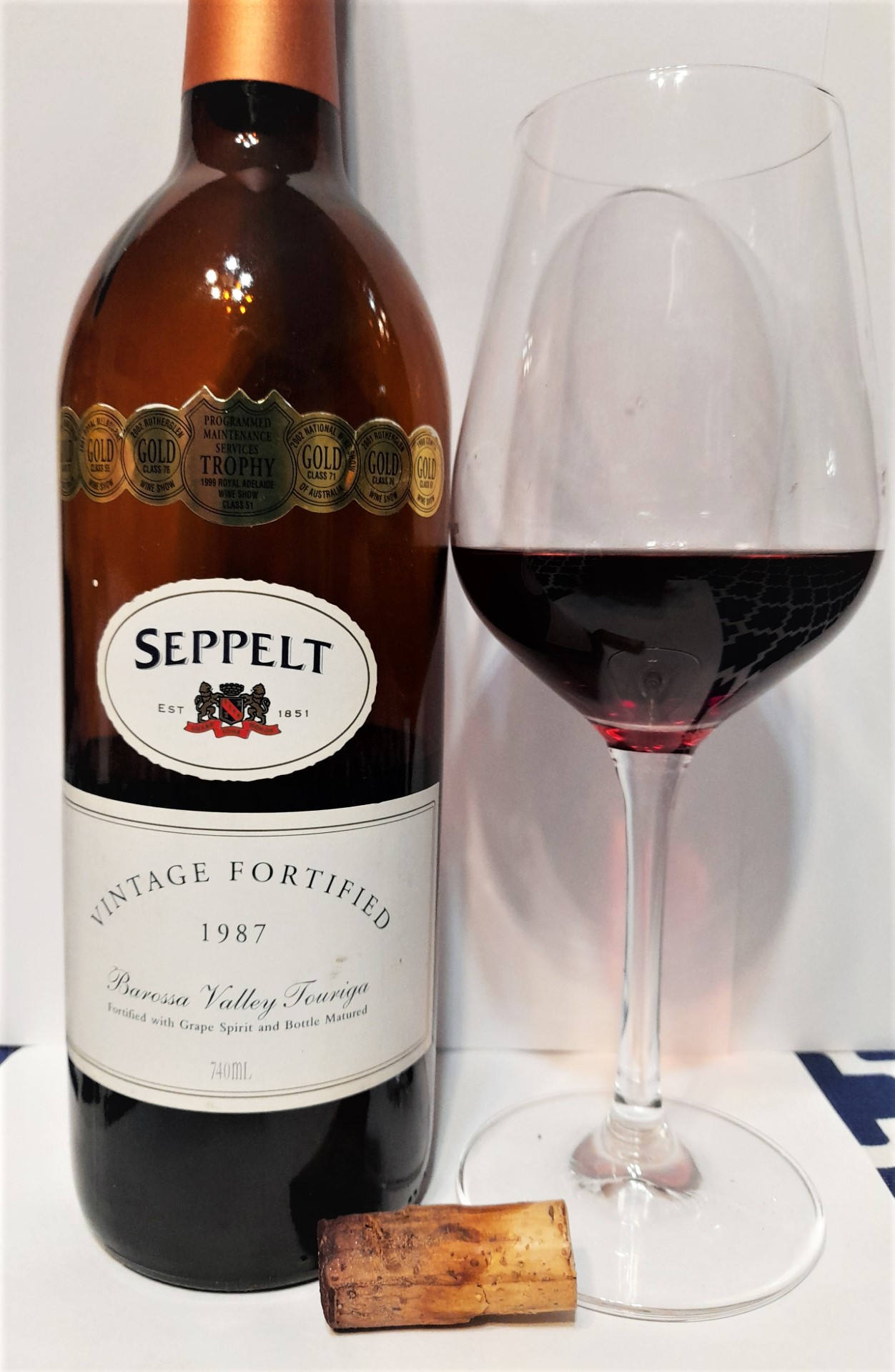
1987 Seppelt Vintage Fortified (Touriga) 20%
Barossa Valley, GR 124 “fortified with grape spirit” with lots of bling up to 2002 – and released around that time, based on back label comments. It was a recent auction purchase for $25.

I didn’t realise much Touriga was available in Australia then, destined for vintage fortifieds; although Lindemans released some Portuguese-varietal fortifieds around the late 1970s. Probably winemakers aspired to the drier and more “classical” in style, necessitating a move away from reliance solely on Shiraz.

Now (as in Portugal) there are also some dry red table wines made from Touriga, or blended with other varieties.

I was conflicted between “too old” vs “mellow for age”. It’s a light ruby colour. Roses, and rose-hip, red liquorice with a touch of mocha, even some earl grey. I’ve settled on “OK, but better previously”. Sweet fruit, immaculate sprit and there is still tannin. But as a pointer to the drier style, this would have thrilled ten years ago.

Drink now, 90 points.

Impressions, again

2009 Zilliken (Forstmeister Geltz) Saarberger Rausch Riesling “diabas” 12.0%
Mosel, 16g/l residual sugar. Pale lemon colour, which leads to scents of passionfruit, quince, pear, red apple, and ginger spice. The palate is brisk, showcasing lemon, nashi pear plus salinity, minerals and depth. It’s rounded, textured mouthfeel, and acidity carries matters along with conviction. This wine is not dry, but not even approaching Kabinett level, and it’s drinking right in the zone.

Drink to 2025 while its fresh, complex and completely delicious – 91 points.

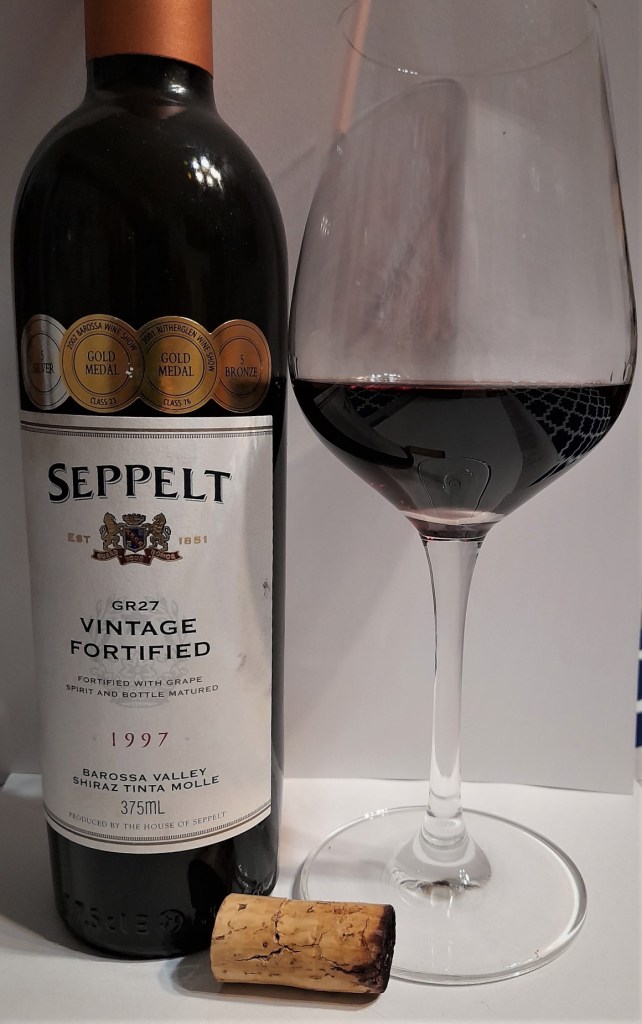
2007 Seppelt GR 27 Vintage fortified 19%
Barossa Valley (South Australia). Shiraz and Tinta molle.  Half-bottle with an abbreviated cork and abundant sediment. Decanting essential! Ruby colour with the beginning of some bricking. Rose-petal, sweet spices, sweet dark fruit and liquorice. The palate is soft, with the dark plum, blackberry and figgy fruit, mocha and brandy spirit in mellow harmony with a lingering spicy kick..

Drink now, as the structure may outlast the fruit – 89 points

1994 Seppelt Show Sparkling Shiraz, and more….

1994 Seppelt Show Sparkling Shiraz 13.5%
Under crown seal, this wine is outstanding, (but unfortunately my last bottle).

1994 seppelt sparkling red

A terrific Australian style; old vines from the St Peters vineyard at Great Western (Victoria)  and around 8 years on lees. Plenty of mousse, a touch of brick on the deep colour but wonderfully good for its age; a multitude of spices, black cherry, and plush leather; the palate is sensual, super rich, ripe and creamy; the combination of freshness and bottle development, blackberry, complex dark fruits, spices and a super, long, long finish is stunning. Around  25 g/l residual sugar meshes harmoniously with the evident, fine tannins.

Drink anytime over the next 20 or so years; some mushroom development will appear, but the fruit power, balance and freshness make this wine an absolute winner and a complete delight to drink.

Drink to 2035, 95 points

2007 Donnhoff Oberhauser Leistenberg Riesling Kabinett 8.5%
From the Nahe (adjacent to Mosel). Light-to medium gold in colour, the wine displays cumquat, petroleum, white peach, white flowers and honey. Red apple and redcurrant are more accessible on the palate with steely acidity. Exceptionally well balanced, this is ultra-easy to drink- in the zone- with a few more years of pleasure ahead.

Drink to 2025, and 91 points

2007 Reinhold Haart Piesporter Domherr Riesling spatlese 8.5%
Mosel, with a light gold colour, tropical fruits (predominantly pineapple) meshed with lemon

There is abundant residual sugar (even for a spatlese) but the acidity is well judged. Mouthfilling, vibrant citrus and a touch of mineral and spices makes this wine easy to consume.  A touch of hardness on the palate suggests caution about further cellaring.

Drink to 2022, and 88 points

Facts behind iconic Australian wine labels

Professor Albert Pedant (MA Hons- Lagos, PhD – Port-au-Prince) – from the online university of Woolloomooloo,  has diligently researched the history of numerous Australian wine brands and labels. “There are extensive gaps in the records; family and staff have often put a spin on history; but meticulous searches through dusty filing cabinets, microfiche, oral histories and numerous interviews  have shown much of the branding is a mixture of spin, myth, mischief and accident; my definitive conclusions are set out below – certain to disturb and dismay the establishment. No black armbands, fake news or alternative facts here!”

Clonakilla
Long-claimed that Clonakilla refers to the name of Dr John Kirk’s Irish grandfather’s dairy farm (translated as the meadow of the church); my scholarship proves the name was inspired by the family’s shared love of ritual and obsessive viewings of World Championship wrestling on their TV. The stunning character of Killer Kowalski, and his trademark manoeuvres – the piledriver and Kowalski claw – stimulated much household study and emulation. There was also an protracted period when winemaker Tim (“Captain”) Kirk channelled the music of another “killer” –  Jerry Lee Lewis – but with guitar rather than piano.

Clonakilla thus epitomises the Kirk clan’s hero worship and Tim’s secret ambition to become a professional wrestler. As chief winemaker, Tim’s career is probably a win for oenology, but a sad loss to the gladiatorial arts.

clonakilla logo

The Clonakilla logo is purportedly taken from the 7th century Irish gospel manuscript the Book of Durrow. But its resemblance to Killer Kowalski’s championship belts is compelling.

It’s no coincidence that the very same wrestler also inspired the label Kilikanoon. Lightning can strike more than once. Certainly, the Killer has left an indelible mark on Australian wine.

Henschke Hill of Grace

henschke hog bottle

The legend insists that the famous Henschke wine Hill of Grace is a translation from the German ‘Gnadenberg’ (a region in Silesia). The truth is more prosaic; although vines were planted on the location in 1860, the site produces an extra-ordinary variety of weeds, thistles and thorns; the biological control agent deliberately introduced – rabbits- did not have the desired outcome. Instead, several different grassy cover crops -both local and imported- were – successfully-  deployed to crowd out the weeds. Thus for many years, the site was known to the family, and neighbours as Hill of Grass”.

This was the intended name for the label, and it was only due to the linguistic misunderstandings, and a degree of hearing impairment of the printer, that Hill of Grace was created. In 1958, When Cyril Henschke saw the newly-printed labels for the first time, he was torn between fury and despair. Owning a cashflow-impaired small business, he could not afford a reprint, and was gracious enough not to hold the printing firm, or the printer- a fellow congregationer -responsible for their error. Thus Hill of Grace was born- now a venerable Australian wine icon.

But the true founder of this Australian label is a long-forgotten, unknown print tradesman of ethnic German descent.

Seppelt (now Seppeltsfield) Para Port
There is no truth that “Para” was derived from the arcana of print and publishing mark-ups.
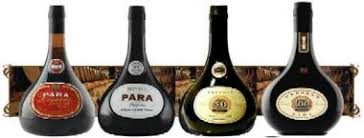
para labels

The legend attributes this Seppelts (and now Seppeltsfield) brand to the Para river in the Barossa valley; but this is erroneous. The key market for Australian wines – at that time – was England, and the Antipodean approach to branding was to create “critter labels” often featuring emus, kangaroos and other native fauna.

The group tasked with creating the name settled on Parrot Port. Further, the colourful Australian King Parrot was chosen to be depicted on the label. But economics intervened; the quoted cost of multi-coloured printed labels was formidable and weighed decisively against a new market entrant. A plainer label would fail to display the avian magnificence of this ornithological beauty.

Forced to make a hasty decision , the shorter Para was selected. It’s become famous in its variant guises, especially the extra-ordinary 100 year old “port”.

Penfolds Grange Hermitage
The official back-story is that Penfolds’ winemaker Max Schubert travelled to Bordeaux, and after returning to South Australia made the very first – experimental –  “Grange” in 1951. But where did the name come from? This question is far from straightforward.

One proposal – noted in Huon Hooke’s volume “Max Schubert winemaker” – suggested Grange was the name of the Penfold’s cottage inside the Magill vineyard- but alternate explanations surely have greater plausibility than this convenient corporate flim-flam.

penfolds grange

Due to a scarcity of high-quality Cabernet Sauvignon, Max used the grape variety Shiraz (aka Hermitage). Max would have been well aware of the famous Chapel (la Chapelle) on the Hill of Hermitage. Did Max pay direct homage here? – it’s not a huge leap of description between Chapel and Grange.

Grange is not a wordplay on Garage, and it’s not related to 3rd growth St Julian property Chateau Lagrange. It is highly unlikely that Max was aware of the gentlemens’ establishment outside La Grange Texas (also called the Chicken Ranch), brought to widespread notoriety in 1973 by the band ZZ Top.

Max Schubert typically refers to the wine as “Grange”, but he has unwittingly provided several clues, claiming his aim was to produce a wine “capable of improving year by year for a minimum of twenty years …something different and lasting….controversial and individual.”

One serious suggestion is that Max Schubert was inspired by the Australian composer and performer Percy Grainger– best known for his revival of the tune “(English) country gardens” but also a renowned connoisseur and collector of Europe’s finest wines. Could Max have originally referred to his own opus as “the Grainger”, but ultimately tired of explanations to his less-high-browed colleagues, and gradually it became the “Grainge” and then somehow the spelling was corrupted or simplified? Certainly this heritage is controversial, individual and different.  It is unclear, however, if Max was aware of Percy Grainger’s proclivity for self-flagellation and his other sado-masochistic interests.

Grange is a seaside suburb of Adelaide, where Max spent countless hours on his lesser-known pastimes, fishing from the jetty, and imbibing beer – and smoking-  at its numerous attractive hostelries. Like Marcel Proust’s madeleines,  did this humble municipal district and its numerous attractive recreational memories – perhaps a teenage romance? –  inspire Max to pay tribute, and create the wine Grange?

We have a riddle wrapped in a mystery inside an enigma; the contenders are numerous, but the true origin of Grange remains a conundrum. Further research is planned, although regrettably the current owners of this brand have so far not co-operated with my endeavours.


As Austrlia’s foremost historian, and while my vinous research is ongoing, (Wendouree and Giaconda are currently under my intense scrutiny), I am honoured to have finally set the record straight on the factual origins of these famous Australian wine brands, and shamed the writers and historians who have uncritically and recklessly promulgated the fantasies behind these labels.

My discoveries will surely impel studies of establishments in Bordeaux, Burgundy, the Rhone Valley, Rioja, Alsace, Tuscany and Piedmont – just for starters. Heads will roll – Vive la revolution!