2003 Pondalowie Vintage Port 19.5%

50/50 Tinta Roriz (Tempranillo) and Shiraz; 500ml bottle “fortified with selected grape spirit”, and only two barrels made- cork stained about 1/3 through.

Domenic and Krystina Morris have ample experience in Australia , and overseas, with workplace Quinta do Crasto in Portugal being perhaps an inspiration for their only fortified – so far. The Bendigo-based  Pondalowie wines are fruit-driven with oak as a complement; the reserve wines are vintage and variety-dependent. Prices are very fair.

2003-pondalowie-vpFrom a hot, low-yielding drought year in Victoria, the colour of this wine is a dense black red, with minor bricking;  Fruit-powered, with aromatics of  exuberant dark liqueur Morello cherry and some red liquorice; the palate mirrors this with some plum too, and fine, lingering chalky tannins; spirit is a bit hot to start but resolving.
Lovely drinking to 2023 and 91 points, but certainly requires a decant to remove the sediment.


Blogs, sites, resources (part 2)

Frank Zappa’s quote on rock journalism has long resonated “People who can’t write, doing interviews with people who can’t think, in order to prepare articles for people who can’t read”.

There must be something similar about wine writing; perhaps like Samuel Johnson.  “Sir, a woman’s preaching is like a dog’s walking on his hind legs. It is not done well; but you are surprised to find it done at all”. Now, If only wine writers could talk; alas, some of them do, sometimes forcing us to listen.

And once more, an excerpt from Steve Slatcher from a World of Fine wine article, with the key quote being “One result was that while the experts’ ratings correlated with price, the non-experts (customers lacking a wine education) actually preferred cheaper wines. It is a difficult sell to get those customers to invest time and money in learning about wine so they can then spend even more money on expensive wines they never used to like”.

Yet this is exactly what wine writers aim at – convincing readers to follow their own tastes and prejudices.

Here is a list of some selected – free- international sites, again for people with much spare time.

Regular posters

  • Winenous – Steve Slatcher in flight, a thinker, a  researcher,
  • Andrew Jefford on Monday (Decanter magazine). Writes with heart; tasting notes that have a admirable touch of melancholy
  • Wine anorak – Jamie Goode’s wine-ranging blog- reviews, news, welcome and refreshing material
  • Wine Detective – Sarah Ahmed’s “outside” views; the affection shines through, and some courage too.
  • Hosemaster – Ron Washam – satirical, with a US focus- not every post is not a winner, but crikey what fun when it is. (Eg Bob Dylans Nobel win)

Reference sites – general

  • CellarTracker -a wonderful resource with community reviews (but you should find “sympathetic and knowledgeable” reviewers – such as Cam Wheeler) . Payment is encouraged, and allows you to upload your wine details.
  • Wine-searcher; where can I get it- and how much? The pro version captures more retail sites; subscribing may thus save you money when buying wine!

Reference sites – specific

Most regions, and many companies, and wine retailers have their own sites; Google away, but the two sites below are among my regulars

Mosel Fine wines – by Jean Fisch and David Rayer-  I am astonished at the depth, and number of reviews; their, charm, scores,enthusiasms and knowledge have led me to many purchases, and guided appointments made in the Mosel.

Bureau du Champagne – Not wonderfully up-to-date, and ultra-protective of Champagne, but there is a vast amount of history, geography and “feel” here, if you have the patience to trawl through the links


Blogs, sites, resources (part 1)

Here’s a list of some sites and blogs that may interest  folks with more spare time than me;  I have concentrated on free sites; my list is far from complete but will gradually improve.

Australian reviews and so on

  • Chris Shanahan – Canberra-oriented, beers too. No scores, but the descriptions provide enough cues.
  • Australian wine review – Andrew Graham’s very active site, refreshingly honest with his views and scores; he’s fortunate enough to get to many vertical tatsings and other opportunities
  • Drinkster; Philip White’s site – imagine Hunter S Thompson in stream of consciousness mode about wine; I can get pleasurably lost in the full-throttle imagery
  • Grape Observer – despite Sean Mitchell’s WSET diploma, the language in the reviews is cogent and usefully abetted with the right amount of background history, theory and analysis
  • Brisbane Book Club – sporadic, but worth the odd peek; scores usually realistic, avoiding the hyper-inflation of some other places.
  • Wine reviewer – Patrick Eckel reviews many interesting wines in unexpected and useful detail; and some more extended musings are worth the detour.
  • Simple palates seriously – Terence Pang’s writing is easy to read, but there is a real sense of person and perspective here.

 NZ reviews and so on

  • NZ Wine of the week – Sue Courtney’s site, relentlessly positve, but also has excellent indixing of tasting notes, information about NZ wine areas, wine show results etc.
  • Otago daily news– Mark Henderson’s weekly wine page, provocative insights, not just reviews
  • Geoff Kelley – quite technical, but some terrific tastings here, many international benchmarking studies, amazing wines
  • Raymond Chan wine reviews – very active, good reference site for NZ – and beyond – scores are on the enthusiastic side

Australian reference sites

  • Winebiz daily wine news – a roundup of links to news snippets, PR pieces; some international (mainly NZ) too
  • Sommeliers Australia – events, education, industry jobs
  • Australian Wine Research Institute (AWRI); more of a site for winemakers, but there is lots of information tucked into the tabs
  • Langtons – it began life as an auction site, but the “price guide” area (under the resources tab) provides estimates of what the market (rightly or wrongly) believes is a fair price for thousands of different wines

 Community forums

  • Auswine is very active, with a healthy South Australian focus, and very varied contributors – a good source for “off-line” events.
  •  Australian Frequent Flyers wine lovers– enrol to reduce maddening ads; this is a great place for bargain hunters to pick up discount codes, identities of mystery wines, and some wines to avoid!

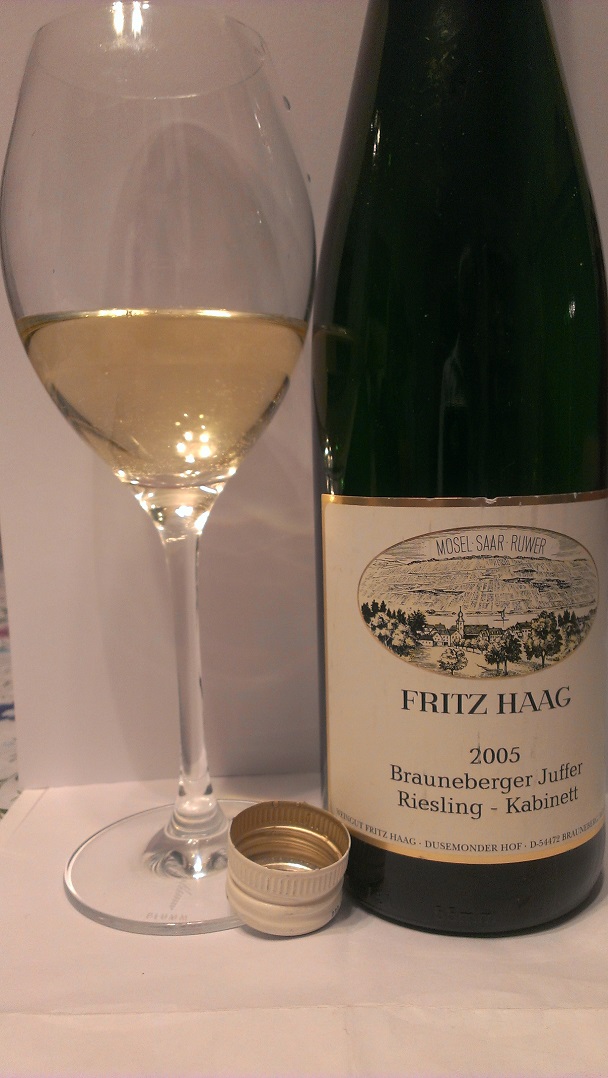
2005 Fritz Haag Brauneberger Juffer Riesling Kabinett 8.5%

Another white wine under screwcap, and age has not harmed this lovely and utterly convincing Riesling Kabinett from a sterling year in the Mosel.

2005-fritz-haag-bj-kabinett

It’s still a pale lemon colour, and there is ripe apple, some tropical guava, and some “fruit tingle” too. The palate is appropriately light for this category of sweetness, and resounds with crunchy, stony limey citrus character (“mineral” is out-of-favour, despite this word being clearcut and descriptive). Delicious, bright, tangy, with terrific length and everything under control. A benchmark from this well-known estate.

Drink to 2025, 91 points

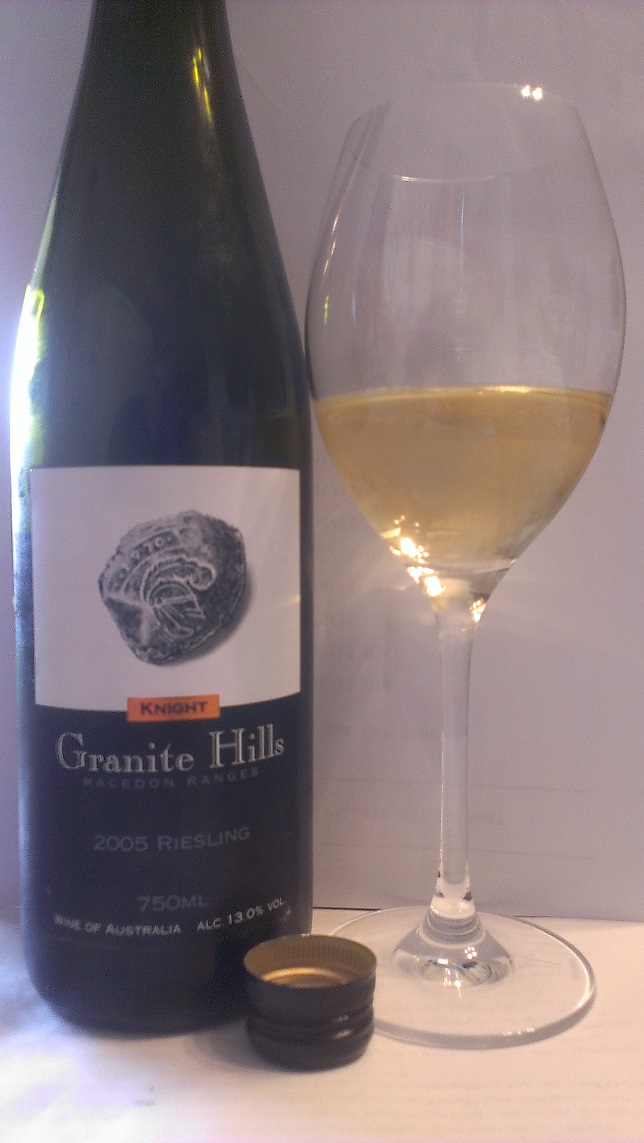
2005 Granite Hills Riesling 13%

Granite Hills produces quality Rieslings from the Macedon ranges area of Victoria, where Chardonnay, Pinot Noir and sparkling wines are much more prevalent.

Llew Knight has been making Riesling (and other varieties) for many years, and the Riesling is a often a standout- I have fond memories of the trophy-winning 1998, and the still available 2014 is excellent. Its one of the very consistent, commendable age-worthy, minerallly Victorian Rieslings, pitched at a lesser tariff than Crawford River or Seppelt Drumborg.

The drive towards Baynton features spectacular granite outcrops littering the hills, amidst dense bushland.

This wine I suspect is not completely dry, but is near-enough, with still powerful fruit.

Update! – winemaker Llew Knight has assured me the wine is completely dry, so it’s just fruit that conveys the impression of slight sweetness.

Under screwcap, time has infused the varietal expression with some faint but attractive toastiness.

2005-granite-hills-riesling

It’s a bright pale lemon colour, and strides out with abundant lemon zest, ripe red apple and a hint of lanolin. Talc, lemon, flint, viscosity and bright, lively refreshing natural acidity are the keynotes of the palate. This is a confident, complex expressive wine drinking wonderfully well. It has huge appeal and will match to a huge variety of food – Asian, poultry, seafood, creamy dishes.

Drink to 2026, and 94 points.

Films about wine, winemaking, wine drinking and wine marketing (possibly)

There are a surprising number of films made about the unwelcome effects of drinking -the Lost Weekend, and Withnail and I come to mind; and more where wine takes centre-stage- Sideways is well known, as are Mondovino, Somm, Red obsession and A good year.

I’ve ransacked my archives to provide a partial list of wine-relevant films, none of which curiously are available through the AWRI or Wine Australia, so there is a deep educational gap within the wine community..

  • The acid test
  • All creatures great and small
  • The birds
  • The colour purple
  • Do the right thing
  • Fires on the plain
  • Gone with the wind
  • The grapes of wrath
  • The greatest show on earth
  • Hail the conquering hero
  • How green was my valley
  • It’s been a hard days night
  • I walked with zombie
  • Lord of the flies
  • The miracle worker
  • Never give a sucker an even break
  • Red harvest
  • Red river
  • The ten commandments
  • The 39 Steps
  • The magnificent seven
  • True grit
  • The wild bunch
  • The wizard of Oz

These will repay close study.

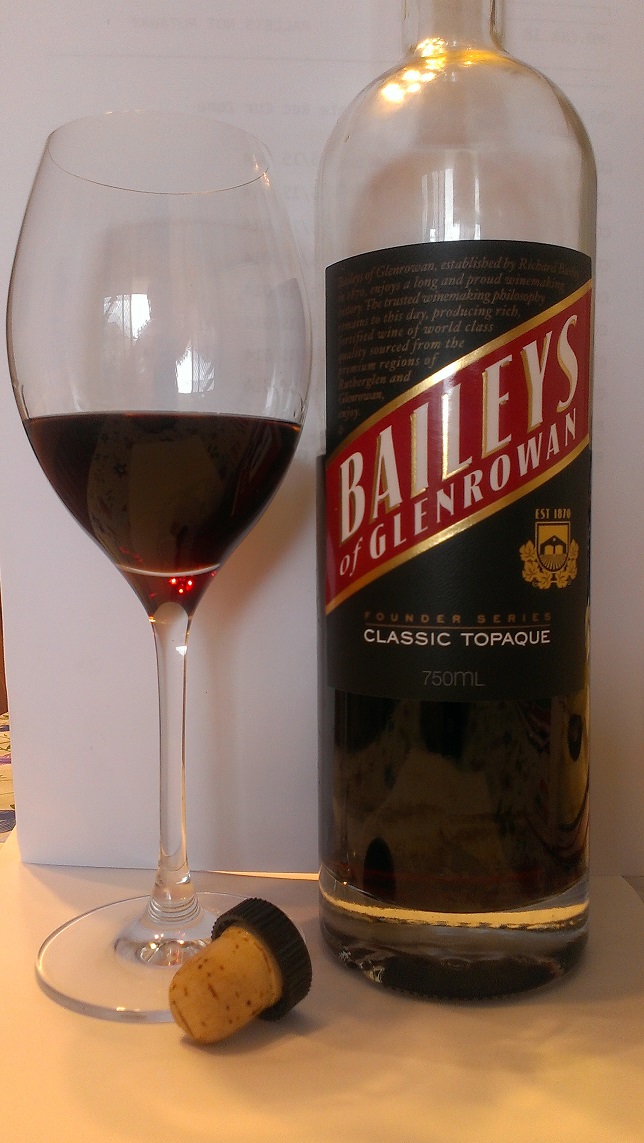
NV Baileys of Glenrowan Founders classic topaque 17%

Baileys is a winery we detour to when travelling along the Hume Highway from Melbourne. Just out of Glenrowan, the visits I recall have largely been during summer heatwaves where the eucalyptus oil is heady in the air, or during winters when rain is lashing along. In both situations, the winery is a welcome relief.

For sentimental reasons (written about earlier) I have a longstanding affection for the luscious fortifieds and traditionally-styled bold  ferrous reds of Baileys. Harry Tinson’s legacy is respected by talented winemaker and custodian Paul Dahlenberg. So I should like the wine.

nv-baileys-topaque

Topaque is the revised name for the Australian fortified Tokay. Unusually for this young, fortified muscadelle style, the wine is sold in normally sized 750ml bottle (rather than the more common 375ml or 500ml). Its an amber colour, with a khaki rim; malt and digestif biscuit dominate the aromatics, with a touch of sea, seaweed and iodine adding to the intrigue. It is rich and inviting. But that’s where the highlight reel tails away; the palate displays ample but simpler butterscotch characters. While there is no doubting its sweetness, it’s a bit of a letdown after that bouquet, and overall something is missing. There is some rancio from wood aging; there is ample acidity to cut through the sweetness; I’ve struggled here and ultimately concluded that the bottle is a bit stale (a batch or storage issue); as the result does not match other tastings of this wine over the past two months.

It still represents excellent VFM, and many will appreciate this wine more than I did.

Drink now, but this bottle only merits 85 points

2008 François Chidaine Montlouis-sur-Loire Clos Habert 13%

From a small appellation opposite Vouvray, this is Chenin Blanc, but not what we are familiar with in Australia. Chris Kissack’s site is a tremendous resource.

Here, Chenin blanc is typically grown in warmer regions; and contributes fairly anonymously in blends where its acidity helps. There are some exceptions (Coriole, Peel Estate, and from New Zealand, Millton) but it’s a slender set of resources. Chenin blanc formerly was a mainstay of Houghton’s White Burgundy (which blossomed with a few years age), and I recall a truly striking 1981 St Leonards botrytis version.

Chidaine has a huge reputation, and I purchased this wine for a bargain price (under $40) a few years ago.

2008-chidaine

This wine is an exceptional experience; lemon to light gold in colour, it presents an exciting, exotic set of aromas and flavours. Quince, pineapple rind, ripe red apple, lime juice, yellow pear and freshly cut grass are all present,  It’s meshed with perhaps 20 g/l residual sugar which is swallowed by the balanced, refreshing acidity. Lastly, that set of flavours hangs around with a honeyed, thick, textured mouthfeel.

A fabulous match with varied cuisine (many Asian dishes,  fish, white meats) this VFM wine will kick goals for many more years.

Drink to 2030, 95 points

Morris Cellar One Classic Liqueur Muscat 17.5%

It’s been a while; juggling two new casual positions has been wearing; and a few intended posts have fallen victim to photographic mishaps, lost notes and wine faults. Hectot Lannibal will return in October with another Stoney Goose Ridge new release.

In the meantime, here’s a tasting note on a wine that is actually available for purchase!

Morris is a longstanding Rutherglen winery, recently offloaded by Pernod Ricard and acquired by Casella. I strongly hope that David Morris can continue to produce the full-bodied red wines including the memorable Durif, the amazing VFM Shiraz and other specialties, plus the plethora of fortified wines – Aperas (sherry styles) , Topaque (Australian tokay styles), Muscats in a range of calibres (and prices) and a vintage fortified.

“Classic” is the 3rd tier of quality hierarchy employed by most Rutherglen fortified makers; entry level is Rutherglen, then Classic, then Grand; “Rare” is the classification at the summit. These have longer barrel aging (generating more concentration) Finally the wines endure the judgement of peers; the wines are assessed for quality and adherence to style parameters, so the higher classifications tend to be older, richer, more concentrated.

More information about the classification system  is here.

A useful opportunity at the Morris cellar door is to taste through the range side-by side from Classic to Rare, then try to exercise purchase restraint. I seldom escape with  less than one dozen mixed bottles each visit.

Given that Morris makes a quality Classic Muscat at a lower price, the Cellar One Classic Liqueur Muscat is an “alternate” higher priced version (500 ml for $35 with a generous 20% discount for Morris wine club members), what is the story? My judgement is it’s a young wine but made from a blend of “better” vintages, and demonstrates alignment of fruit density with freshness, pointing that “classic” is a worthy, and broad-ranging classification level, not a poor relation.

morris cellar one muscat

It’s a clean bright light amber/khaki colour, with visible legs; as well as the typical raisin aromas and other dried fruits, there are voluminous scents of fresh rose petals and jersey caramel, the fortifying spirit seems neutral allowing these varietal characters to shine. Oak is not directly noticeable in this style, although it contributes to the rancio characters and a grainy, finely woody acidity. In this sweet fortified wine, bright flavours dwell in the mouth, coating all parts persistently while the acidity means the wine retains vibrancy and the imperative for further tastes.

Not meant to be cellared; exposure to this style should lead to a legion of new converts; and merits a merry 91 points.

another Champagne masterclass

I wrote about a tasting of Champagnes in December 2015, and once again the Bureau du Champagne and Sommeliers Australia hosted another enlightening tasting in late June.

Kate McIntyre MW and Wiremu Andrews led the way, with tulip glasses (not flutes) correctly deployed, and a cunningly selected cross-section of Champagne presented.

Wines were served in brackets of two, with part of the exercise to determine what the underlying themes were. This was impossible for me; my Champagne consumption is limited by budgetary consideration to less than one bottle each month, so familiarity with house style is theoretical (and some house styles are on the move).

Participants were encouraged to concentrate on structural aspects (such as acid profile, phenolics and oak) rather than merely aromatic and flavor descriptions. This required severe concentration, but was rewarding. Given Champagne winemakers have variables such as reserve wines, MLF options, oak maturation, dosage, and time on lees, it’s no surprise that trying to unravel blending decisions and assess outcomes while compensating for confounding effects from glassware and serving temperature is problematic. And in the real world, a further complication exists – food matching, which vastly impacts appreciation.

Too often Champagne is merely used as an introduction to the “serious” wines at a tasting – it warrants much much more attention.

fizz masterclass jun 2016

Bracket 1; same cépage but different houses (Pinot Noir predominant)

  • NV Canard Duchene
  • NV Bollinger

Bracket 2; same house, different cépage (Chardonnay predominant)

  • NV Delamotte Brut
  • NV Delamotte Blanc de Blancs

Bracket 3; Vintage 2006

  • 2006 Moet & Chandon
  • 2006 Mumm

Bracket 4; same house NV vs Vintage

  • NV Pol Roger
  • 2004 Pol Roger

Bracket 5; Rosé , saignée vs red wine addition

  • NV Pommery Rosé (saignée)
  • NV Jacquart Rosé

No worthy notes, but the Delamotte Blanc de blancs was a revelation for me. No poor wines here, but it all depends on what you look for and prefer (elegance vs power; what kind of mouthfeel). I left with renewed appreciation of the blending art of Champagne; constructing a wine from lots of moving parts, and an (expensive) determination to drink more Champagne