April 1 release of the Unicorn

“Brainless, heartless, spineless, gutless, charmless and useless. But I don’t publicly use these descriptions of my competitors, especially when I have an astonishingly great breaking news announcement, said CEO Hector Lannible.

It’s rare but it’s not a myth. Well-heeled collectors often boast of their so-called “unicorn wines” – due to their cost, rarity or both. But under my dynamite stewardship at Stoney Goose Ridge, we continually break novel ground, transformationally disrupting the binary paradigm mindset, and today we launch the Unicorn into the firmament. It’s no myth – we have one. This is not a terminological inexactitude.

It’s the finest, most exclusive wine we make; a spectacularly curated selection of our top barrels, artisanised through our innovative proprietary technological wizardry.

It’s rarer than a (Northern Hemisphere) black swan, scarcer than hens’ teeth, and in shorter supply than rocking horse manure. The wine itself is obviously truly unique; a red wine from the noble Cabernet Sauvignon, with some Merlot and other varietals. It’s from a specifically unique terroir, a particular block we call Area 51, concealed from public view.

One of my numerous visionary ambitions for Stoney Goose Ridge was to create a compelling monument; several earlier attempts were declassified as not fulfilling my passionate quality aspirations, but this time I have drop-kicked the googly directly into the side-pocket to gammon the bout with a triple jackpot; at last now I proudly proclaim the impending debut of 2017 The Unicorn.

Crafted by our squadron of expert fashionistas, matured in superior oak, with all key decisions taken by myself, this wine will deservedly sell like wildfire, and even impress the legions of wine-writing toady freeloaders. Truly, I rolled the dice and came up trumps, smelling of roses. No shortcuts have been taken, no marketing expense spared, no stone left unadorned.

Although astonishingly supreme drinking already, the Unicorn will literally last for centuries if cellared under appropriate conditions, proving a long-lasting legacy for future generations.

Vegan-friendly, and fully biogeneric, the Unicorn is like finding a needle in a haystack under a blue moon on the twelfth of never at the end of the rainbow.

  • Each bottle is presented in a timber receptacle certified by sustainable forestry organisations.
  • Each individually-nomenclatured bottle is recyclable, and fully carbon offset neutral.
  • Each bottle includes a hoofprint of authenticity, with artwork inspired by the creature.
  • Each timber case contains a certificate (suitable for framing and display) commending the owner for their responsible purchase

Prepared under the indirect supervision of several RSPCA members, plus input from selected members of Zoos Australia, the World Wildlife fund, Amnesty International and Greenpeace, no animals were harmed in the manufactured assembly of this utterly glorious wine.

Some early reviews from some key columnists ….

“Yet another brazen barrage from the inexhaustible Stoney Goose Ridge; extraordinarily detailed, indeed lavish packaging, presentation and production. The wine is symptomatic of the producer’s style, and some may even be prepared to pay the piper.” (J ”Doc” Hallidae)

“Formidable box, bottle, certificate” (CM – Frontwine)

“Squarely aimed at a particular lucrative market niche, even down to the minuscule but accurate Chinese back label” (J. Olivier)

With an RRP of AU$140 (€88, £78, US$80), the Unicorn 2017 represents a valuable pathway entry to the stratospheric pantheon of upper echelon vinous beverages. This mega ultra-premium super-deluxe wine is affordable even to aspirational mass-market millennial gen X FMCG consumers, and is predestined as a lavish-appearing gifting reward. WYSIWYG. Alternatively, guests will be stunned by the magnanimous generosity of humanitarians prepared to sharingly broach the contents when it’s opened.

Truly, the Unicorn is a wine worthy of its origins, my own unrivalled, unparalleled creative genius and a worthy homage to immortal gravely endangered creatures. And it tastes just magnificent. All the usual rent-a-crowd misfit vinous scribblers will whole-heartedly fulsomely endorse its compelling virtues. Stoney Goose Ridge triumphs once more!

Importantly, for every bottle sold, with our culturally embedded philanthropic charitable ethic, Stoney Goose Ridge commits to donate $1 to the Unicorn Funding Organisation (UFO), for habitat rejuvenation. Additionally, our ensemble of tax magicians will ensure intangible magnification of counterbalanced downstream benefits.

Available from 1 April, and likely to sell out on the same day, do your duty to this blue planet, quickly rush to your nearest fine wine boutique for your piece of the Unicorn”.

An Australian Topaque and a Pedro Ximenez

Lindemans Classic  Tokay (topaque)  solera WH2 18%
Lindeman’s is a well-established Australian wine label, whose wines have lost lustre and market credibility over the years, with short-term accountancy driving the brand backwards. The Hunter River Semillons and Shiraz are almost invisible – and of lesser renown; the Coonawarra wines (St George, Limestone Ridge and Pyrus) still exist as the flagship, and the Leo Buring Rieslings – Leonay excepted – are a shadow of their antecedents.

Lindemans ran a Classic release program; my paper archives record that the Tokay solera WH1 was released in 1996 with an RRP of $64.95 – serious money 20 years ago! From Corowa and Rutherglen, it was based on an old Rutherglen Tokay parcel purchased in the late 1950’s. The WH2 was a later release that picked up 1 trophy and 20 gold medals.

nv lindemans tokay

It’s another historic fortified wine that is a seriously dark khaki colour with amber tints. Varietal malt, smoothness and density attest to serious average age. Malt, honey, espresso mocha and the clean acid grip of barrel-age impresses, but it still displays wonderful sweetness, balance and refreshment. More please!

Drink now, 94 points.

Buller Pedro X 18%
Buller is based in Rutherglen, Victoria and their bird park was a delight for my children that compensated partly for the long road-trip. Occasional sparkling reds, fortifieds and even a botrytis Semillon (from Swan Hill) were greatly enjoyed. The family has moved on, but this wine is still available (full-bottle) on their website for $29.

In Spain, Pedro Ximenez is often air dried before being used to either bolster sweeter sherry styles, or on its own as a powerfully sweet fortified wine packed with raisin and coffee liqueur traits. In Australia, several brave souls have made PX into a -typically undistinguished- dry white wine, but it has more often been blended with palomino to make sherry-styles.

NV buller px

This wine does not possess an attractive label, and the bottle is another regrettably heavy dreadnought. The cork is pristine, and the back label claims the base wines date back to 1976, with brandy spirit used in the fortification.

Surprisingly, this Buller wine is entirely in the style of Topaque; the colour is a lovely khaki; an absolute paradigm of malt, mocha and honey are in play; the palate is rich and sensual, malt, toffee and caramel combine, with a supple, all-too-easy dark and light honeyed palate. This is an exceptionally smooth, luscious (albeit not the oldest) fortified wine that is utterly delicious.

At the price, it’s worth a food match with a range of cheeses, and after-dinner conviviality.

Drink now, 92 points – and extra merit for great value.

A pair of 2006 Rieslings from Max. Ferd Richter

The Richter winery is based in Mulheim, in the Mosel, and when I visited – and tasted- had an extensive range of back-vintages available for purchase. Richter produce richer wines than typical Mosel producers, and are very well known for their Helenkloster Eiswein, which – unusually- is produced in most years.

The wines below made an educational pair- the technical/analytic numbers are reasonably similar; the wines (from a year with plenty of botrytis) are very different. Corks were respectable for their age.

2006 richter pair

2006 Wehlener Sonnenuhr Riesling Spatlese 8%
91 g/l residual sugar
Light gold colour, and highly aromatic- camphor, wax, tropical fruits especially mango, and a little petroleum. Palate is varietal, clean, lively and delicious.

Drink to 2025, 90 points

2006 Brauneberger Juffer-Sonnenuhr Riesling Spatlese 9.5%
106 g/l residual sugar.
A slightly deeper gold colour than its sibling; and a bit shyer aromatically, but displaying  honey, and minerals., The palate is weightier, fleshier, creamier and richer, with brown spice, mineral, ripe apple and blackcurrant. This wine is drinking beautifully.

Drink to 2030, 92 points.

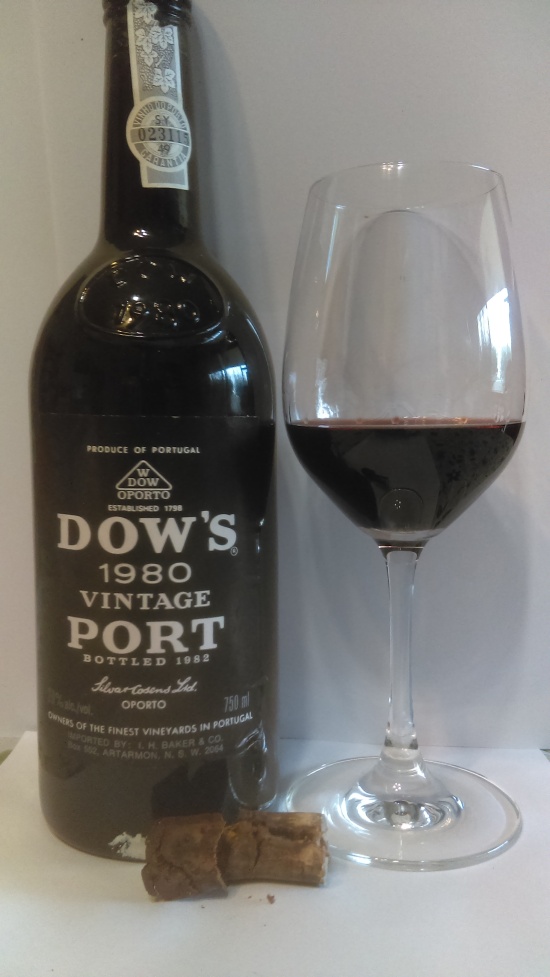
1980 Dow’s Vintage Port 20%

Dow’s is part of the Symington stable, with its vintage ports regarded as relatively dry for the style.

1980 is regarded as a “lesser” – but still declared – vintage in Portugal, but this wine shone – despite a pretty soaked cork.

1980 dow's vintage port
It still possesses plenty of brooding colour, with even some crimson left; camphor, dark chocolates, figs, blueberry, spices (nutmeg and cinnamon). On the palate it’s a drier, savoury style, delicate, and lively with clean spirit, very smooth and persistent; almond-meal, redcurrant, and mulberry.  “Correct” and very stylish, with fascinating melange of flavours- blue, red and back fruits; its balance will see this wine hold for many more  years – a magically impressive bottle!

Drink to 2030, 94 points.

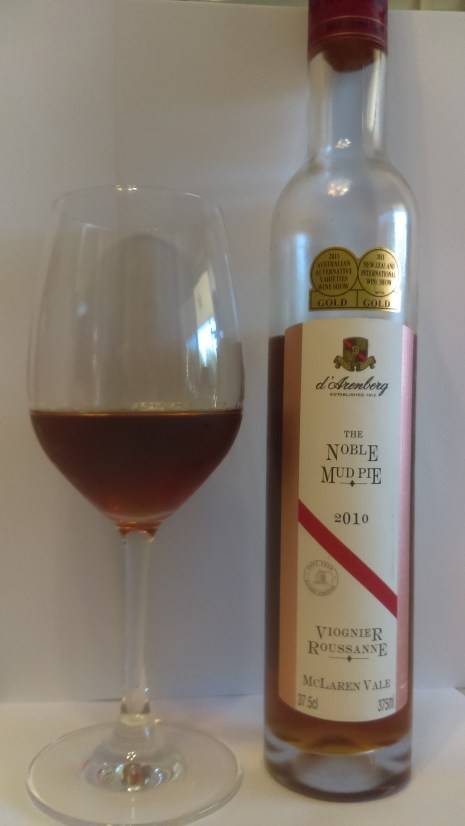
2010 D’arenberg Noble Mud Pie 8%

From McLaren Vale in South Australia, this wine is a blend of 60% Viognier and 40% Roussanne. D’arenberg makes a number of botrytis wine within their immense portfolio; from different years the varietal composition of this wine changes; this year a blend of Northern Rhone varieties. I commented on the 2015 edition in November 2016.

There are difficulties making this wine style; keeping botrytis away from other grapes,  minimising errant “non-noble” rots; the fragility of grapes that easily fall from the vine; the vastly reduced yields, the difficulties pressing and fermenting. And for all the travails, it’s an under-appreciated style.

2010 d'arenberg noble mud pie

This wine has an extraordinary sugar content; around 300 g/l.  The colour is a deep copper/amber; with this degree of botrytis, varietal character is largely extinguished; there are scents of orange liqueur, stewed apricot, red apple and peppermint. The palate is very sustained and syrupy, laden with cumquat and orange marmalade flavours, with some golden honey, and typical botrytis dust and spice. There is still freshness, and enough acidity to assist with the extraordinary level of sweetness.

However, the wine would have been more exuberant, with greater interplay between fruit and development characters a few years ago.

Drink up,  90 points (with a higher score if opened several years earlier)

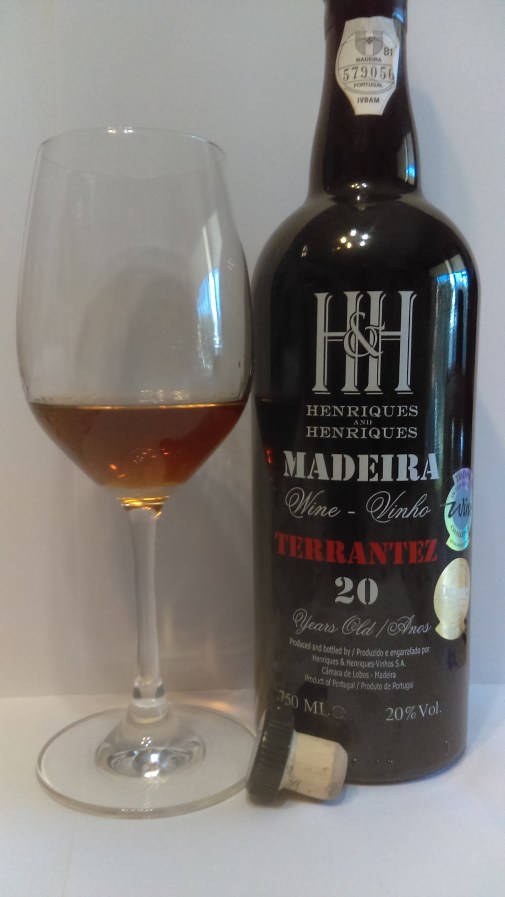
Henriques and Henriques Terrantez 20% (Madeira)

I am well out of my comfort zone here, as respectable Madeiras are not easy to find, or affordable in Australia, so my tasting experience is limited. This wine was an opportunity to increase my knowledge; although retail at around $125, an extravagant exercise.

Madeira is an island of Portugal, but lies roughly 1000k south-west of the mainland, and has a Mediterranean climate.

The main variety used in making (cheaper) Madeira is Tinta Negra Mole; the higher quality varieties are Sercial, Verdelho, Bual, and Malvasia (Malmsey), in order of increasing sweetness.  Terrantez is another quality variety, but an outlier – due to its rarity. Cheaper, earlier drinking madeiras are made by heating, and cooling the wines; higher-quality wines rely on barrel aging and associated oxidation, so these wines are “sherry-like”. Once opened, they can be consumed – very slightly chilled- over several weeks.

There is more extensive detail on the internet than I expected; an excellent resource on Madeira wine is here, another from Nicks is here and a blog from a mad-keen devotee here.

h&h 20 terrantez

It’s amber in colour with a clear, almost green rim; bouquet has spices, walnut, fruitcake, curry powder, dried fruits/fruitcake, but there is a stale note too. The palate is better; medium-dry, lively with fresh almond, citrus peel, fig, coffee , abundant acidity and a dry crisp finish.

The wine will not improve after bottling, but will hold for a long time; the touch of staleness (real, or unappreciated with my naivety at the style) restricts my score to 88 points.

another Willi Schaefer

2007 Willi Schaefer Graacher Domprost Riesling Auslese #17, 7.5%
94 g/l residual sugar- serious territory.

2007 willi schaefer

The wine is still a bright pale gold colour, with more “presence” than the two Kabinetts opened earlier.  There is a touch of petroleum, which does not detract from the array of white peach, white flower, ripe red apple, lemon sherbet  and flinty aromatics; the palate is sensual, with those fruit flavours melding with light honey viscosity and a twangy vibrant acidity. This wine is a parcel of delectability, and a fine example of a Mosel sweetie with some bottle development – with great prospects for its future.

Drink to 2033, and 94 points

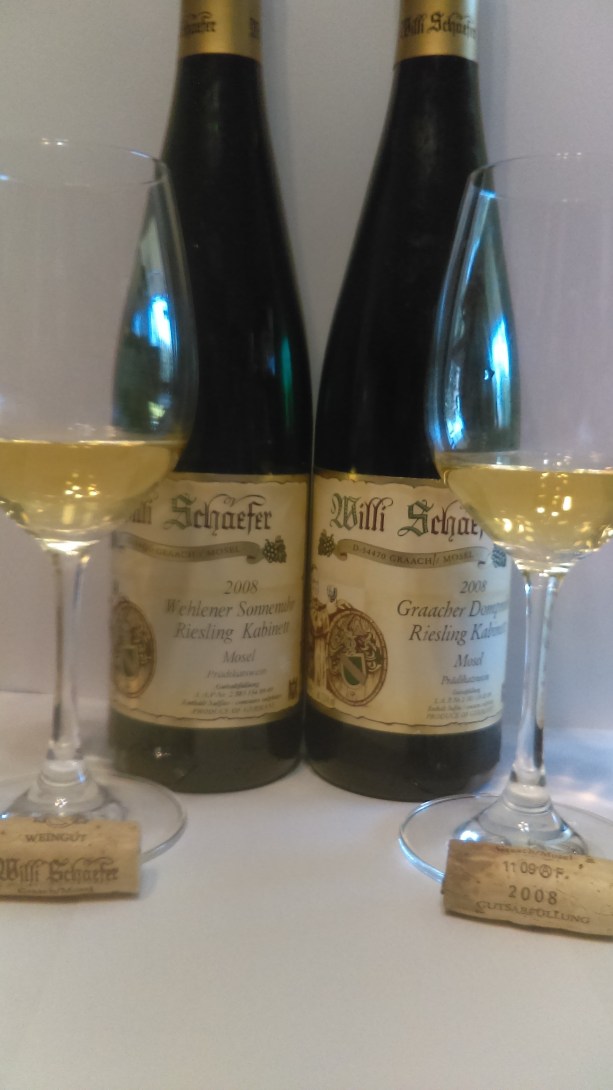
Willi Schaefer (2008 times two)

Willi Schaefer is an extremely well-regarded Mosel producer, whose wines have been available ( in Australia) for around the last ten years through Eurocentric. Riesling is their forte, with well-sited blocks producing a wide range of excellent wines. Two wines tasted below demonstrate the cellar-worthiness of even “humble” Kabinetts, and their refreshing delivery of full flavours at modest alcohol levels.

willi schaefer 2008 x2

2008 Willi Schaefer Graacher Domprost Riesling Kabinett #2 7.5%
52 g/l residual sugar. Pale lemon/gold colour, this wine shows stonefruit characters, and is an earthier, rounder, softer expression than its sibling below; the palate shows preserved lemon , but this is a delicious easy-drinking Riesling with lovely acidity. While there is no obvious cork detriment, I will not be surprised if other bottles show greater vibrancy, and look forward to testing this in the next few months.

Drink to 2023, and 89 points

2008 Willi Schaefer Wehlener Sonnenuhr Riesling Kabinett #9 7.5%
46 g/l residual sugar. Again this wine is a pale, lemon/gold colour, but slightly brighter. This wine displays a multitude of  scents- stonefruit (nectarine), minerals and drive. The palate really lights up with spices, red apple, green plum, and sweet lemon. Providing sensual approachability, this wine combines finesse with balance.

Drink to 2030, and 92 points

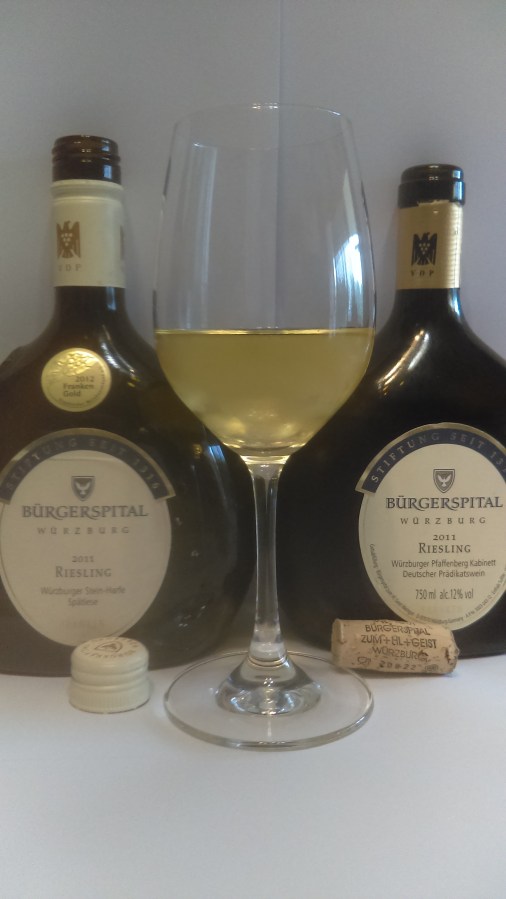
A Burgerspital duo

It was fortuitous that two Burgerspital wines from the same vintage were opened this week (the glass shown in the photo contains the Kabinett).

Burgerspital is a large winery with an easily-accessible shopfront based in Wurzburg (Franconia, Germany). It has a very extensive wine list, with some museum curios available for purchase. Its wines are very clean, with plenty of highlights! Franconia has many wineries, although its speciality is probably its flavoursome Sylvaners, with Riesling also widely planted.  The dumpy-shaped bottle is the bocksbeutel, but notice that tradition doesn’t run totally rampant; a screwcap seals the more expensive bottle here. A range of dry and sweet styles are made, with minimal importer enthusiasm evident by the invisibility of this area’s wines, at least in Australia.


burgerspital duo

2011 Riesling Pfaffenheim Kabinett 12%
A decent cork has helped- this wine has a  bright light gold colour, and shows some restrained mango, waxiness and varietally correct scents (but is relatively dry-tasting). It has light clean flavours, and a touch of phenolics. This wine seems to be drying out, and my advice is to drink up while it retains vitality,

Drink to 2021, and 87 points.

2011 Riesling Stein-harfe Spatlese 9%
It seem that I reviewed this wine in late 2015; notes etc turned out to be similar!

Pale gold colour, this wine is fresh and decadent; ripe tropical fruits abound – mango, passionfruit and nectarine; the palate displays bright citrus fruits, yellow honey, and is an excellent blend of sweetness and fresh acidity. This wine is drinking magnificently right now.

Drink to 2025, and 92 points


Xmas message from Hector Lannible, CEO of Stoney Goose Ridge

“It’s easy to dwell on our triumphant successes of Stoney Goose Ridge in 2018; the record growth in sales, ebitda improvements, the dizzying diverse media adulations, new export markets, the multiple launches of new product such as “Terra Nullius”, assorted prestigious wine packaging, marketing campaign and labelling awards, and my own increasing profiled notoriety. Our prolific social media optimisation strategizing continues to befuddle our opposition, with their advocates ineffectively minuscule in influence, visibility and credibility. Our SEO and SEM are bleeding edge.

But I couldn’t have achieved these profound triumphs without my subordinate employees ready, willing and able to act on my numerous compelling insights, decisive actions and time-critical unflagging guidance. Truly, my hand-picked executives owe their bonuses (if any) to my expert micro-management. Yes there is a “me” in “team”, and obviously my own stratospheric performance has been deservedly magnificently remunerated.

The sterling efforts of our team of legal, accounting and related personnel to locate further loopholes to minimise the dead hand of taxation as well as locating extra grants, subsidies, facilitation opportunities, export support and so forth – which we have taken complete advantage over- is extraordinary. The number of legal manoeuvres conducted in fiscal calendar 2018 stands at formidable record levels.

Obviously, Stoney Goose Ridge offers an increasing fan-base of loyal committed customers who continue to reap the benefit of our ever-growing over-delivering suite of labels, and enjoy the fresh taste sensations of our product brandline extension proliferations. This will continue- our data  tracking harvesting and analytics is profound; finding and exploiting any niche opportunities as well as provoking repeat purchase decisions. Brilliant outstanding excellence in customer satisfaction parameters always remains a critically important KPI priority. Our beverage facilitators must take credit for their professional competencies, that allied to my blending expertise embeds the mystique to our SKUs.

To the countless people submitting CV’s begging for consideration as unpaid interns, note that an MBA or equivalent is highly desirable; stellar achievement in multidimensional start-up  disintermediation or transnational taxation law will also meet with some approval. Few will find a position available, so I wish you well in future endeavours.

We exist in a market full of competitors, but if the Good Lord had wished them to prevail, they would have been bequeathed talent. They can only watch, and wonder “what happened?” as Stoney Goose Ridge rushes past, dwarfing their misplaced puny misguided efforts. Stoney Goose Ridge has rigorously exposed and vigorously highlighted the personal scandals, fiduciary lapses and reckless law-breaking of our rivals solely from the compulsions of our ingrained philanthropic social responsibility obligations.

On a personal note, my TED piece this year on “the China Syndrome” has deservedly been an internet sensation. It’s gratifying to be compared with Warren Buffett, Nelson Mandela and Cormac McCarthy , though I freely admit I have some distance to surpass their respective achievements, and the exultation they deservedly receive.  Plus, several of my own verbatim dictated spare-time fictional writings have been optioned by a Hollywood studio- but details are embargoed until final A-list casting decisions have been confirmed for these serial blockbusters.

There is always WIP.  Succession planning is incomplete – even mentoring my hand-picked executive subordinates has not yet seen a clear front-running pecking order emerge from the wolf-pack domain. So watch this space as we discard the dead wood in our ranks, and parachute in fresh talent eager to action my plentiful charismatic initiatives.

I particularly thank my small, lean, agile team of executive assistants, media liaison, stylists, publicists, administration support, legal services and biographers for their loyalty, and unflagging commitment to help me fulfil my entitled destiny.

Next year, Stoney Goose Ridge  will continue to unveil innovative alcoholic  beverage concepts and aggressively pursue double-digit momentum at a raw minimum. My opportunity lens is unshaken, aggressively leveraging domestic and international prospects continuously to allow Stoney Goose Ridge to double-down and move the needle forcefully.

To all our direct and indirect employees, agents, free-lancers, contractors, consultants, joint venture outworkers and partners, I wish you and your families a festively merry season, and may you return refreshed and enabled to put your best feet forward to the grindstone, offering your complete subjugation to my compelling vision.

In 2019, onwards to repetitive victories, your worthy leader – Hector”.