Xmas message from Hector Lannible, CEO of Stoney Goose Ridge

“It’s easy to dwell on our triumphant successes of Stoney Goose Ridge in 2018; the record growth in sales, ebitda improvements, the dizzying diverse media adulations, new export markets, the multiple launches of new product such as “Terra Nullius”, assorted prestigious wine packaging, marketing campaign and labelling awards, and my own increasing profiled notoriety. Our prolific social media optimisation strategizing continues to befuddle our opposition, with their advocates ineffectively minuscule in influence, visibility and credibility. Our SEO and SEM are bleeding edge.

But I couldn’t have achieved these profound triumphs without my subordinate employees ready, willing and able to act on my numerous compelling insights, decisive actions and time-critical unflagging guidance. Truly, my hand-picked executives owe their bonuses (if any) to my expert micro-management. Yes there is a “me” in “team”, and obviously my own stratospheric performance has been deservedly magnificently remunerated.

The sterling efforts of our team of legal, accounting and related personnel to locate further loopholes to minimise the dead hand of taxation as well as locating extra grants, subsidies, facilitation opportunities, export support and so forth – which we have taken complete advantage over- is extraordinary. The number of legal manoeuvres conducted in fiscal calendar 2018 stands at formidable record levels.

Obviously, Stoney Goose Ridge offers an increasing fan-base of loyal committed customers who continue to reap the benefit of our ever-growing over-delivering suite of labels, and enjoy the fresh taste sensations of our product brandline extension proliferations. This will continue- our data  tracking harvesting and analytics is profound; finding and exploiting any niche opportunities as well as provoking repeat purchase decisions. Brilliant outstanding excellence in customer satisfaction parameters always remains a critically important KPI priority. Our beverage facilitators must take credit for their professional competencies, that allied to my blending expertise embeds the mystique to our SKUs.

To the countless people submitting CV’s begging for consideration as unpaid interns, note that an MBA or equivalent is highly desirable; stellar achievement in multidimensional start-up  disintermediation or transnational taxation law will also meet with some approval. Few will find a position available, so I wish you well in future endeavours.

We exist in a market full of competitors, but if the Good Lord had wished them to prevail, they would have been bequeathed talent. They can only watch, and wonder “what happened?” as Stoney Goose Ridge rushes past, dwarfing their misplaced puny misguided efforts. Stoney Goose Ridge has rigorously exposed and vigorously highlighted the personal scandals, fiduciary lapses and reckless law-breaking of our rivals solely from the compulsions of our ingrained philanthropic social responsibility obligations.

On a personal note, my TED piece this year on “the China Syndrome” has deservedly been an internet sensation. It’s gratifying to be compared with Warren Buffett, Nelson Mandela and Cormac McCarthy , though I freely admit I have some distance to surpass their respective achievements, and the exultation they deservedly receive.  Plus, several of my own verbatim dictated spare-time fictional writings have been optioned by a Hollywood studio- but details are embargoed until final A-list casting decisions have been confirmed for these serial blockbusters.

There is always WIP.  Succession planning is incomplete – even mentoring my hand-picked executive subordinates has not yet seen a clear front-running pecking order emerge from the wolf-pack domain. So watch this space as we discard the dead wood in our ranks, and parachute in fresh talent eager to action my plentiful charismatic initiatives.

I particularly thank my small, lean, agile team of executive assistants, media liaison, stylists, publicists, administration support, legal services and biographers for their loyalty, and unflagging commitment to help me fulfil my entitled destiny.

Next year, Stoney Goose Ridge  will continue to unveil innovative alcoholic  beverage concepts and aggressively pursue double-digit momentum at a raw minimum. My opportunity lens is unshaken, aggressively leveraging domestic and international prospects continuously to allow Stoney Goose Ridge to double-down and move the needle forcefully.

To all our direct and indirect employees, agents, free-lancers, contractors, consultants, joint venture outworkers and partners, I wish you and your families a festively merry season, and may you return refreshed and enabled to put your best feet forward to the grindstone, offering your complete subjugation to my compelling vision.

In 2019, onwards to repetitive victories, your worthy leader – Hector”.
 

Mixed drinks, recent short impressions

2003 Joh Jos Prum Wehlener Sonnenuhr Riesling Auslese 8%
Very pale lemon in colour, there is an array of the usual petroleum (not kero), and faint smokiness mixed with tropical fruits of mango, passionfruit, a pull of citrus, flint and warm spices. The palate is sweet, fresh, viscous  and long-lasting. The wine got better as it sat in the glass.

Its not easy to resist the style, one of my favourite Mosel vineyards plus the combination of freshness and bottle-aged complexities. It’s a triumph of old vines and winemaking nous over the heatwave European 2003 vintage.

95 points, and drink to 2030.

2014 Chateau La Tour blanche 14%
Sauternes (83% semillon, 12% sauvignon blanc, 5% Muscadelle; 130 g/l r/s)

A great VFM Sauternes producer, and a wonderful result from an excellent vintage. Light gold in colour, the wine displayed vibrant nettle, stonefruit, pineapple rind and bright lemon icing sugar. The palate showed more barley-sugar, and some vanilla pod to add to the aromatics. Rich, sweet, balanced with much more pleasure to cover over the next ten to fifteen years.

The range of fruit flavours, the complexity and balance makes the wine a delight.

94 points, and drink to 2030 (at least)

2014 Chateau Lafaurie-Peyraguey
Sauternes (93% Semillon, 6% sauvignon blanc, 1% Muscadelle)

Served (masked) at the same occasion as the La Tour Blanche above, this wine looked darker in colour, showed greater – and simpler- tropical fruits, and custard apple. The palate was sweet, fresh and supple, but with greater oak presence, some hardness, and some bitterness. Time may help, but the contrast did not help its cause.

87 points, drink to 2023.

1952 Saltram Pinnacle selection Show Muscat 18.8%
Barossa muscat, stored in small oak, believed to have been bottled sometime in the 1980’s.

Colour (after decanting) was a bright khaki, and the wine showed caramel, toffee, mocha. Some raisin character, and a degree of vanillan oak and rancio.

Served masked as usual, the mix of attributes made it difficult to decide style between muscat and tawny; the lushness pushing for muscat, the rancio pointing to tawny. Revealed as muscat,  the wine itself was excellent, and a nice piece of Barossa history.

90 points, drink now.

2003 Taylor Fladgate Vintage Port
A devastatingly hot year in Europe, but most Port producers declared the vintage. Cork – or storage- struck; the bottle I sampled was strong, powerful in colour, but the flavour impact was tertiary mixed mocha and coffee grounds; and the wine looked plain, young, raw and lacking finesse. A hasty look at remnants from another two bottles opened showed more expected fruit flavours of violets and dark cherry, but time and the amount left conspired against further contemplation

Not rated, but I will have other opportunities!

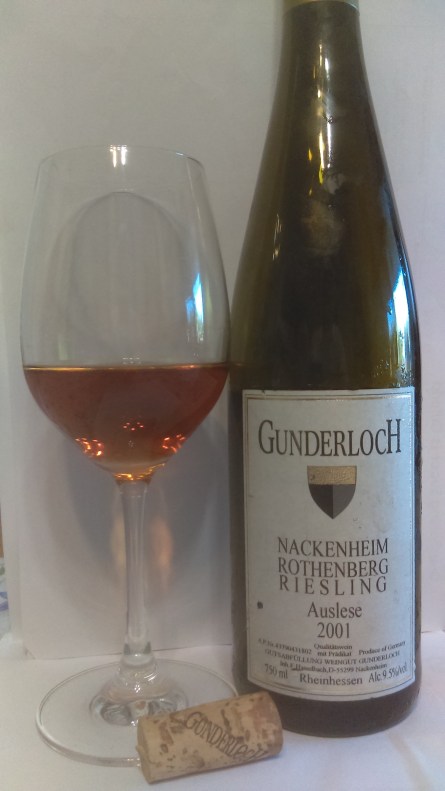
2001 Gunderloch Nackenheim Rothenberg Riesling Auslese (goldcap) 9.5%

The cork had behaved; its colour was copper; but in this case evidence of botrytis, not oxidation. I’m not very familiar with the Rheinhessen area of Germany; haven’t visited, and haven’t tasted much – more homework is needed!

The Rheinhessen is  Germany’s largest wine-growing area, often used  in making mainly innocuous white wines, but has undergone a re-evaluation with some very serious winemakers (such as Keller).

Its Australian importer Cellarhand has some helpful notes on the producer, site and winemaker here. The gold capsule indicates the wine is “more” than a basic Auslese.

2001 gunderloch auslese gc

The wine presents with raisin, red apple, dark honey, orange peel, and fruitcake spices, plus a hint of syrup and wax; the palate is vibrant and unctuous; stonefruit impressions add to the mix. Bounteous residual sugar is balanced by acidity; the compelling richness and freshness tempts further sipping, analysis and enjoyment. No hurry to drink (cork permitting).

94 points, and drink to 2028 (cork permitting).

1997 Stanton and Killeen Vintage Port 19%

The vintage was rated (by this Rutherglen winery) as 10/10, with a suggested drinking window between 2022 and 2026.  Their first vintage fortified to include a healthy proportion of traditional Portuguese port varietes (60% Shiraz, 25% Touriga, 5% each of tinta cao, tinta barocca and Durif), it was awarded 3 trophies and 13 gold medals at Australian wine shows. “Considered as one of the finest ever produced at Stanton and Killeen. Careful cellaring will reward the patient passionate port lover”.

1997 S&K vp

The cork is short, but in excellent condition. The wine has a deep ruby colour with some bricking; decanting removed a modest crust. Initial aromas included rose-petal, blueberry and raspberry  The palate is bright and fresh, showing sweet (but not overly sweet) red cherry, rhubarb and blueberry fruit, light milk chocolate, choc/mint and an occasional tease of plum, with still appropriately assertive tannins. Spirit is well absorbed.

The complexity and sustain makes this an outstanding wine, with a long future.

95 points, and drink anytime to 2032.

Recent drinks, mixed

Here are some very brief notes of wines recently consumed where I had little opportunity for leisurely contemplation, and sometimes dim lighting!

Stanton and Killeen are based in Rutherglen (Victoria), and continue to make a Vintage Fortified  (their first vintage was 1971), including some traditional Portuguese grape varieties since the mid 1990’s.  They have conducted several retrospective tastings, and from notes they have published, the cepages, vintage ratings and their – conservative- optimum drinking spans have been included below. They have a number of older vintages still available for sale (here). 

1990 Stanton and Killeen “Moodemere” Vintage Port (100% Shiraz)
The vintage was rated as 8.5/10, with a suggested drinking window between 2010 and 2015. (Stanton and Killeen also released a “jack’s block” Vintage Port from that year, rated as 9.5/10)

Served blind, I estimated this wine to be around 25 years old. Deep red colour with some bricking; camphor, lavender, musk, salted almond; dark fruits, mocha, spirit, cocoa. Plenty of time ahead – drink to 2030 and 92 points.

2004 Stanton and Killeen Vintage Fortified (30% Shiraz, 19% Durif, 21% touriga, 10% each of tinta cao, tinta roriz and tinta barocca).

The vintage was rated as 8.5/10, with a suggested drinking window between 2020 and 2024, and was awarded 5 gold medals and 4 silver medals at various Australian wine shows – “decadence, cocoa, relatively dry, wholesome”. Drink to 2030 and 93 points.

2005 Stanton and Killeen Vintage Fortified (32% Shiraz, 32% Durif, 16% each of tinta cao, 10% tinta roriz and 10% touriga).

The vintage was rated as 9/10, with a suggested drinking window between 2022 and 2026, and was awarded 1 trophy and 10 gold medals at Australian wine shows. Cocoa, raspberry and blackberry jam. This wine was amazingly vibrant, chewy with beautifully integrated spirit and fine tannins –  a long decant and further cellaring is highly recommended. Drink to 2040, and 95 points.

2015 Pressing Matters r9 Riesling
Tasmanian (Coal river valley) with around 9 g/l residual sugar; (the company also typically releases an r0, R39, r69 and r139 Rieslings), abundant vitality, clean citrus notes and the level of sweetness sits well with its framework of acidity; while it will keep, I would drink this wine while it is in a vibrant phase; anytime to 2025, and 89 points.

2005 Fritz Haag Brauneberger Juffer Sonnenuhr Riesling Spatlese 7%
Excellent winemaker, excellent site, and an excellent vintage in the Mosel, so I had high expectations. The wine is pale and youthful, with exciting viscosity, a touch of petroleum overlaying ripe red apple, flintiness and delicacy. Irresistible, so 93 points and drink anytime to 2030.

Terra Nullius

“At Stoney Goose Ridge, we are entirely fanatical about cutting costs. Imagine my outrage to discover an enormous cache of wine stored in an extremely vast tank!

It turned out that the person notionally in charge was understandably enamoured of Stoney Goose Ridge’s incredible multiplicity of exceptional beverages, but was wholly unprofessional in his excessive imbibing. He absolutely neglected his contractual fiduciary obligations. This is the same “character” that was responsible – through neglect and disregard of voluminous worksafe practices- for our semi-orange wine Hipster’s Reward, where only my inherent genius salvaged the situation and once more created a new worldwide brand of renown.

The personage in charge of this uncovered vinous malpractice has necessarily been summarily dismissed and assorted subsequent legal manoeuvres mean an end to his career in wine, or indeed any occupation involving responsibility. We wanted to keelhaul him over hot coals like a sitting duck, but had to be satisfied knowing his earnings will be garnisheed for decades.

Due to this person’s cavalier disregard for our extraordinarily accurate audit trail, we have been unable to determine very much about this wine. Despite our meticulous forensic analytic endeavours, we were confounded with its origins. Truly it seemed we had bolted the stable door after the chickens had flown. But I rolled the dice, and came up trumps, smelling of roses. This can of worms really put the icing on the cake.

The proof of the pudding is in the eating, and with my inspired creativity, Stoney Goose Ridge launches Terra Nullius.

As CEO, I, Hector Lannible, don’t know the grape varieties involved; I cannot be certain of the vintage or vintages; even the areas where the grapes are from is a mystery. We do not know what treatments this wine experienced, or their timings. But we do know, thanks to my subsequent ninja blending cunning, that this is now a great wine. If we could reverse engineer this wine, we absolutely would, but alas there are apparently limits to my virtuoso intellect and hyper-distinguished sensory exceptionality.

I triumphantly debut Terra Nullius, respectfully showcasing this country’s heritage.

This red wine is a user-friendly 12.5%, with minimal tannins to diminish enjoyment. Indeed, we encourage people to drink responsibly by having at least one extra glass of this noble wine concoction. Any why not? Its berry flavours – derived from processed Australian grapes and transubstantiated into an exceptional alcoholic brew – will baffle the cognoscenti, and fulfil the neophyte.

Terra Nullius – the great unknown, and of course the topic of intergenerational legal debate of astonishing complexity.

Yet for an RRP of $16, this one-off piece of history is available at all respectable liquor vending establishments, sitting proudly alongside the mouth-watering array of our other wines, beers and spirits.

Stoney Goose Ridge provides yet another phenomenal wine in its unique heritage pantheon that illustrates, respects and challenges the mythology of our mystical homeland antiquity – Terra Nullius”.

1997 Chateau Reynella Vintage Port 19%

McLaren Vale Shiraz, bottle number 17580. The very dry cork disintegrated despite my  best efforts with massed gadgetry, and some filtering was required to remove fine sediment.

1997 ch reynella vp

The wines is still a deep ruby colour with trivial bricking; aromas include red liquorice, black cherry, blackberry and mocha, with sweet spice notes present too. The palate is rich, sweet and fresh with greater blackberry fruit impact; the brandy spirit is deliciously balanced, the liquorice materialises with the blackberry, spices and light mocha, and there is a prolonged, pleasingly drying finish.

At 21 years, this wine has reached an excellent drinking plateau.

93 points, and drink to 2030.


2016 Cookoothama Darlington Point Botrytis Semillon 11%

From the Riverina, New South Wales, where the De Bortoli Noble One produces the best known example of a consistently excellent botrytis Semillon style. The Cookoothama is however, a more affordable option, and at around $22 for a half-bottle, is outstanding value.

The wine is a bright light gold colour, with voluminous scents of orange blossom, ripe apricot, vanilla icing and lime and orange marmalade. This wine is exuberant on the palate, very rich, sweet, powerful and flavour-packed, with enough acidity to avoid any cloying sensations.

This wine has enough power to match most desserts (avoid chocolate though) and is utterly delicious.

This is a wine that I would enjoy while it demonstrates its youthful precocity; a few years won’t hurt, but it’s beautifully pitched for short-term enjoyment.

Drink to 2023, and 92 points

Bodegas Alvear Pedro Ximinez 1927 solera 16%

From Spain, in the Montilla-Moriles region. Pedro Ximinez (commonly referred to as PX) is a thin-skinned white grape variety with some minor plantings in Australia (Campbells and Buller’s come to mind).

In Spain, it is often air-dried on  mats, concentrating the sugars, placed into barrel, and fortified to produce an unctuous, dessert wine, often using a solera system to keep the blends fairly consistent.

This wine (served blind and shared with a group) was a very dark khaki/espresso coffee colour with an amber rim. It was bursting with vitality, with ripe raisin and some black tea characters. While people were having mental debates about whether this wine was a muscat or a topaque (formerly tokay)  – of considerable age), I confidently asserted that the wine was an excellent PX example.

The palate was incredibly lush, with raisin, mocha and toffee notes; the flavours lingered, and while I guessed that the wine had >300 g/l of residual sugar, their website confirmed 405 g/l. The intensity assisted my score, the freshness also assisted, but the wine was relatively straightforward. Its alcohol level made the wine very easy to drink!  Despite being an excellent example of an old PX, it lacked the savoury bite, mouthfeel and layers of myriad flavours of old and rare Rutherglen fortifieds.

The bottle shows 1927 as the start date of the solera,and it undoubtedly contains some very old material, but I find it’s very difficult to assess an average age for this wine – as does the producer– but warmly encourage people to give this wine style a try.

Drink now, and 92 points

Two Australian off-dry Rieslings

2017 Pikes “Olga Emmie” Riesling 10.5%
From the Clare Valley, South Australia, from a classic year.  Pikes make a well-priced and readily available “traditionale” Riesling, and their reserve is the “Merle” (a terrific wine that I have purchased to cellar).

2017 pikes oe riesling

The “Olga Emmie” is Pike’s off-dry Riesling, described as “slightly sweet” on the back label, with perhaps 20 g/l of residual sugar. It is available for around $20, and well worth seeking out.

“Olga Emmie” proved an interesting wine, particularly since I had the luxury of consuming it over several days. Each time, my assessment, and score improved- so perhaps this is a wine whose virtues are not instantly obvious. It’s youthful and pale in colour; its aromatics are present but not overt and include lime marmalade, passionfruit and pebbles.

There is some residual sugar, and my first impression was that an extra tweak of acidity would have pleased me; but the wine is absolutely delicious with lime, and then lemon, and some fresh honeydew melon. The acidity is keenly pitched, and fills out a wholesome drinking experience.

I am baffled that there are so few examples of serious off-dry Rieslings in Australia; food-friendly, approachable and delicious – Grosset’s Alea, and the  Pewsey Vale Prima come to mind; further mental effort retrieves Pressing Matters R9, a Rieslingfreak offering, then the memory bank fades.

It’s not necessarily easy for a customer to work between the range of “dry” and “dessert”; and the complex interplay of sweetness and acidity on perceptions is another issue; not today’s topic! Labelling wines as off-dry, semi-sweet, medium dry or medium sweet doesn’t seem to have helped.

While this Pike’s wine will certainly improve for a few years (particularly based on the moving target of my views), it will already be a terrific accompaniment to a range of foods much broader than generic “Asian”, with fish and white meats well into play.

Conservatively, drink to 2022 and 90 points

Disclosure- this was a sample bottle.


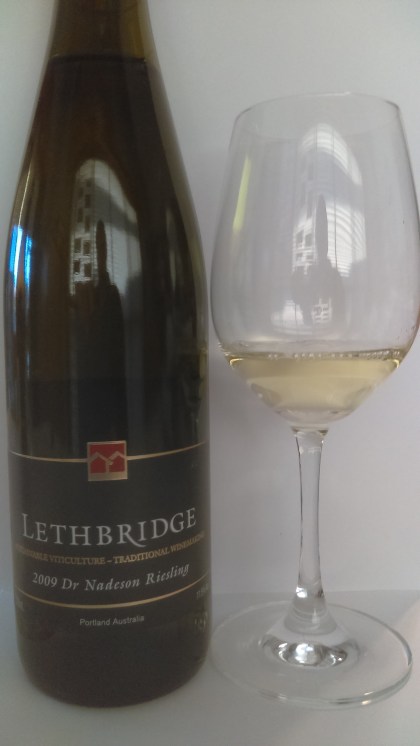
2009 Lethbridge Dr Nadeson Riesling 11.5%
Although Lethbridge is based in Geelong Victoria, this particular wine is from Portland, SW Victoria, from the Barratt vineyard. There have been several releases from this vineyard, but not for the past few years.

2009 lethbridge riesling

It’s a pale gold colour, and displays varietal talc, wax, mango, cantaloupe and some definite but unobjectionable petroleum. The palate shows green apple characters, some textural grip and a twist of lemony acidity. There is perhaps 10 g/l of residual sugar which adds to the package, providing intrigue to the palate . Nine years old, but the taste is still defiantly fresh.

Perhaps not a wine for technocrats (with its degree of textural grip); certainly idiosyncratic in its winemaking approach, and I firmly favour drinking this wine soon, while its vibrancy critically supports  its drinkability. But the wines very slow evolution means it will last much longer.

Drink to 2020, and 88 points.