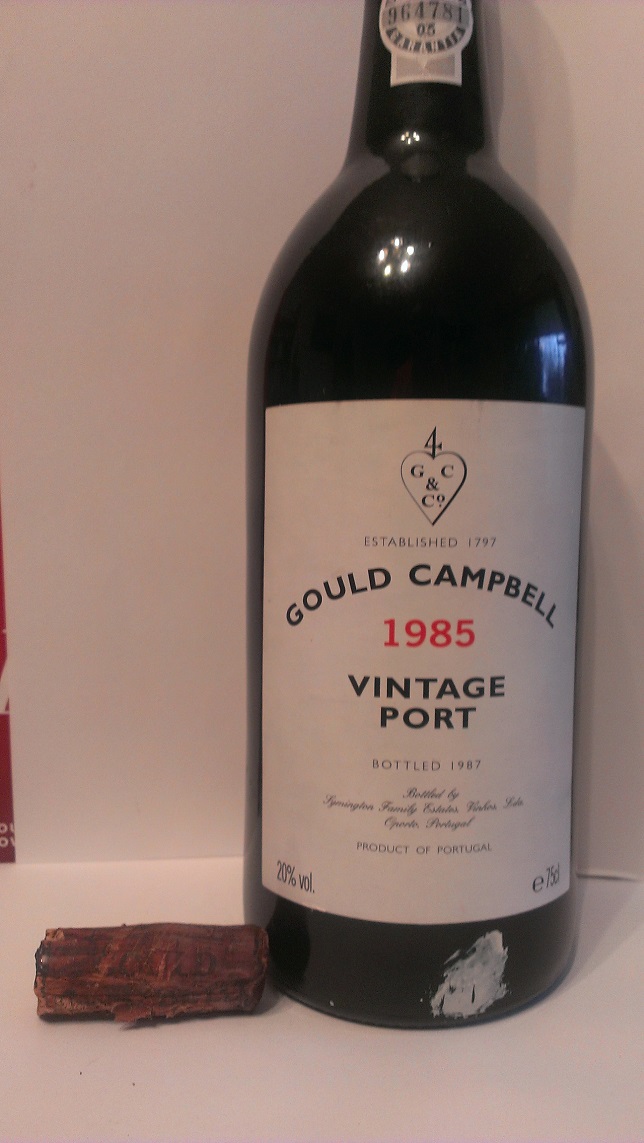
1985 Gould Campbell Vintage Port 20%

Gould Campbell is a less-renowned part of the Symington group. I am alert to wines that outperform their putative status, which may be available for reasonable prices. Langtons auction site records recent sales of this Portuguese Vintage Port for a respectable $110 (plus buyers commission).

1985-gould-campbell-vp

No photo of this wine in a glass alas, as the lunch group merrily consumed the wine. The cork was wizened and soaked, but had performed its duty over 30 years. The white smear on the bottle is the chalk mark (or splash mark) showing the upper side of the bottle in its cellaring state. I let the bottle stand for several days, opened it (with an ah-so), and carefully decanted to the remove the sediment that had settled.

The colour was a dark ruby; the aromatics were blueberry and cream, with some complexing licorice, fig and almond. The wine was very approachable, lively and rich, with mocha and cocoa dust making an impression; clean acidity and a warm, and long mouthfeel completed the picture. The spirit was deliciously integrated with the fruit.   It seems to be at the sweeter end of the Portuguese drier-than-Australian vintage port styles, but no shame here.  It’s a wine in a delightful drinking window, with no danger signs of decrepitude. I was very happy with this wine’s generous flavours, and impressed with its delightful performance at the lunch.

Drink to 2030; 95 points.

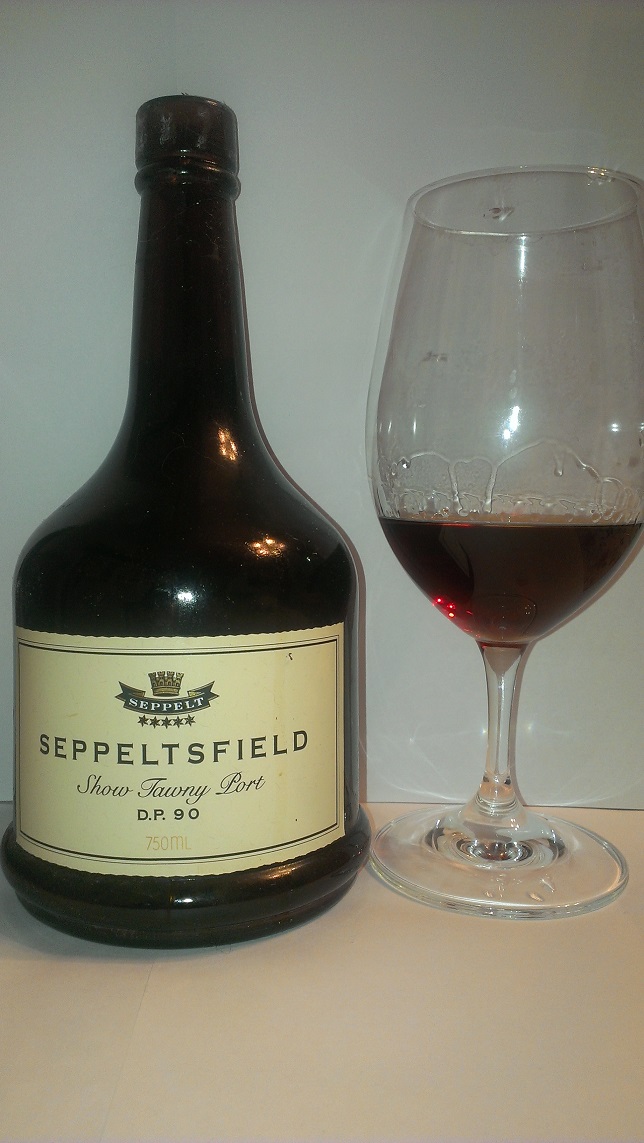
Seppelt Show Tawny port DP90 21.5%

Purchased via auction recently, this was likely to have been bottled in the mid-1990s, made from Barossa Shiraz, Grenache and Cabernet Sauvignon, with an average age of 21 years. This line has been superseded by the Para Rare Tawny (now under the Seppeltsfield banner). DP means “duty paid”.

The best way to revitalise old fortifieds is to decant. Not only does this remove the sediment, it coaxes out the aromatic vibrancy that prolonged bottle-age can diminish.

nv-dp90

The colour is a bright khaki; malt, mocha, almond and walnut, VA is evident- perhaps a little prominent for this style – and some dusty oak on the bouquet; these are also present on the concentrated palate, with obvious rancio from barrel age, plus light caramels and vanilla, It’s a rich mouthfilling wine, with bright acidity to help sustain tasting interest. It’s an enjoyable wine that encourages contemplation.

Drink now, and 91 points.

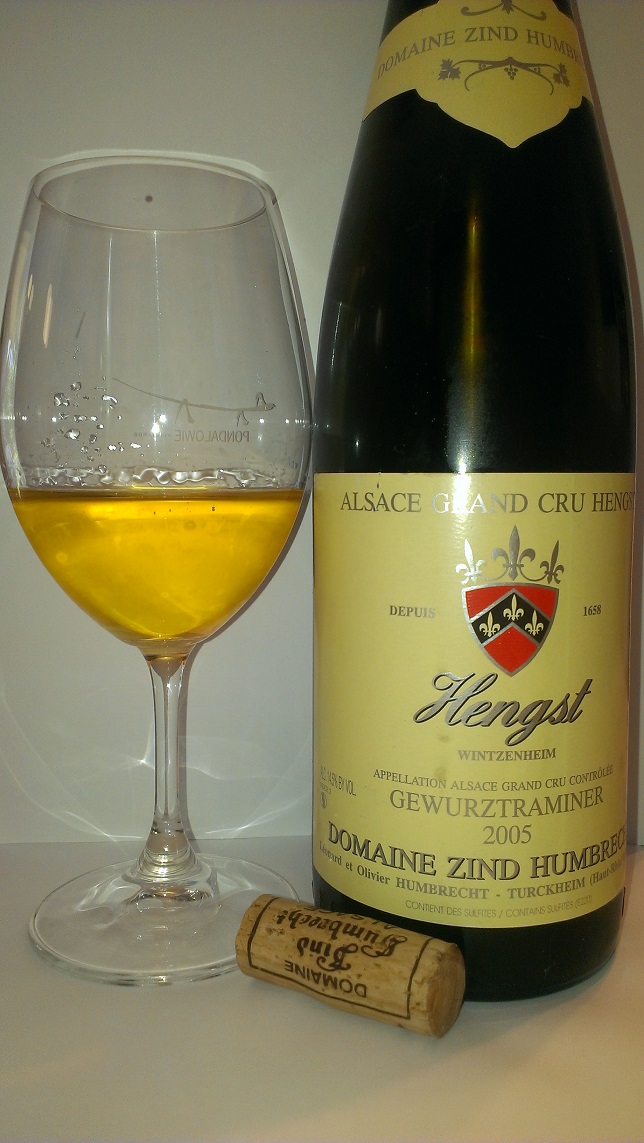
2005 Zind Humbrecht Gewurztraminer Hengst 14.5%

From Alsace, and much, much better than a bottle tasted about 12 months ago (drying out and where the alcohol poked through too). Hengst is one of the too-numerous distinguished sites of Alsace.

Long cork, in excellent condition. Quite a developed gold colour, but the aromatics absolutely leaped out, providing enormous confidence; musk stick, green pineapple rind, dried fruit spices as well.

2005-zh-gwt-hengst

The palate is rich and viscous, faintly oily; the integrated acidity sets off the 40-odd g/l of residual sugar providing a versatile “not-dessert” food match (chicken, tonight). Despite that sweetness, its a savoury style, concentrated,  with tropical flavours of just-ripe pineapple, a dash of lime, and some ginger spice to tickle the interest further.
A terrific wine overall, and an excellent tribute to the skills of Zind Humbrecht, the complexity that cellaring can bring, and the marvels of Gewurztraminer from the right site, in the right hands. Vintage notes can be found here.

If only every cork-sealed bottle could be this pristine!

Drink to 2023, and 94 points.

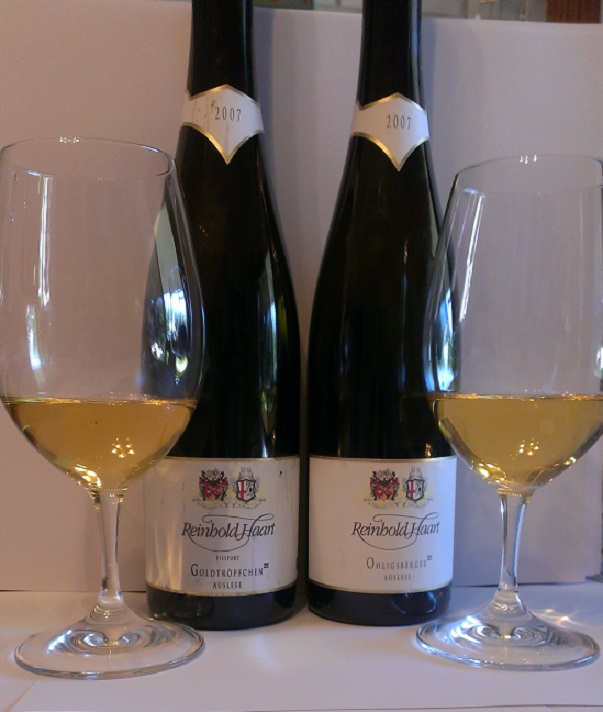
Fraternal twins – 2007 Reinhold Haart Riesling Auslese

Two Mosel Rieslings were tasted blind; the exercise was “spot the difference”; keeping tasters on full alert. Similarities were present, but the difficult task was in defining where, what (and why).

The wines presented were

  • 2007 Reinhold Haart Piesport Goldtropchen Riesling Auslese 7.8%                           119 g/l, 7.7 acid,                                             94 points,  drink to 2023
  • 2007 Reinhold Haart Wintricher Ohligsberg Riesling Auslese 7.4%                             127 g/l, 8.3 acid,                                             95 points, drink to 2028

The wines had sufficient distinctiveness to warrant separate bottlings; the Goldtropchen displaying smoky, yellow peach, a touch of green plum and red apple, mineral and redcurrant, silky and delicious; Ohligsberg brighter, more linear, finer, slightly sweeter, with similar descriptors plus some yellow-skin apple and slightly greater persistence. The complex interplay between acidity and residual sugar came into play, with the Ohligsberg seeming much sweeter than the analytics indicate. Both had nervy acidic drive to balance the considerable residual sugar.

2007-haart-twins

Piesport has had its reputation tarnished in the past- possibly due to excessive yield and inappropriate sites; Haart is one of the brigade determinedly correcting this legacy.

Two absolutely delicious, balanced, wines at a lovely stage in their development.  The  residual sugar is high for the Auslese category; with Ohligsberg shading the Goldtropchen for complexity and pleasure, but both wines offered delights that will continue into the future.

A fresh fruit platter was an ideal accompaniment.

Another year over; a new one just begun

An exclusive internal corporate email from Hector Lannible, CEO of Stoney Goose Ridge.

“In this holiday season, it’s timely to introspect and reflect, after a frenetic year’s inspirational leadership at Stoney Goose Ridge.

Once again, we’ve achieved double digit growth in sales, our stock market performance excelled, and more importantly we have improved our ROI.  We’ve won countless medals at prestigious wine shows, numerous advertising, promotional, marketing and media awards, plus the critical and business press naturally applauds our legendary efforts. Our social media rankings are through the stratosphere, new export markets have been conquered, and traditional markets blitzed. And apart from my essential guidance and 24/7 oversight, this could not have been accomplished without the competence and commitment of my underlings.

Both within Australia and abroad, the  many fine Stoney Goose Ridge products are welcome at any occasion- hatches, matches and dispatches. Plus of course anniversaries, celebrations, casual and formal meals, BBQs, and so on whether alone, in couples, small, medium and large groups. Our product portfolio is suitable for family, friends, colleagues – in fact everybody .

For example, just this year we’ve launched our instant runaway successes of Lawyers’ Picnic, and Hipster’s Reward, plus rejuvenated and revitalised all our PLU SKU offerings. There will- naturally- be more new exciting exclusive wines and innovative channel fulfillment deliverables.

We celebrate the successes of all our winningest sales teams; not just our newest Thunderbirds, Rattlers, Buffaloes, Orioles, Grizzlies, Swifts and Sidewinders; we’re excited too about the performance of our traditional long-standing true-blue dinky-di Aussie teams- Dingoes, Macadamias, Koala bears, Wombats, Bilbies, Gumnuts, Copperheads, Bullants, Jumbucks, Lamingtons, and Brumbies.

We reflect on our actions; our commitment to core KPI competencies engendering our highly rewarding bonuses; plus our attention to our necessary soft measures. Our recruitment strategies and ongoing skill development are uniquely admired throughout multiple industries. None would be possible without the scribes that filter and elaborate my illuminating utterances. The contribution from my family is of course essential.

But of course we don’t pause; we face the transformational challenges of this millennium, we march into 2017- refreshed and revitalized-  with a critical mission; Stoney Goose Ridge will naturally prevail; my own new year’s resolution is to go beyond and above, challenging myself to contribute, again, 120% of my endeavors.  This will be a tough audacious goal, but I am confident that with my abilities, and support from my direct reports and sales creatures, my ambitions will be managed.

I am confident you will achieve your own targets magnificently, with ensuing consequent potential recognition.

Good cheer to all, with my blessings, Hector”.

Cork problems in 2016 – 5.5%

The headline figure for my cork problems (TCA or oxidation) throughout 2016 settled at 5.5%.

I’m relieved that the mid-year result of 8.6% did not continue; with only one bottle  I opened in the past six months having unacceptable cork-derived problems (a 1992 Stanton and Killeen Vintage Port).

5.5% is still a terrible result- and a key reason why I avoid-purchasing-  where possible- wines that are cork-sealed.

The last few years’ cork failure performance can be seen in the “corks and statistics” tab.

2011 Auburn (lowburn) Riesling 11.5%

2011-auburn-lb-riesling

This is a sibling of the Auburn Bannockburn Riesling tasted recently. Not surprisingly, it’s similar, but not identical.

From a sub-region of Central Otago, in a screwcapped crazy-tall bottle, the wine is pale in colour. It has varietal lime and lemon aromas, with wafts of mineral and tangy saline characters, possibly with some botrytis. The palate is rich and crunchy, carrying its 48 g/l of residual sugar; intense citrus , red apple and stony, talcy flavours linger deliciously. This wine is more complete than the nearby Bannockburn-sourced wine – there is no hardness or reductive distractions; just fruit purity.  Overall, an excellent wine.

Drink to 2022, and 92 points.

McWilliam’s Show reserve Muscat 18.5%

Available for around $70 for 500ml, this “limited release” wine provides excellent value. It proclaims an average age of 25 years (in French oak), and it’s batch 002, bottled in 2015. There is no mention of where the grapes were grown. The art in constructing these fortifieds is to balance the aged material with younger, fresher wine so there is freshness and vibrancy- mission accomplished!

The colour is a healthy glowing amber/brown with a khaki rim; the aromas are lush soaked raisins and assorted fruitcake spices of nutmeg and cinnamon, with a rancio edge derived from extensive barrel maturation; and the concentrated palate delivers a long-lasting sensation of raisin, mocha, dark chocolate and green olive. Silky and voluptuous,  it’s intense, beautifully balanced and conceals its enormous sweetness through zesty acidity.

nv-mcwilliams-muscat

Australia excels with this underpriced and hard-to-sell style, and this bottle is another that compelled assorted decadent re-tastes, overcoming inertia and willpower.  There is no recommended food match- perhaps a strong coffee!

Drink now, and a very easy 94 points.

2011 Auburn (bannockburn) riesling 10.5%


I seldom see Rieslings from Central Otago (NZ) – apart from Felton Road- and I am not familiar with wines from Auburn. They make Riesling wines from several small plots in the region, and I will open a Lowburn and report on it soon.

2011-auburn-bb

It’s a tall, and absurdly heavy bottle. Under screwcap, this wine is pale, but displays vibrant lime and orange blossom aromas, fainter spice (ginger) notes, and some reductive touches too. The palate shows welcome viscosity, and brisk natural acidity which neatly balances the 45 g/l of residual sugar. There are echoing orange and mandarine flavours, plus mineral notes, but there is also some underlying hardness, which prevents a higher score. This level of integrated sweetness means it suits a surprising variety of dishes; it was consumed with pan-fried salmon, but would also match well with many Asian-oriented meals – or by itself as a surprising aperitif.

It scores 89 points, and will provide drinking pleasure to at least 2020.


2005 MF Richter Brauneberger Juffer Sonnenuhr Riesling Spatlese 8.5%

From a terrific year in the Mosel, this wine provides extremely attractive drinking, and shows the magic that time can generate. We visited the cellar door (via appointment) in 2007, and were struck by the quality, then the astonishing range of back vintages available. A quick tour of the winery and the small library of museum stock left us breathless.

2005-richter-bjs-spatlese

Golden in colour, this wine possesses varied attractive and complex attributes -there is certainly the TDN (petroleum) character, and a mélange of green (nettle), yellow (peach and further tropicals), plus red (blackcurrant) fruits. The palate also displays these, as well as a dense minerally stony texture. I continue to be surprised at how much flavor can exist in such a light frame. And a key bonus attribute is the wine’s vitality and freshness, with crunchy acidity neatly offsetting the 106 g/l of residual sugar (my speculation was 90 g/l). All -around deliciousness saw the bottle contents diminish rapidly.

This wine is in its prime, expected to thrive till 2026, and 92 points.